Browse

Log in / Register
 Share

The G50-generation BMW 3 Series is now official, and it’s a much bigger leap than the last generational switch. As of March 20, 2026, the gas-powered lineup is led by a new M350 xDrive model with a 3.0-liter B58 inline-six rated at 443 horsepower. The 320 four-cylinder remains the launch volume engine, while the familiar 330i is nowhere to be found. That makes the G50 vs G20 comparison about more than styling; it’s about how BMW has repositioned its most famous sports sedan.
Here’s a quick rundown of the major changes before we dig into the details:
The most obvious changes are visual. The G50 gas sedan shares the Neue Klasse design language with the electric i3, which was already revealed. There are only a few small distinctions between the battery-electric and combustion versions. Up front, the new nose is flatter and more vertical than the G20’s. The body sides are more sharply creased, and the roofline sweeps toward the tail with a more angular, almost fastback-like slope. The G20 always looked streamlined and conservative by comparison; the G50 looks more aggressive and intentional.
Walk around to the back and you’ll notice something odd: the 320 model has no visible exhaust pipes. The M350 xDrive, by contrast, still gets conventional tailpipes. That’s a clear sign BMW is willing to make some models look more EV-like even when they are gasoline-powered.
The new car also sits on larger wheels. The G50 offers 20-inch wheels as an option, whereas the G20 topped out at 19 inches. And the G50 is physically bigger across the board: it’s about two inches (50 mm) longer, one inch (24 mm) wider, and half an inch (12 mm) taller. The wheelbase grows by about 0.4 inches (10 mm). None of those numbers are huge, but they add up to a more substantial road presence.
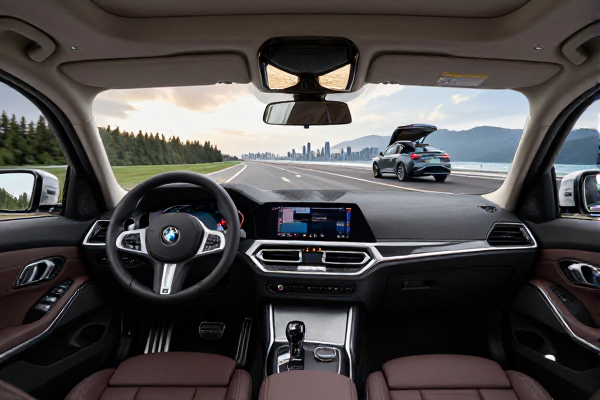
Inside, the G50 makes one of the boldest changes in 3 Series history: the steering wheel now has haptic buttons on the center spokes. Those spokes are also “floating,” meaning they are not physically connected to the wheel rim. It looks futuristic, but it will take some time to get used to, especially for anyone who prefers physical buttons.
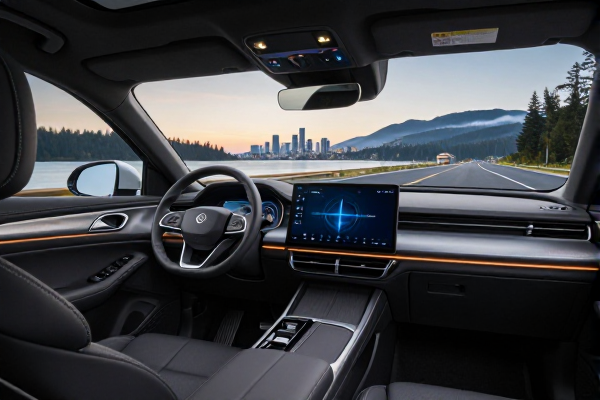
The G50 replaces the G20’s dual-curved-screen setup with a single 17.9-inch center display. BMW has also reworked the switchgear around the dash and center console. One welcome change: seat controls are now mounted on the door panels. It’s a small thing, but it is the first time a 3 Series has used that layout, and it makes seat adjustments easier to find without looking at the side of the seat.
Material choices remain strong. Buyers can spec Veganza, PerformTex, or Merino leather, so there’s still a clear tier between synthetic and full-leather upholstery. The cabin feels cleaner and less cluttered than the G20’s, though some fans will miss the physical climate and audio controls that were easier to use while driving.
The trunk does shrink. The G50 offers 450 liters (15.9 cubic feet) of cargo space, while the G20 offered 481 liters (17.0 cubic feet). It is not a dramatic loss, but it is noticeable for a car that was never particularly known for a massive trunk anyway.
The G50 gas lineup starts with the 318, which uses a 156-horsepower (115 kW) engine. Above that sits the 320, powered by a 2.0-liter B48 four-cylinder making 211 hp (155 kW). BMW says the 320 reaches 60 mph from rest in 7.4 seconds. That’s modest by sports-sedan standards, but it will be adequate for most buyers.
The more exciting news is the M350 xDrive. Its B58 3.0-liter inline-six produces 443 hp (326 kW) and 428 lb-ft (580 Nm) of torque. BMW quotes a 4.1-second run to 60 mph. That gives the new M350 a clear performance advantage over the previous-generation M340i, which made 382 hp in U.S. spec. The gap between the base four-cylinder and the top six-cylinder is larger than ever.
All of that performance comes with a weight penalty, though. BMW’s own DIN figures show the outgoing 320 at 1,460 kg (about 3,219 lb). The new 320 tips the scales at 1,680 kg (3,703 lb), which is roughly a 485-pound increase. The M350 xDrive adds even more mass. Those numbers are not unusual in the current car market, where safety equipment, battery-hybrid hardware, and extra sound deadening keep pushing curb weights up. But anyone comparing the G50 to the G20 should expect a heavier car.
BMW has not thrown out the familiar tech features. Apple CarPlay and Android Auto are both included, along with built-in navigation, voice control, and My BMW app integration. The new operating system adds more ways to customize the display and the ambiance inside the car. The optional head-up display now uses 3D graphics, which should be useful for drivers who want navigation and speed information directly in their line of sight.
The biggest technology question is the steering wheel. Haptic controls are generally hit-or-miss in modern cars. The floating spokes look clean, but they require pressing and swiping on surfaces that don’t physically move. BMW’s execution will need to be precise, or drivers may find themselves looking down more than they should.
The absence of the 330 from the launch lineup is one of the bigger storylines here. In the previous generation, the 330i was a core model for BMW, especially in the U.S. market. Its omission suggests BMW is still rearranging its engine and trim strategy for the G50.
Nothing about a future 330 has been confirmed. BMW has not said whether it will return with a tuned B48, a 48-volt hybrid, or something else. It could simply be a delayed launch slot, or it could mean BMW plans to position the 330 higher or lower than before. Buyers looking for that middle ground between the 320 and the M350 will need to wait for official word.
The G50 3 Series is not an evolution. It is a rethinking of what a compact BMW sedan should look like, and it links the gas car and the electric car in a way we have never seen before. Some changes are clearly improvements: the M350’s power jump, the larger standard wheels, the cleaner interior design. Others are trade-offs: the extra weight, the smaller trunk, and the learning curve for haptic controls.
The real test will come when journalists and owners get the G50 on a road. BMW says the 3 Series is still the Ultimate Driving Machine, and the revised chassis and powertrain lineup should back that up. Until then, the G50 vs G20 comparison comes down to this: the G50 is a bigger, bolder, and heavier take on the classic formula. Whether that’s the right direction depends on what you value most in a sports sedan.