Browse

Log in / Register
 Share

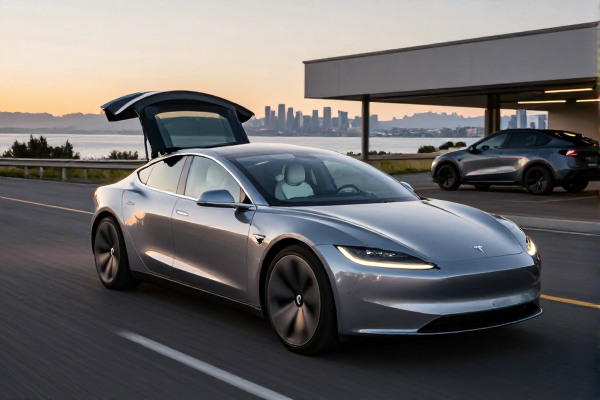
Tesla first teased the next-generation Roadster in 2017, but the "flying" version — a spec with SpaceX-style cold gas thrusters — has never had a firm release date. As of today, May 3, 2026, Tesla's official Roadster page still points to a performance EV without saying when production will start. This guide separates what's on paper from what is likely to reach streets, and whether the thruster-equipped model can ever be a regular production car.
Musk unveiled the Roadster during a semi-truck event in 2017, calling it the fastest production car ever built. The headline numbers were hard to ignore: 0 to 60 mph in 1.9 seconds, a top speed above 250 mph, and a quarter-mile time that would embarrass most supercars. The base price was set at $200,000, with a limited Founders Series at $250,000.
But the model that grabbed more attention was a separate option referred to in Tesla's presentation as the "SpaceX package." Musk described it as a set of ten small rocket thrusters mounted behind the rear license plate. The thrusters would "eliminate the blind spot" and help with braking, cornering, and straight-line speed. Musk later joked the car could "fly" or at least hover briefly, using compressed air stored at high pressure.
That single joke turned into a permanent product question. Every year since, news cycles repeat the same phrase: Tesla is working on a flying Roadster. Yet the company has never published a complete technical specification for the package, and it has not updated buyers on an exact production timeline.
The key detail is that Tesla is not trying to build a vertical take-off vehicle or something like a flying taxi. The thruster package is closer to a high-pressure air system than a jet turbofan. Cold gas thrusters expel compressed air to adjust the car's attitude and trajectory, helping it pull off maneuvers that ordinary tires cannot explain.
Engineers outside Tesla say the concept is plausible but complicated. Storing enough air to move a 4,000-pound sports car would require heavy tanks and a compact pumping system. That adds weight and eats into cabin or cargo space. It also creates a safety problem: a tank rupture in a crash would be much more dangerous than a fuel leak in a conventional car.
This explains why Musk has used the word "hover" rather than "fly" in many interviews. The car would not sustain flight for miles. It would use short bursts of thrust to change pitch or, in Musk's words, "jump over" obstacles. That kind of behavior is not a flying car in the traditional sense, but it is enough to make headlines.
When Tesla first showed the concept, deliveries were expected around 2020. That date slipped to 2021, then 2022, then later. Musk's own comments point to two big reasons for the delay: Tesla's focus on the Model Y, Semi, and Cybertruck, and the simple fact that the Roadster is a halo car, not a volume product. Halo cars tend to get pushed to the back of the line when a company needs to hit quarterly delivery numbers.
For the flying version, the delay is even more logical. Tesla would first need to finish and sell the standard Roadster. Only after the electrical architecture and chassis are proven could the company bolt on thrusters and run certification tests. A reasonable read of publicly available information is that the standard Roadster might arrive in late 2026 at the earliest, with the SpaceX package arriving years later — if at all.
Tesla has made no official announcement for the second-generation Roadster's on-sale date. The company's most recent earnings calls have mentioned a "new vehicle" platform and a more affordable model, but they have not given a calendar date for the Roadster. At this point, anyone who says they know exactly when the flying model will hit the market is guessing.
A car with rocket thrusters faces more than just technical hurdles. Federal motor vehicle safety standards cover everything from brakes to steering columns, but they do not include high-pressure thrusters. Automakers can request exemptions for new technologies, but the Federal Motor Vehicle Safety Standards process requires a reason that safety is not reduced. That is a hard argument to make with a system that can generate a controlled explosion of pressurized air.
There is also the airspace question. If the car can leave the ground on its own, regulators outside the U.S. such as the European Union Aviation Safety Agency could classify it as an aircraft. That would trigger a separate certification path, adding years and millions of dollars to development. Musk's team at SpaceX knows how to fly rockets, but commercializing a road-legal car with thrusters is a completely different problem.
Even with all these doubts, the Roadster remains a useful marketing tool. Every mention of a "flying Tesla" generates free press. It also helps Tesla recruit engineers and keeps the brand associated with the future. The car itself is unlikely to be a huge seller — Tesla sells hundreds of thousands of mainstream EVs each year — but the Roadster's existence tells customers that the company is still willing to push the limits.
For buyers who put down $50,000 reservations years ago, the wait has been frustrating. Tesla has not said whether reservation holders can still back out with a full refund. Most analysts assume the final design will look different from the 2017 prototype. If anything, the production version will be dialed back, particularly if the thruster package turns out to be too expensive to certify.
People watching the flying Roadster should focus on three signals.
The first two signals would matter more than any teaser clip. A press event or render can be done at any time; a certification filing proves that the hardware works and is moving toward the market. Until one of those appears, the flying Roadster is still a high-profile promise — not a product you can order.
The flying Tesla Roadster is one of the most anticipated cars in the company's history. It is also one of the hardest to schedule. Combining a sports car with SpaceX derived thrusters is an engineering challenge unlike anything Tesla has built. The short answer to the question "when does it go on the market" is: not yet, and still unknown. The long answer involves tanks, valves, crash tests, and regulators, all of which take time.
For now, the flying Roadster exists mostly in public imagination. That may be exactly how Tesla wants it.