Browse

Log in / Register
 Share

Date: April 26, 2025
The internet has already made up its mind about the Ferrari Luce. But I’ve just spent a day at the Stellantis test track near Balocco, Italy, driving a pre-production prototype, and I’m here to tell you: the consensus is spectacularly wrong. This is Ferrari’s first EV, and it is—against every expectation—a proper Ferrari. Just not the kind we’re used to.
Ferrari has never been afraid to polarize. From the moment it hired Sir Jonathan Ive’s agency to design the Luce, the vitriol was predictable. A Ferrari designed by an Apple guru? An electric Ferrari at all? Social media erupted. But after spending hours behind the wheel on a demanding circuit that mimics everything from autostrada sweepers to British B-roads, I can say with confidence: the Luce is a masterclass in translating Ferrari’s DNA into an electric language.
The hardware that powers the controversy
Let’s start with the numbers that matter. The Luce rides on an entirely new chassis—hollow aluminum castings, extrusions, and sheets, all built to minimize weight and optimize rigidity. The 122 kWh battery pack is integrated into the floor, placing the center of gravity 95 mm lower than the Purosangue’s. That’s a staggering achievement for an SUV-sized machine that weighs 2,260 kg. Yet the engineers claim—and I can confirm—it feels 400 kg lighter on its feet.
Four independent electric motors deliver outputs that would have seemed insane a decade ago: 282 hp at the front, 831 hp at the rear, for a combined total north of 1,000 hp. Torque? The rear wheels see 5,900 lb‑ft. The front motors spin to 30,000 rpm and can go from zero to full tilt in under a second. An 800‑volt architecture keeps everything cool and efficient.
The e‑manettino: a new way to talk to the car
Ferrari’s traditional manettino on the right side of the wheel now has a partner—a new e‑manettino on the left. It offers three drive modes: Tour, giving 608 hp and full all‑wheel drive; Performance, unlocking 958 hp and the 190‑mph top speed; and a track‑focused setting that lets you shift the torque curve in real time. Each mode reshapes the power delivery from the four independent motors with a precision that’s almost telepathic.
Chief test driver Raffaele de Simone put it best: “The interface hasn’t changed—steering, brakes, throttle. But the driving emotion is different. The most important thing is that nothing feels artificial. There has to be a direct relationship between what the driver asks and what the car does.”
On the road: torque vectoring magic
Pull away in Tour mode, and the Luce glides off the line with an effortless, almost deceptive smoothness. This isn’t a Tesla‑style instant‑jolt EV. Ferrari has deliberately dialled in a progressive throttle response—more of a torque demand switch, really—so that the car telegraphs its immense potential with a light touch. The steering is positive without being darty, and the mid‑corner balance is exquisite.
Switch to Performance with stability control off, and the Luce transforms. Rear‑axle torque vectoring, combined with rear‑wheel steering, allows four‑wheel drifts that feel as natural as the ones you’d achieve in a 296. The adjustability is extraordinary: you can rotate the car with the throttle, hold a slide with opposite lock, and power out with unreal traction. The chassis and software are in perfect harmony.
The elephant in the room: looks and interior
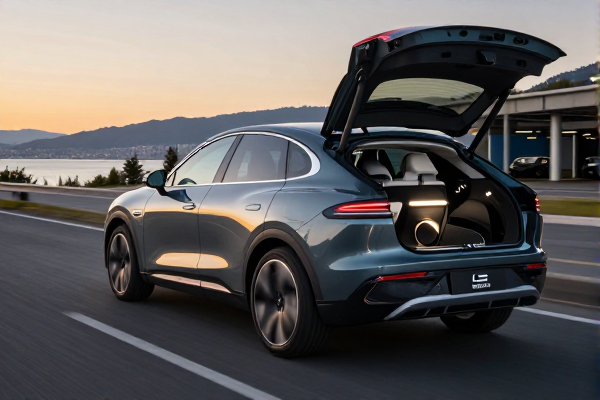
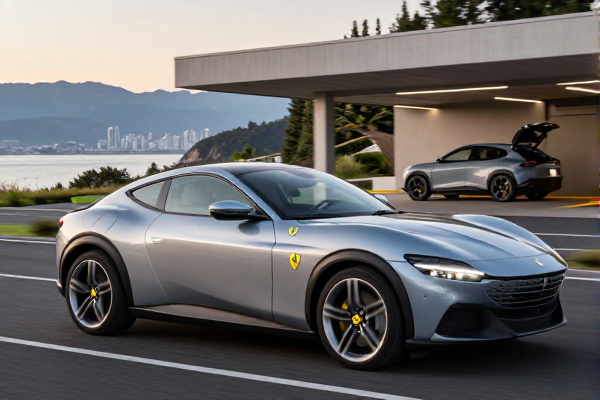
Yes, the Luce looks wildly different from any Ferrari before it. Up close, the floating front wing, the clean surfacing, and the cab‑forward proportions are actually more fascinating than in photos. It’s futuristic in a way that honors Ferrari’s past without copying it. The interior—pure Jony Ive—pairs minimalist design with peerless materials. Some have called it too simple, but simplicity here equals clarity. The fit and finish in the production‑spec car I’ve seen is simply beautiful.
Why the internet is wrong
The Luce is not Ferrari abandoning its combustion soul. Six‑, eight‑, and twelve‑cylinder Ferraris are still very much alive. The Luce is Ferrari going off‑piste, exploring what a Ferrari can be when you remove the engine and start from a clean sheet. It’s a car that challenges the definition of driver engagement, proving that electrification doesn’t have to mean numbness.
The bottom line
At nearly 5 meters long and 2 meters wide, the Luce is a big car to hustle. But it hustles like a much smaller machine, thanks to a chassis that defies physics and an electric powertrain that delivers thrills on its own terms. Ferrari has taken a huge risk—and it has pulled it off.
For anyone who still thinks an EV can’t be a Ferrari, I have only one recommendation: drive this car. The internet isn’t ready to hear it, but the Luce is the most important Ferrari in a generation.