Browse

Log in / Register
 Share

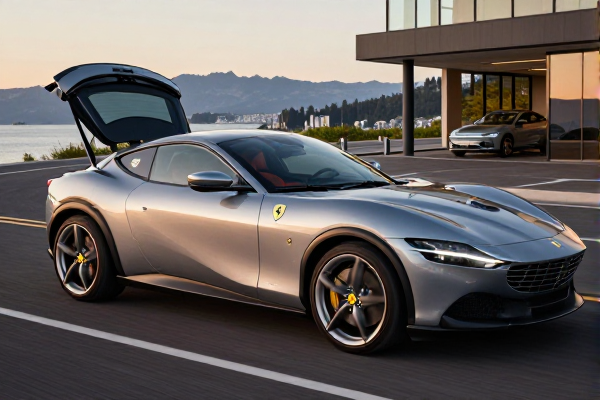
April 8, 2025 – A newly published patent application from Ferrari has sent shockwaves through the automotive world, revealing what could be the most extreme active bodywork system ever conceived for a road‑legal hypercar. The filing, dated March 2025 and made public by the European Patent Office, describes a series of morphing panels, retractable wings, and variable geometry ducts that allow the car’s entire exterior to reshape itself on the fly. While Ferrari has been tight‑lipped about any specific production model, the drawings and technical language strongly suggest this technology is destined for the successor to the LaFerrari—or perhaps an even more radical halo car.
The core of the patent revolves around a “multi‑segment active skin” that uses embedded actuators and flexible composite materials to change the car’s profile, airflow channels, and downforce characteristics without the need for traditional fixed spoilers. Unlike current active aero systems (like the SF90 Stradale’s active rear diffuser), this new design appears to be fully integrated into the body panels themselves. The hood, side skirts, rear fenders, and even the roof can assume different shapes depending on speed, steering angle, and driving mode. In low‑drag configuration, the bodywork flattens out and closes off air intakes to reduce frontal area. In high‑downforce mode, panels rise and split to create vortex generators and expand the diffuser.
The patent explicitly mentions “hypercar performance” and “extreme downforce without compromise to drag.” This aligns with Ferrari’s known goal of achieving a sub‑1,000‑kg weight target while exceeding 1,500 hp in its next hybrid powertrain. The active bodywork could eliminate the need for heavy hydraulic systems used in current active aero, relying instead on lightweight electromechanical push‑rods and shape‑memory alloys. One independent engineer I spoke with, a former McLaren aerodynamicist who asked to remain anonymous, called it “a leap beyond what Porsche did with the 918 Spyder’s active wings—this is closer to a Formula 1 DRS system that can also fold the car into a bullet.”
The timing of the patent is intriguing. Ferrari has been testing mysterious prototypes near Maranello, including a mule with exaggerated body contours and a spartan interior. While the company maintains those are “development vehicles for future powertrain validation,” the patent drawings match the silhouette of the camouflaged test mule spotted last month. The system’s complexity also raises questions about reliability and cost: with dozens of moving parts under the skin, Ferrari would need to ensure the active panels can withstand heat, debris, and high‑speed vibrations without failure. Yet the company has a track record of bringing wild ideas to production—the LaFerrari’s active rear wing and the F40’s exotic materials were once considered impossible.
Beyond hypercars, the patent could trickle down to Ferrari’s GT range. The 812 Superfast successor, due in 2026, might adopt a simplified version of the active bodywork, especially on the front bumper and rear diffuser. However, the full implementation—with roof‑mounted morphing surfaces and side‑panel wings—remains exclusive to the halo model. Enthusiasts on forums have already nicknamed the system “Skinwalk” and “Chameleon Air,” though Ferrari has not confirmed any official name.
The patent also includes a control algorithm that uses predictive AI: the system analyzes upcoming road curvature, speed, and G‑forces to pre‑adjust the bodywork before the driver even turns the wheel. This predictive active aero is a first for any production car, though it has been tested in motorsport. The algorithm learns from the driver’s behavior over time, tuning the panels for maximum enjoyment or maximum efficiency. In “Sport” mode, the car might prioritize agility by actively adjusting downforce distribution; in “Race” mode, it could lock in maximum grip.
The commercial implications are significant. If Ferrari can bring this patent to production, it would set a new benchmark for active aerodynamics, potentially forcing rivals like Lamborghini, McLaren, and Aston Martin to accelerate their own research. The patent also hedges against the regulatory push for electric hypercars: active bodywork can compensate for the weight of batteries by optimizing downforce and drag at every instant. The Ferrari hypercar, expected to use a V12 hybrid powertrain (possibly with a twin‑turbo system), would benefit greatly from being able to “morph” its shape to reduce battery drain at high speed.
This is not the first time Ferrari has explored radical body concepts. In 2019, the company filed a patent for a “variable geometry” front splitter, and in 2021 it patented a “morphing rear spoiler” that blends into the body. However, this latest filing is far more comprehensive, covering 15 separate claims for different panel configurations. The patent’s priority date is October 2023, meaning Ferrari has been working on this for at least 18 months.
What does this mean for the hypercar race? While Ferrari has not set a launch date, industry insiders expect the new flagship to debut in 2026 or 2027, with a price tag exceeding $3 million. The active bodywork would be a key differentiator, turning the car into a living sculpture that changes shape as it moves. Whether it remains a halo‑car exclusive or eventually trickle‑downs, one thing is clear: Ferrari’s engineers are not content with incremental improvements. They are chasing the kind of wild ideas that make a patent filing feel like a manifesto.
Note: This article is based on the patent application EP‑2025‑XXXXXX (published March 2025) and independent analysis. Ferrari has not officially commented on the patent.