Browse

Log in / Register
 Share

You step out of a silent electric car, and suddenly the cabin erupts with chimes: “Key not in vehicle.” You scramble back in, press the start/stop button, and the noise stops. This small frustration highlights a bigger question: why do many EVs still have a start/stop button at all?
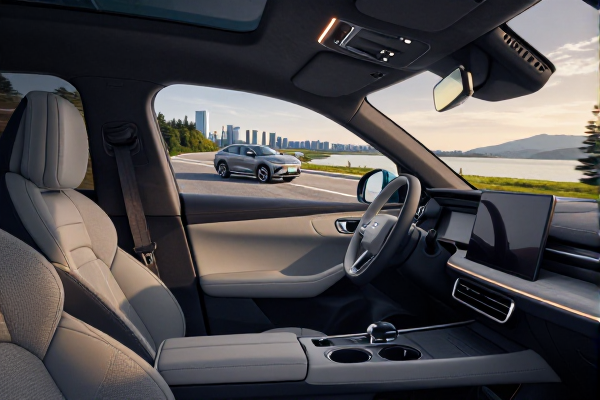
In a gasoline car, that button serves a clear purpose: it cranks the engine. In an EV, there’s no engine to start. The button simply switches the car from “ready to drive” to an even deeper “on” state — or allows you to turn it off completely. Several automakers, led by Tesla over a decade ago with the Model S, have already eliminated the button. Rivian, Lucid, Polestar, Volvo, and General Motors models let you just sit down, press the brake, and shift into gear. To stop, you put it in park and walk away. The car wakes when you enter, sleeps when you leave.
Yet many popular EVs from Hyundai, Toyota, Kia, and others still require that button press. Why?
Familiarity as a “security blanket”
Industry analysts point to consumer psychology. “For the uninitiated, not having a way to manually turn the car on and off feels weird,” says Ed Kim, president and chief analyst at AutoPacific. “That start button is a security blanket.” As of April 2025, the EV market is still dominated by first-time buyers, many coming from internal-combustion vehicles. Automakers worry that removing the button could alienate these customers.
Hyundai confirmed this when asked. “While some EV manufacturers have chosen to eliminate the start/stop button, Hyundai continues to use it on its EVs because it gives drivers a clear indication that the vehicle has entered its READY state,” a spokesperson said. “This familiar interaction helps reduce the learning curve.” Toyota echoed the sentiment, stating the button “gives customers an EV experience that feels familiar and is easy to use.”
The hidden benefits of a real button
A physical button does have practical advantages. For example, if you want the air conditioning to keep running while you step out to grab coffee, a simple press of the “on” button keeps the car powered. Tesla and Rivian offer “Pet Mode” or “Keep Climate On” through the touchscreen as a workaround, but that’s an extra step. Volkswagen EVs don’t have a start button, but they do include a stealth-mounted button on the steering column specifically for this scenario.
Another edge: if the car’s software glitches, a physical button can force a restart. “It’s a simple way to reset the system without digging through menus,” says Kim.
The broader debate: what to carry over from the ICE era?
The start-button issue is part of a larger industry conversation. Porsche and Hyundai have added simulated “gears” and fake shift paddles to some EVs. Dodge’s Charger EV pumps engine noise through external speakers. Many EVs still creep forward when you lift off the brake — a purely artificial behavior designed to mimic gas cars.
Carmakers are cautious about over-innovation. Tesla learned this when it removed the turn-signal stalk from the refreshed Model 3 — backlash forced its return after two model years. The company also moved the gear selector to the touchscreen, a move that remains in beta and divides opinion. “Screen-operated vents and touch-only controls can feel like a step backward,” Kim notes.
A new wave of buttonless EVs
Despite the caution, the trend toward buttonless EVs is accelerating. The 2025 Chevrolet Blazer EV and Equinox EV, both from GM, have no start button. The 2025 Polestar 4 follows suit. In Europe, the Renault 5 E-Tech and the upcoming Volkswagen ID.2 also ditch the button. A 2024 J.D. Power study found that 78% of EV owners who experienced a buttonless system said they preferred it.
Analysts predict that within five years, the majority of new EVs will forgo the start button. “Once you get used to it, a physical button feels like an unnecessary relic,” says Kim. “The car knows you’re there. It should just work.”
The verdict
If you’re shopping for an EV, a start button isn’t a dealbreaker. But the evidence suggests that automakers are gradually moving toward the simplicity that Tesla pioneered. The button’s days are numbered — it’s only a matter of time before it becomes as quaint as a keyed ignition.
Got thoughts on your car’s on button, or any other EV feature? Contact the author at Tim.Levin@InsideEVs.com.