Browse

Log in / Register
 Share

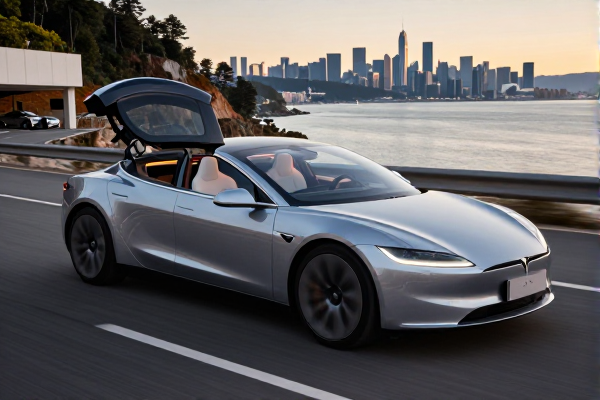
Tesla CEO Elon Musk says the wildest moments from the new Roadster prototype reveal won’t be one-time theater. Customers will eventually be able to command the car to repeat those stunts autonomously, using its onboard perception systems. Musk also confirmed that Tesla will build an extreme loop track at its Texas headquarters, one he says will make Hot Wheels look tame.
The comments came after an October 15 demonstration at SpaceX’s McGregor test site near Waco. A fully unmanned, remotely controlled Roadster prototype drove upside down along an inverted C-shaped ramp, using under-car fans to generate up to 2g of downforce. It then fired cold gas thrusters to complete aerial flips, barrel rolls, and a leap over a line of Tesla vehicles including the Semi and Cybertruck. The entire sequence ran without a driver, a deliberate safety decision for high-risk maneuvers.
The prototype used 10 cold gas thrusters supplied by roughly 600 liters — about 250 kilograms — of compressed air stored in carbon fiber pressure vessels. With thruster assist, Tesla recorded a 0-60 mph time of 0.81 seconds. Tesla Vice President of Engineering Lars Moravy said the fan system alone can produce 2g of downforce. Musk went further during the event, claiming the vehicle can “essentially fly like a rocket” and perform what he called “crazy gymnastics.”
The production target remains set for 2028. Reservations are already tiered in the United States. The Performance version requires a $50,000 deposit, split as $5,000 by credit card and $45,000 by wire transfer. A Thrust configuration requires a $250,000 deposit and is limited to one per customer. The Rocket version is invite-only and may not be street legal. The reservation agreement states plainly that the vehicle is still in development, with no guaranteed delivery date or feasibility, and that all deposits are refundable.
Musk has previously described the Roadster as “the last and best human-driven car,” and said it will eventually be Tesla’s only manual-driving model. During the event, he acknowledged that success “cannot be guaranteed.” But after the successful demonstration, he claimed the car could execute rolls and stunts at the owner’s request, shifting the conversation from “will it work?” to “what happens when owners push the button.”
What’s easy to miss in the spectacle is the financial mechanics. Tesla reopened the $50,000 and $250,000 reservation tiers in September 2026, before the demonstration took place. That timing suggests the event wasn’t a lead generator; it was a closing tool. The company has effectively used refundable deposits since 2017 to lock in committed buying power while developing the technology on its own schedule. The Roadster has been delayed repeatedly since its original November 2017 unveiling, when Musk claimed roughly 1.9-second 0-60 times and promised a SpaceX cold gas thruster package. Founders series buyers paid $250,000 upfront back then, and some are still waiting nine years later.
The technical approach is strikingly aerospace. The cold gas thrusters are descended from rocket attitude control hardware, and Tesla is routing that know-how directly into a street-oriented vehicle. Carbon fiber pressure vessels, high-flow valves, precision timing, and vehicle-side perception all have to coordinate for a stunt to land cleanly. Tesla’s fans and active aerodynamics add a second layer of control. That combination — thrusters plus downforce plus autonomous execution — is what separates this project from traditional supercar heritage.
There are obvious comparisons to Ferrari’s XX Programme, which builds invitation-only track cars that are not road legal and are used only under supervision. The Roadster Rocket version follows the same logic. There is also a structural echo of the Cybertruck, which kept its pre-order queue intact through multiple delays and eventually entered production. Right now, the Roadster is in what analysts would call a demonstration-driven expansion phase: high-visibility, high-stakes, and focused on brand momentum as much as engineering validation.
Traditional supercar brands may face the larger strategic challenge. Mechanical horsepower and aerodynamic tuning have long been the basis of pricing power. Tesla is repositioning performance as a hybrid of thruster-assisted acceleration, active downforce, and software-controlled risk. If that shift matures, the definition of a halo car changes from “what the driver can handle” to “what the vehicle software can safely execute.”
Regulatory questions remain. Autonomous stunt modes would likely be locked to closed-course operation, and the perception systems that enable them will play a different role than public-road autonomy. Still, the demonstration shows that Tesla is willing to test high-risk maneuvers at scale, using software and remote control to contain liability.
As of October 16, 2025, the Roadster story is no longer about delayed promises. It is now a demonstration-led program with production ambitions for 2028 and a growing stack of high-value deposits. Whether the car ever ships remains an open question. But Tesla has already changed the conversation: the Roadster isn’t fighting for lap times anymore. It’s fighting for the idea that a production car can be a stunt performer, and that owning one means having a personal thrill ride on command.