Browse

Log in / Register
 Share

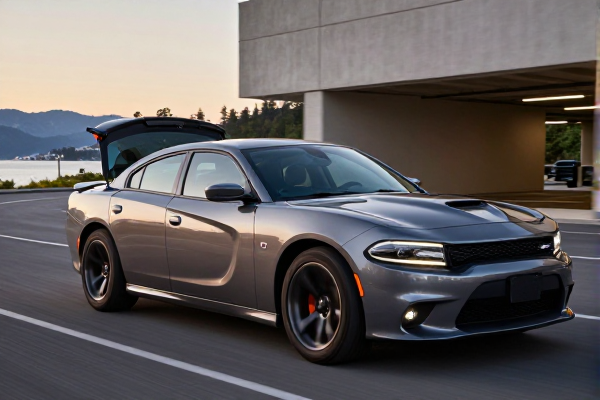
May 9, 2026 — The Dodge Charger is reportedly getting its thunder back. According to Automotive News, which says it has reviewed supplier documents, Dodge has prioritized work on a 6.2-liter supercharged V8 for the new Charger — one that should almost certainly wear the Hellcat badge. The same materials point to a relatively limited run of about 12,000 units and a launch in late 2027 as a 2028 model-year vehicle. If accurate, that timing would put the most anticipated combustion engine in Dodge’s recent history on sale just a few years after the Charger began life as an EV.
The new Charger originally arrived as the Charger Daytona, an electric performance model with synthetic sound and a body that looked ready for a superhero movie. That launch was part of Stellantis’s aggressive electric push under then-CEO Carlos Tavares, who also made no secret of wanting to shrink the company’s dependence on V8 power. For a brand whose identity is built on Hemi muscle, the strategy felt like a mismatch from day one. In hindsight, it became a case study in brand personality collision: Dodge’s core buyers did not ask for an electric Charger first; they asked for a V8 Charger that happened to be modern.
Dodge has spent the past year atoning for that awkward start by offering the Charger Sixpack with a turbocharged 3.0-liter inline-six. On paper, the Sixpack looks strong. It delivers serious torque, makes respectable power, and is far more fuel-efficient than any Hellcat could ever dream of being. Behind the wheel, the Sixpack brings back more of the old Charger’s attitude than most people expected, and it can light up the rear tires in the right drive mode. But it still does not sound like the V8 that defined Dodge for decades. That is where the 6.2-liter supercharged program comes in.
Interestingly, this is not the first time Dodge has hinted at a Hellcat return. About four months ago, the company confirmed that a Hellcat variant was eventually coming back to the lineup, but it offered no timing and no technical details. The new supplier report fills in much of the blank space. Automotive News describes the leaked information as a directive to parts makers preparing for roughly 12,000 Hellcat powertrains for the Charger, with production scheduled to begin late in 2027. That means Dodge would launch the model as a 2028 model-year vehicle, likely as a flagship halo above the Sixpack.
Why start with the 6.2-liter supercharged engine instead of something tamer? Simple: Hellcat is the brand’s most valuable name. It has serious recognition outside enthusiast forums, commanding enormous attention at car shows and strong resale values on older models. Supercharged Hellcat variants have been among Stellantis’s most profitable vehicles, thanks to hefty price tags and loyal buyers who write checks for the highest-output version without flinching. A 2028 Charger Hellcat would give Dodge an instant conversation piece and give dealers a reason to keep their showrooms busy while the rest of the lineup transitions to hybrid and electric technology.
The engineering challenge should not be underestimated. Dropping a 6.2-liter V8 into a platform designed from the start around a battery pack and electric motors is more complicated than opening the hood and making a few bracket changes. The Charger’s production architecture, STLA Large, was not initially drawn with a supercharged V8 in mind. Engineers will have to solve packaging constraints, cooling capacity, fuel system plumbing, and a long list of calibration work. There is also the matter of wiring, exhaust routing, and the structural tuning that keeps a big V8 from rattling a body designed for a quieter powertrain. None of that is impossible, but it is time-consuming and expensive.
Ram has already proven that the company can do this kind of transplant. The current Ram 1500 family was engineered to accommodate Hemi V8s after the decision to keep combustion power alive in the light-duty pickup segment. Suppliers and engineers worked through the same headaches, and the result is that Ram now offers both straight-six turbo power and traditional V8 power in the same truck. The Charger should be able to follow a similar path, especially if the V8 program reuses some of the Ram re-engineering work on cooling, mounting, and exhaust components.
The 6.2-liter is the easy first step because it already produces the power that buyers expect from a Hellcat badge. But if the engine fits, there is no technical reason why the 5.7-liter and 6.4-liter Hemi engines could not eventually join the lineup as well. Dodge has not confirmed any of that, and the supplier documents reportedly focus on the 6.2-liter supercharged unit. Still, the prospect of a broader V8 family on the new Charger is not far-fetched. Offering a naturally aspirated V8 below the Hellcat would give Dodge something to sell to buyers who want the soundtrack without the supercharger premium.
Volume of around 12,000 units is also notable for another reason: it is small enough to keep Dodge clear of the most punishing emissions and fuel-economy penalties, yet large enough to be a real business. That suggests Stellantis is treating the Hellcat Charger as a low-volume, high-margin halo model rather than a mainstream volume champion. It is a strategy that worked well for the previous-generation Challenger and Charger Hellcats, which generated outsized marketing buzz without needing to match the sales numbers of six-cylinder models.
For buyers, the big question is what this means for the existing Sixpack and the company’s electrification plans. Dodge is not canceling its EV ambitions. The Charger Daytona remains an important part of the lineup, and a 2028 Hellcat does not signal a return to a V8-only lineup. What it does signal is a renewed understanding that performance buyers want choices. Some will buy electric, many will buy the Sixpack, and a lucky few will buy a supercharged V8 with a badge that still carries emotional weight.
There is no word yet on pricing, final horsepower, or even the exact model name, though "Hellcat" is the obvious candidate. Dodge has been quiet since the official-but-vague confirmation earlier this year, and the company is unlikely to start a formal marketing campaign so early in the development cycle. If the timeline in the leaked supplier documents holds, expect the first official teasers sometime in late 2026 or early 2027, with full details arriving closer to the launch.
The last few years have been a strange ride for Dodge fans. The company killed the old Charger, spent years insisting that electrification was the future, and then watched that plan get rewritten after a leadership change. Now, one of the most beloved performance engines in modern Americana is reportedly coming back. That is not just good news for Mopar loyalists. It is a sign that Stellantis finally understands who Dodge is built for.
A late-2027 introduction would also align with the Charger’s life cycle, giving Dodge a chance to keep the current generation fresh into its fourth or fifth year of production. The supercharged V8 would be the emotional peak of that generation, just as it was for the last Charger. Whether it arrives with the exact Hellcat badge or another name from the Mopar vault, the news is already causing more excitement than almost anything else Dodge has done since the Daytona’s reveal. For a brand that sells attitude as much as metal, that enthusiasm is the most important metric of all.