Browse

Log in / Register
 Share

Citroën 2CV Electric Comeback Targets €15,000 Price and 2028 Launch
October 13, 2025
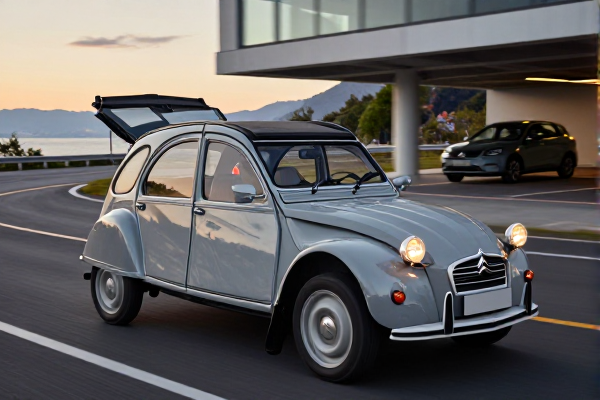
Citroën has resurrected the 2CV, and this time the iconic French runabout runs on electricity. The automaker pulled the wraps off its 2CV concept Sunday evening in Paris, on the eve of the Paris Motor Show, with CEO Xavier Chardon describing it as "a true people's car designed for real life." The production version is scheduled to reach showrooms in 2028 with a starting price near €15,000 — roughly $16,300 at current exchange rates.
Why the 2CV still matters
The original 2CV debuted in 1948 and stayed in production until 1990, a four-decade run that made it one of the most recognizable cars ever built. More than 3.8 million passenger versions rolled off the line, and commercial variants pushed the family total well past five million. It was never fast, never flashy and never expensive, which was exactly the point. The 2CV was designed to carry four people and 50 kilograms of farm goods across rutted French country roads, and it did that job with remarkable grace.
That heritage is the emotional core of the comeback. Chardon's phrasing matters. He did not call the concept a retro tribute or a design exercise. He called it a people's car and tied it directly to real life — a deliberate contrast to the wave of expensive, feature-laden EVs that dominate European showrooms. The implied argument is that going electric should not mean going luxury.
The price is the point
€15,000 would place the new 2CV below nearly every EV currently sold in Europe. Even the Dacia Spring, the continent's designated budget EV, starts around €16,900 depending on the market and trim. That gap matters because Europe's EV market has cooled noticeably, and high prices are the most commonly cited reason. Under-cutting the cheapest existing rival is a serious flex, and the industry will be watching whether the numbers actually pencil out.
A boost from Brussels
The business case connects directly to a regulatory proposal in Brussels. The European Union has been developing a new "e-car" vehicle class intended to relax the safety and equipment mandates that weigh on small cars. Current rules — advanced driver-assistance systems, connected-car hardware, increasingly strict crash standards — load every new model with expensive technology that is hard to shrink. The proposed category would let lighter, simpler vehicles be certified at a fraction of that burden, making a €15,000 sticker realistic.
Citroën says it will build the 2CV whether or not that legislation is finalized. That commitment is notable. It effectively tells the market the project is not dependent on a political outcome, and it pressures competitors who have used the regulatory environment as an excuse for keeping small EVs scarce and pricey.
Small car, tight weight
The specification list is thin but revealing. Autocar reports the concept is about four inches shorter than the original 2CV, a footprint tuned for narrow streets and tight parking. Citroën promises the production car will weigh under a tonne — roughly 2,200 pounds — which would make it one of the lightest EVs on sale anywhere. That is an aggressive target for a modern car carrying a battery.
The weight cap also explains why there are no powertrain details. Autocar's James Burnett notes the concept has no announced motor, no battery specification and no range figure, and he is right to flag the tension: a sub-tonne EV requires a very small battery, and a very small battery caps the range. A realistic outcome is probably 150-200 kilometers (90-125 miles) of range, which works for daily commuting but not much else. Citroën will have to convince buyers that a shorter leash is a fair trade for a much lower price.
Design with a wink
Visually, the concept is a love letter to the original. The 19-inch steel-style wheels are bigger than the classic 15-inch units, but their simple, utilitarian spoke pattern keeps the period-correct look. The cabin has no dashboard in the conventional sense: the steering wheel, controls and instrument display mount on a single cylinder, with an 8-inch touchscreen as the only real concession to modernity. It is a radically simplified layout that fits the car's mission.
The nostalgic touches go deeper. The signature fabric folding roof is back, offering open-air motoring without the weight or complexity of a power top. The door pockets are shaped to hold eggs, a direct nod to the 2CV's farming roots. The rear window carries three numbers — 48, 90 and 26 — marking the 1948 launch, the 1990 production end and this year's electric rebirth. None of it is accidental.
What happens next
The production car is expected to appear in 2027, with sales starting in 2028. That leaves two years of engineering work and a long list of open questions. No battery supplier has been named, no motor output confirmed, no official range figure exists, and the production site is unannounced. Citroën has set itself a hard deadline and a hard price, and the entire industry is watching.
The US reality check
For American readers, the sobering part is that this 2CV is not headed to the United States. Citroën has announced no North American plans, and history suggests that will not change. The brand stopped selling cars in the US in the 1970s, and the original 2CV was never officially offered here. The new model's price point, modest range and reliance on the EU's proposed e-car class all point to a Europe-only product.
A hypothetical US launch would face brutal math. Import certification, stricter American crash standards and the need for a larger battery would blow past the €15,000 target within months. The Fiat 500e, America's closest equivalent, starts in the low $30,000s; the Mini Cooper SE sits in the same neighborhood. That is roughly double the 2CV's European price, and it shows how far the US small-EV segment has drifted from Europe's price realities.
None of that means the 2CV lacks American fans. The original found a devoted stateside following through grey-market imports, decades of campus parking lots and pure cult appeal. Many of those fans will be watching the Paris coverage and hoping, against the evidence, that Citroën changes course. The electric 2CV is cute, honest and unapologetically affordable — a combination the US EV market has not seen in years.
If Citroën hits its marks, the 2CV will be the most interesting small car Europe has launched in a long time: a genuine people's EV at a people's price. American buyers will have to admire it from a distance, at least for now.