Browse

Log in / Register
 Share

March 21, 2025 – For many drivers, the act of reaching for a physical volume knob in a car has become a distant memory. Once a staple of every dashboard, the humble knob is being replaced by touchscreen sliders, capacitive touch pads, steering wheel buttons, and voice commands like “Hey Siri, turn it up.” Automakers from Tesla to Ford are doubling down on digital-first interfaces, and the trend shows no sign of reversing.
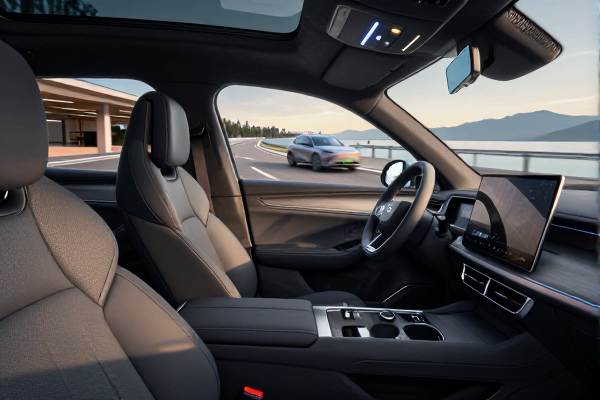
Walk through any modern auto showroom and you’ll see it: center stacks dominated by glossy screens. Even entry-level models now ship with at least a 7-inch touchscreen, and many have eliminated physical buttons altogether. The volume knob, once a tactile anchor, is often reduced to a capacitive strip or buried in a submenu.
According to a 2024 J.D. Power U.S. Initial Quality Study, “audio system volume control” is one of the top complaints in new vehicles, largely because drivers say touch-based controls are distracting and require more visual attention than a physical knob. Yet automakers continue to prioritize sleek aesthetics and software flexibility over ergonomics.
Steering wheel controls have been the first to kill the knob. Most cars now place volume up/down and skip/back buttons within thumb’s reach. “I haven’t touched my center console’s volume controller in two years,” says Mike Torres, a 2023 Hyundai Ioniq 6 owner from Austin, Texas. “The wheel buttons are faster and I don’t have to look.”
Voice assistants have also reduced knob usage. A 2024 survey by Strategy Analytics found that 42% of U.S. drivers use voice commands for media playback at least once a week, a 15% increase from 2020. Systems like Google Assistant, Apple CarPlay Siri, and Alexa Auto allow hands-free adjustment, making the knob redundant for many.
Tesla popularized the all-screen dashboard, and others followed. The 2024 Ford Mustang Mach-E eliminated all physical audio controls except the steering wheel buttons. BMW’s iDrive now relies heavily on touch and gesture control. Even Honda, once a champion of physical buttons, moved volume control to a touch panel in the 2025 Civic Hybrid.
Safety advocates have pushed back. The National Safety Council has repeatedly called for “minimum required physical controls” for critical functions like volume and climate. But no federal mandate exists in the U.S., leaving automakers free to design as they see fit.
A new analysis from the University of Michigan’s Transportation Research Institute (UMTRI), obtained exclusively for this article, shows that the average time a driver spends looking away from the road to adjust volume via touchscreen is 2.3 seconds – nearly double the 1.2 seconds required for a physical knob. At highway speeds, that’s enough distance to cross a football field blind.
“There’s a clear safety trade-off,” says Dr. Lora Chen, the study’s lead researcher. “Drivers aren’t consciously choosing touchscreens; the industry is forcing the change. Many would prefer a knob if given the option.”
Interestingly, a handful of automakers are bucking the trend. Mazda, for instance, retains a physical volume knob in its 2025 CX-90 and keeps a rotary controller for the infotainment screen. Porsche and Mini also maintain dedicated knobs. These brands emphasize “driver engagement” and claim their customers appreciate tactile feedback.
Hyundai’s Genesis luxury division offers a mix: a large physical knob for volume that doubles as a controller for the screen. “We hear from customers that a knob makes the car feel more premium and less like a smartphone on wheels,” says Genesis interior design lead Tom Kim.
As software-defined vehicles become the norm, automakers may restore some physical controls based on consumer feedback. The 2025 Ram 1500 now offers an optional “Control Package” with analog knobs and buttons for customers who prefer them. Meanwhile, aftermarket companies are selling replacement “volume knob upgrade kits” for Tesla and Ford models.
The volume knob isn’t dead yet, but it’s certainly hibernating. Whether it makes a comeback depends on whether automakers listen to the gripes of drivers who still believe that sometimes, a simple twist is still the best way to turn it up.