Browse

Log in / Register
 Share

May 9, 2026 — A dramatic rescue on a Mesa roadway has reignited a simple but important safety question: should your car have a fire extinguisher on board?
Last week, first responders pulled Aymee Ruiz from her burning truck after a crash, and video shows a bystander spraying the flames with an extinguisher while police and firefighters worked to get her out. Mesa Fire Department officials say that bystander’s quick thinking may have made a critical difference — and they’re now urging everyday drivers to consider carrying an extinguisher of their own.
Battalion Chief Isaac Thompson, who spoke about the rescue, admits that a fire extinguisher won’t solve every blaze. But in the critical minutes before crews arrive, he says it can give trapped motorists a fighting chance.
“It may not be able to extinguish the whole vehicle, but it absolutely helps when someone is trying to get a person out,” Thompson said. “It improves the odds of a successful rescue.”
Thompson recommends what’s known as an ABC extinguisher. That’s a dry-chemical unit capable of tackling ordinary combustibles, flammable liquids, and electrical fires — the three types of fire most often found in a car accident scene. Unlike a simple Class B extinguisher, an ABC model is versatile enough for upholstery fires, fuel spills, and wiring problems.
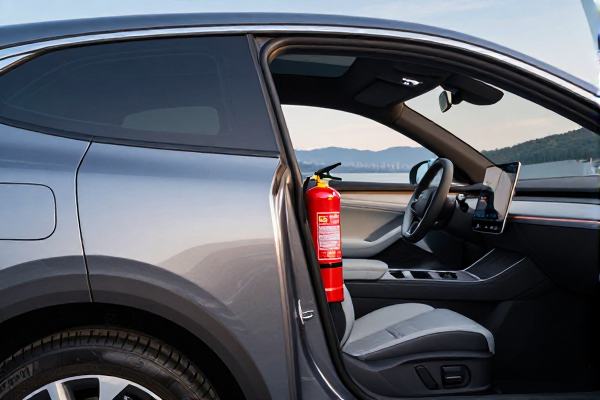
But buying an extinguisher is only the first step. Thompson stresses that mounting it properly is just as important as having it. An unsecured extinguisher can become a dangerous projectile in a crash. He suggests using the manufacturer’s bracket or mount, not a flimsy aftermarket strap. Some drivers try Velcro, but Thompson warns that it should hold the unit securely in place under hard braking or impact.
“You want it easy to grab, but you also want it to stay put when something goes wrong,” he explained.
Fire safety experts also recommend checking the extinguisher regularly. The pressure gauge should read in the green zone, and the unit must not be expired. Many people toss an extinguisher in the trunk and forget about it for years. A quick monthly glance can mean the difference between a functioning tool and a paperweight. Also, make sure every adult in the household knows where the extinguisher is and how to release the locking pin.
If you ever need to use one, the acronym PASS is worth remembering:
Thompson emphasizes that even after the flames appear to be out, the fire may reignite. Vehicle fires can smolder in hidden compartments, beneath the hood, or inside crumpled panels. That’s why professionals say you should never open the hood fully if smoke is coming from the engine area — a burst of oxygen can cause a flare-up. Instead, open it slightly and spray through the gap if safe.
The numbers back up the concern. According to the National Fire Protection Association, U.S. fire departments respond to roughly 190,000 vehicle fires each year. Those fires cause hundreds of deaths, more than a thousand injuries, and nearly a billion dollars in property damage. A small, affordable extinguisher — often under $40 — won’t prevent every incident, but it can shrink the fire’s window of opportunity.
Of course, an extinguisher is not a substitute for calling 911. The first step in any vehicle fire is always to get everyone out safely and move away from the scene. If a fire is small and contained, and you have a clear path to escape, then using an extinguisher can be a reasonable act of self-defense. If the fire is large, toxic, or growing quickly, don’t risk your life.
The Mesa incident also highlights another reality: bystanders can be the first line of defense. In Ruiz’s case, a passing driver grabbed an extinguisher and started spraying while trained professionals handled the rescue. That kind of neighborly readiness, Thompson says, is exactly why he hopes more drivers will equip themselves.
“You never know when it could be your family member stuck in that vehicle,” he said. “Carrying an extinguisher is a small step, and it’s something you hope you never need. But if you do, you’re not going to regret having it.”
Time is the enemy in a vehicle fire. Thick smoke can fill a cabin in seconds, and high temperatures can make a destroyed car unreachable. An extinguisher won’t make you invincible — but it can buy the seconds that end up saving a life. For most drivers, that’s more than enough reason to look under the seat, check the pressure gauge, and keep a little red cylinder within arm’s reach.