Browse

Log in / Register
 Share

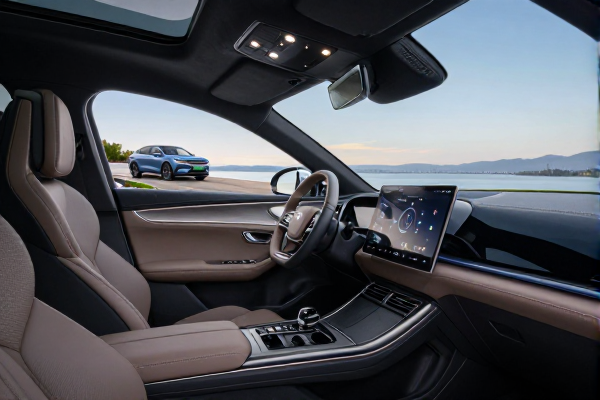
On June 12, 2026, BYD’s ultra-luxury Yangwang sub-brand shared fresh images of a flagship sedan that could shake up the high-end EV market. The model, internally called “HU,” is seen wearing Rolls-Royce-style rear coach doors, and it appears parked at a BYD Flash Charging station. Chinese media speculate that this may be BYD’s first production vehicle with a solid-state battery. If true, it would be a major milestone for both Yangwang and the global auto industry.
BYD created Yangwang in 2023 as a separate sub-brand aimed at premium buyers. The current lineup includes the U8 plug-in hybrid off-roader, the U9 electric hypercar and the U7 executive sedan. Yangwang also functions as a tech flagship for BYD. Past Yangwang models debuted with the e4 quad-motor platform, second-generation Blade batteries, Flash Charging and the Disus body-control system. Those technologies eventually cascade into more affordable BYD models, so this new sedan is significant beyond its price tag.
Yangwang general manager Hu Xiaoqing posted photos of the vehicle on Weibo. He confirmed that the production name has yet to be chosen, and that BYD uses “HU” as an internal code. Hu called the sedan the result of three years of development and described it as an ultra-luxury executive sedan with Yangwang’s latest design language. The photos show an imposing front end, with a tall chrome grille, angular LED headlights and a long hood. Several observers quickly noted a strong visual resemblance to the Rolls-Royce Phantom.
The most notable design detail is the rear-hinged coach doors. This is a classic coachbuilding signature that Rolls-Royce uses on the Ghost and Phantom. It makes entry to the rear seat more graceful, especially for passengers who value a formal arrival. BYD has never offered coach doors on a production model. If the new sedan keeps them, it will immediately stand apart from other electric luxury sedans.
One of the Weibo photos shows the prototype at a BYD Flash Charging station. Flash Charging is BYD’s ultra-fast system built on a 1000-volt platform. In models like the Han L and Tang L, the company says the system can restore roughly 400 km of range in five minutes at peak power. A sedan with coach doors and megawatt-level charging would fit the profile of an executive car expected to handle long inter-city trips without long stops.
The biggest question is whether “HU” will use a solid-state battery. Earlier this month, BYD executive vice president Stella Li gave an exclusive interview to Carwow.es, where she claimed BYD is “in the leading position” in solid-state technology and will “prove it” with its first such vehicle in 2027. She said BYD’s battery team is strong and is studying cell chemistry, production equipment and manufacturing processes at the same time.
Local reports, echoed by CarNewsChina, suggest the Yangwang flagship sedan may be that first model. The likely scenario is a top-spec variant with a solid-state pack, while other versions continue with BYD’s latest LFP Blade batteries. That would control costs while giving the technology a low-volume launch platform.
BYD’s battery division, FinDreams, is reported to plan limited-volume production of sulfide-based all-solid-state batteries in 2027. Mass production would scale up around 2030. Solid-state cells offer potential benefits in energy density, charging speed and thermal stability, but manufacturing them at scale is notoriously difficult. BYD’s existing vertical integration gives it an advantage over automakers that must rely on outside cell suppliers.
Insiders expect the new sedan to use BYD’s e4 quad-motor platform. In the U9 supercar, that system produces more than 1,000 horsepower. For a sedan, the same architecture could deliver astonishing acceleration and torque vectoring, plus off-road-style maneuvers like tank turns. The Disus active suspension should smooth out rough surfaces and keep the body level during hard braking or cornering.
Chinese media estimate a starting price above 2 million yuan, or nearly $300,000. That would make it far more expensive than the Yangwang U7, which opens at 658,000 yuan (around $98,000). At that level, “HU” would compete with the Rolls-Royce Spectre, Bentley’s electric future models, the Mercedes-Maybach EQS and the Lucid Air Sapphire. These are not just electric cars; they are status devices. BYD is betting that technology can substitute for decades of brand tradition.
BYD does not sell passenger vehicles in the United States, and this particular model is unlikely to change that. U.S. tariffs on Chinese-made EVs stand at 100 percent, and federal rules restrict the import of Chinese connected vehicles over security concerns. Yet American automakers should still pay attention. The technology developed for this Yangwang flagship will show up in cheaper BYD cars sold in Europe, Latin America, the Middle East and Southeast Asia. When solid-state or semi-solid-state cells reach mass production, they could reset the cost curve of EV ownership.
BYD is not the only company targeting solid-state around 2027. Toyota, Volkswagen, Mercedes-Benz and several Chinese startups have announced similar timelines. What separates BYD is its ownership of the full supply chain, from battery chemistry to final vehicle assembly. If “HU” debuts the battery successfully, it will put pressure on traditional luxury brands that have been slower to commercialize next-generation cells.
No official name, price or debut date has been confirmed. The Weibo photos indicate that development is far along, but BYD could still be months away from a formal unveiling. As of June 12, 2026, the industry’s attention is fixed on Yangwang. A Chinese ultra-luxury sedan with coach doors, megawatt charging and possibly a solid-state battery is not just a product; it is a declaration that BYD intends to define the next era of premium motoring.