Browse

Log in / Register
 Share
Share

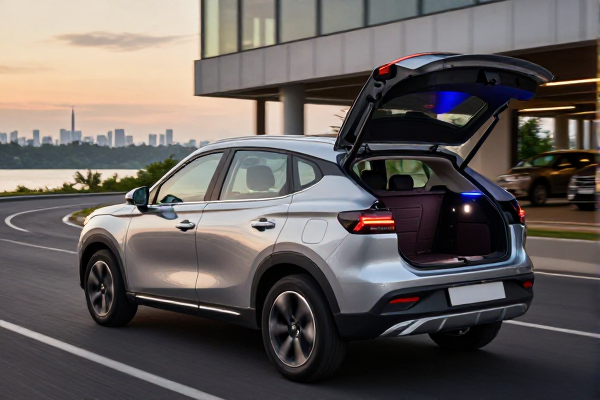
A heavily camouflaged BYD Atto 2 electric SUV has been spotted testing on Indian roads, signaling the Chinese giant’s next push into one of the world’s fastest-growing EV markets. Known globally as the Yuan Up, the Atto 2 will slot below the popular Atto 3, offering a more affordable entry point into BYD’s lineup. As of August 2025, BYD has not confirmed an exact launch date, but industry sources expect a market debut within the next six months—likely before December 2025—intensifying competition in the mid-size electric SUV segment.
The test mule, photographed near Chennai and Bangalore, wears heavy camouflage but reveals the production-ready silhouette. BYD has been aggressively expanding its dealer network in India, with over 30 outlets now operational, and the Atto 2 is seen as a volume driver. The model will take on domestic favorites like the Hyundai Creta Electric, Maruti Suzuki e-Vitara, Mahindra BE 6, and the newly launched Tata Sierra EV. A well-placed dealer source, speaking on condition of anonymity, told us BYD is aiming for a starting price of ₹18–19 lakh (ex-showroom) under a “Make in India” push that could qualify for tax benefits.
Design & Dimensions: Compact, Upright SUV Stance
The Atto 2 rides on BYD’s e-Platform 3.0, the same architecture used in the Dolphin and Atto 3. It measures 4,310 mm long, 1,830 mm wide, 1,675 mm tall, with a 2,620 mm wheelbase. For comparison, that’s about 140 mm shorter than the Atto 3 but taller than a typical hatchback. The test car shows an upright nose, prominent black cladding around wheel arches, and a gloss-black trim connecting the LED headlights—a design cue from the Yuan Up sold in China. Petal-shaped alloy wheels and conventional door handles (no flush units) are visible. The overall look is boxy and practical, emphasizing cabin space over aerodynamic drama.
Powertrain & Range: Two Battery Options, Global Configurations
Globally, the Yuan Up is offered with 32 kWh and 45.1 kWh LFP blade batteries. Indian test mules carry the larger pack, which returns up to 401 km on the Chinese CLTC cycle (approximately 300–320 km WLTP, or 250–270 km under Indian driving conditions). The front-mounted electric motor comes in two tunes: 70 kW (94 hp) with 180 Nm, or 130 kW (177 hp) with 290 Nm. The more powerful variant should do 0–100 km/h in under 8 seconds. Notably, BYD has also recently showcased its DM-i plug-in hybrid tech in India, so a PHEV version of the Atto 2 could arrive later—potentially under a “Atto 2 DM-i” badge—to appeal to buyers wary of charging infrastructure.
Feature-Packed Cabin with BYD’s Signature Tech
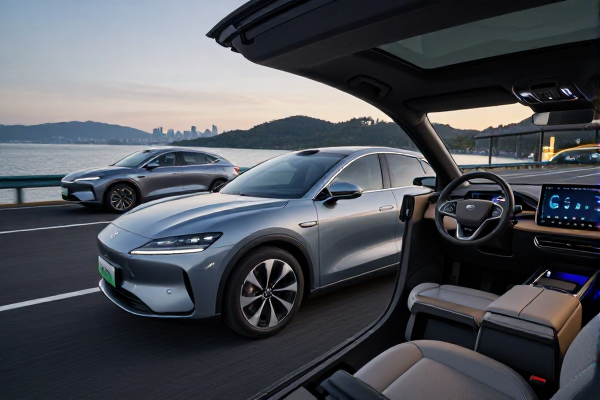
Inside, expect a 12.8-inch rotatable touchscreen, an 8.8-inch digital instrument cluster, and a three-spoke steering wheel with physical buttons. ADAS features—forward collision warning, lane keep assist, adaptive cruise control—are expected based on the camera sensor module spotted on the test vehicle’s windshield. Other highlights include a panoramic sunroof, 360-degree camera, 50W wireless charging pad, and V2L (Vehicle-to-Load) capability, allowing owners to power external appliances. The interior will offer a choice between all-black or a beige-and-black dual-tone theme. BYD’s smartphone app will likely support remote climate control and vehicle monitoring.
Competition & Pricing: Crowded Mid-Size EV Segment
The mid-size electric SUV segment in India is heating up fast. Here’s how the Atto 2 compares against its closest rivals:
BYD’s Atto 2 is likely to undercut most rivals on price while offering LFP battery safety, V2L, and a proven platform. The biggest risk? Buyer perception around BYD’s origins—geopolitical tensions and Chinese brand stigma remain in India. However, BYD’s local assembly (via its Chennai plant) and a growing service network have helped win over early adopters.
Why This Matters for the US Market?
While the Atto 2 is India-focused, its success could influence BYD’s global strategy. The company has faced steep tariffs (100% on Chinese-made EVs) in the US, making India a key testing ground for affordable compact EVs. If the Atto 2 sells well, it may accelerate BYD’s plans for a North American factory, possibly in Mexico, to build similarly sized vehicles for the US market. For now, American buyers will watch the Indian launch as a litmus test for whether BYD can crack the mass-market EV segment outside China.
The Bottom Line
The Atto 2 test sighting confirms BYD’s intent to democratize electric mobility in India. With a feature-rich cabin, decent range, and aggressive pricing, it has the ingredients to upset established players. But the real battle will be fought on service reliability, real-world range, and brand trust—areas where domestic incumbents still hold an edge. Expect a full reveal by Q1 2026, with production at BYD’s Sriperumbudur plant near Chennai.