Browse

Log in / Register
 Share

Updated May 7, 2026
Chinese electric-vehicle maker BYD confirmed today that its upcoming Da Han sedan will launch in China on October 13, and the company will mark the occasion as its ten-millionth Dynasty-series vehicle. The announcement comes as BYD’s export growth story strengthens and as the global auto calendar turns to the Paris Motor Show—events that, together, are meant to put the Shenzhen automaker at centre stage.
The news, however, does not appear to jolt the company’s share price. BYD shares remain about 19 percent below their year-start level, caught between a domestic price war and the heavy cost of building overseas manufacturing. The launch date puts the car at the heart of one of the most competitive periods ever for EV adoption.
The Dynasty family is BYD’s cash cow. Since the Qin’s debut in 2013, the lineup has expanded from a single compact sedan into a broad range that includes the Qin, Han, Tang, Song and Yuan. The model names are drawn from China’s historical dynasties, a branding strategy that resonates in the home market and, increasingly, overseas.
Reaching ten million in that series is an industry landmark. No other Chinese car manufacturer has hit that volume in one product family. It is not only a count of units produced, but also a metric for the speed at which BYD established manufacturing capacity: the final two million Dynasties were assembled in less than eight months.
For BYD, the ten-millionth car title means the upcoming Da Han gets instant recognition. The Han model itself—generally sold in both pure-electric and plug-in hybrid forms—has been among the brand’s most profitable vehicles. The Da Han variant is expected to extend that positioning, layering on a more spacious interior, improved suspension and advanced driver-assistance features.
“Attaching ‘millionth’ to a Da Han is a deliberate marketing play,” said Li Qiang, an automotive analyst in Shanghai. “BYD is saying to consumers: this is not an experimental product but the next step in a proven, huge-selling family.” Li added that in China, where brand heritage still influences the luxury segment, the naming gives the car a psychological advantage over Tesla and Nio.
The company has not released detailed specifications. Based on reports from supplier leaks and homologation filings, the Da Han is likely to share the existing Han’s body structure but with a longer wheelbase and bigger rear cabin space. BYD’s blade battery will be standard, probably paired with a rear-motor layout and a high-performance dual-motor option.
A preliminary filing earlier this year listed a new lithium iron phosphate battery pack offering more than 1,000 kilometres of CLTC range—a number that, in real-world use, would still represent a best-in-class figure. Fast charging capability is expected to improve to 150 kW or more, aligning with newer public charger reliability in both China and Europe.
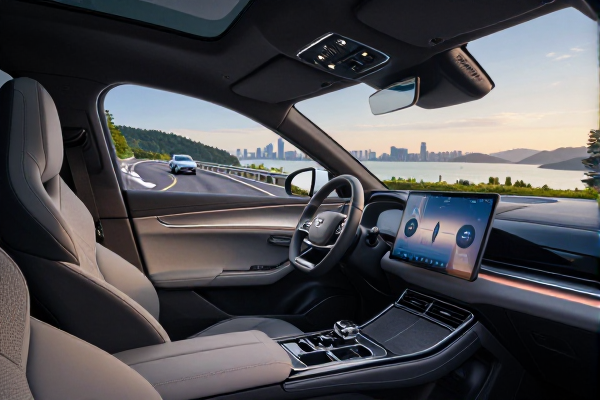
In the cabin, BYD is expected to embed its latest DiLink smart cockpit, including a large central display, multi-zone voice control and a karaoke function. The company has recently focused on AI-based semantic assistants, and the Da Han’s software is likely to become its showcase.
BYD’s future growth is no longer only a domestic story. The company has expanded into Europe, Latin America, Southeast Asia and the Middle East, with models like the Atto 3, Dolphin and Seal quickly becoming common road sights. In several European markets, BYD EV registrations have more than doubled year on year in the first quarter of 2026.
The Da Han, if it reaches export markets, would be BYD’s largest sedan outside China. It would directly compete with premium combustion-engine executive sedans and, in the electric arena, against the Tesla Model S and Mercedes-Benz EQE. Success in that category would help BYD pull its average selling price up—one of the reasons investors are watching the model closely.
“BYD exports are growing, but all that volume comes from lower-priced cars,” wrote Melissa Chan, an equity analyst in Hong Kong, in a research note on Thursday. “The Da Han gives the company a chance to prove that it can sell a premium-by-size car with the same efficiency as a hatchback.”
The October 13 launch date is far from random. The Paris Motor Show opens just one day later, on October 14, and BYD has been one of the most active Chinese brands at recent European showcases. Paris is playing an especially important role this year because several automakers—including Stellantis—have reduced their European R&D budgets, leaving room for Chinese newcomers to claim visibility.
BYD already operates a design and development office in Paris and has announced plans to expand its French retail network to 60 stores by the end of 2026. The Da Han’s timing allows the company to present the milestone to European media with showroom-related momentum.
The company’s European marketing strategy is already leaning on cultural resonance. In France, specially themed versions of Atto and Seal have been launched with local color accents. The Da Han, whose name references Han Chinese identity, may need a more neutral presentation abroad, but the underlying product strengths—range, interior space and aftersales network—are expected to do the heavy lifting.
BYD’s stock is trading lower despite an improving revenue mix. The share price is about 19 percent below the level at the start of the year, a gap that usually means the market is looking for more proof of profitability. Domestic EV price cuts have eaten into gross margins, and CEO Wang Chuanfu has publicly warned that industry consolidation will intensify.
Input costs for lithium and steel have been falling, which offsets some of the margin pressure. BYD’s in-house battery and semiconductor operations also provide insulation. “The market may be pricing in an overly bleak scenario; BYD’s volumes are still beating consensus, and the Da Han launch can act as a catalyst,” Chan added.
But tariffs remain a cloud. The European Union has imposed additional duties on Chinese-built electric vehicles, and BYD’s Hungarian factory only opened production recently, meaning a significant share of European sales will still ship from China until the plant reaches capacity.
BYD has not yet said when the Da Han goes on sale after the reveal. Historically, its launches coincide with openings of reservations and online deliveries. Industry watchers expect customer deliveries to begin in China in November, and a global rollout for 2027 is plausible, pending certification.
What matters for the broader EV market is that the ten-millionth Dynasty model is now a fixed point in the calendar. It underscores how quickly Chinese manufacturers have industrialized EV production, and it challenges the incumbents in every price band. BYD’s ability to turn a milestone into momentum—while its stock lags—will determine whether the company’s valuation catches up with its volume.