Browse

Log in / Register
 Share


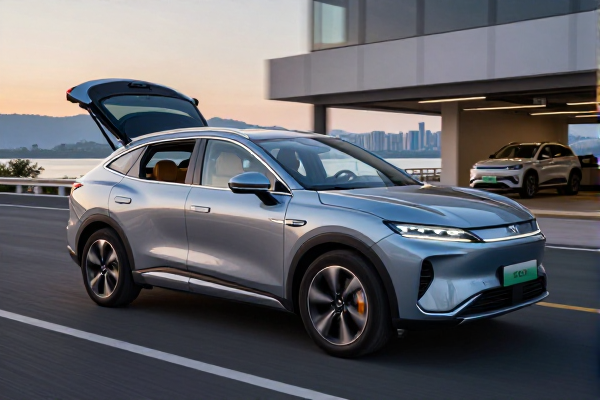
As of Oct. 15, 2026, the budget EV fight outside the US has turned genuinely intense. In Australia, the BYD Atto 1, Geely EX2, GAC Aion UT and Leapmotor B03X are all chasing buyers who want an electric car without the usual six-figure anxiety. The Atto 1 is currently the cheapest new car on Australian lots; the EX2 is climbing the sales charts; and the B03X is the latest arrival. None of the four is currently sold through normal US dealership channels, but their spec sheets show just how far Chinese automakers will push affordability.
The BYD Atto 1 makes the loudest statement: A$19,990 drive-away. That makes it the cheapest new car in Australia today, not just the cheapest EV. The catch is the price only lasts until Dec. 31, 2026; after that, it reverts to A$23,990. A higher-grade Atto 1 adds a 43kWh battery with a 310km WLTP range and starts at A$27,990 before on-road costs.
The Leapmotor B03X enters at A$29,990 drive-away, undercutting every other small electric SUV in Australia. Geely's EX2 starts at A$26,490 before on-road costs, so the typical drive-away figure lands closer to A$30,000. The GAC Aion UT sits at the top of this group at A$31,990 drive-away, but a cheaper standard-range version is coming in December 2026.
There is also the MG4 Urban, which is not part of this four-way test. It is currently available for A$29,990 drive-away until Oct. 31 thanks to a A$2,000 cashback offer.
For US readers, a rough currency conversion matters: A$1 is worth about US$0.66 in mid-October 2026. That puts the Atto 1 around US$13,000, the B03X around US$19,800, and the Aion UT around US$21,100 before shipping, federal taxes, and any profit margin. Those are numbers no mainstream automaker in America can match right now.
Power outputs tell a clear story. The Aion UT's single electric motor produces 150kW (201 horsepower) and 210Nm (155 lb-ft), which puts it ahead of the B03X's 130kW/200Nm (174 horsepower and 148 lb-ft). The EX2 is further back with 85kW/150Nm (114 horsepower and 111 lb-ft), while the Atto 1's 65kW/175Nm (87 horsepower and 129 lb-ft) is modest but workable for city commuting.
The EX2 stands out, though, as the only rear-wheel-drive car in this group. That gives it a slightly different personality on the road, especially for drivers who like a little playfulness from a small hatchback.
Range is where the Aion UT runs away from the pack. Its 60kWh battery delivers 430km (267 miles) of WLTP range, far ahead of the other three. A thriftier, cheaper Aion UT arriving later in 2026 will use a 44kWh battery and offer 320km (199 miles). The B03X covers 292km (181 miles) from a 40kWh pack, the EX2 offers 280km (174 miles) from 35kWh, and the Atto 1's 30kWh battery manages 220km (137 miles).
Keep in mind: WLTP figures are measured in a lab and usually come in higher than EPA numbers. If these cars ever land in America, expect the official US range estimates to be a touch lower.
Claimed efficiency is close across the group, around 15.5kWh/100km for the Atto 1 and EX2, 15.7 for the B03X, and 16.4 for the Aion UT.
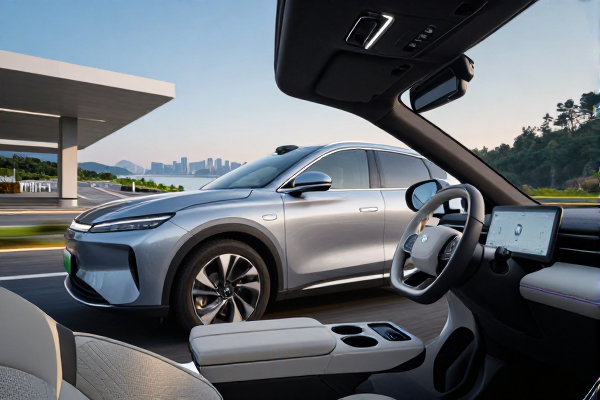
The Aion UT and B03X both get a 14.6-inch central touchscreen and an 8.8-inch digital driver display. Synthetic leather seats are standard on the Aion UT, while the B03X makes do with fabric. The EX2 also has synthetic leather seats but uses a 12.3-inch central screen and a smaller 8.0-inch driver display. The Atto 1 is the most basic here, with a 10.1-inch central touchscreen, a 5.0-inch digital driver display, and fabric seats.
Cargo space is more surprising. The B03X, despite being an SUV, offers 1,325L of total cargo space, including a 105L under-floor bin. The EX2 hatchback is right behind with 1,320L, and it also has a 70L front storage area — the only frunk in this comparison. The Atto 1 has 1,037L, which is impressive given it is the smallest car here. The Aion UT brings up the rear with 689L of total cargo space with the rear seats folded.
With the back seats up, the B03X leads at 405L, followed by the EX2 at 375L, the Aion UT at 321L, and the Atto 1 at 308L.
On size, the Atto 1 is the shortest at 3,990mm (157 inches). The Aion UT and B03X are tied for the longest at 4,270mm (168 inches). The Aion UT is also the widest at 1,850mm (73 inches) and has the longest wheelbase at 2,750mm (108 inches), which usually translates to better rear-seat legroom. The B03X is the tallest at 1,635mm (64 inches), which makes it feel more SUV-like than the hatchbacks.
Safety ratings for this group are mostly strong. The BYD Atto 1 and Geely EX2 both earned five stars from ANCAP, Australia's independent crash-test authority. The Atto 1 scored 82 per cent for adult occupant protection and 86 per cent for child occupant protection. The EX2 was assessed under ANCAP's newer "Stages of Safety" criteria, earning a 79 per cent score for safe driving, 72 per cent for crash avoidance, and 86 per cent for crash protection.
The GAC Aion UT also received a five-star ANCAP rating and posted solid scores across the board. The Leapmotor B03X has not been tested by ANCAP yet, although it comes with active safety features including auto emergency braking and adaptive cruise control.
US buyers should remember that an ANCAP rating is not the same as an NHTSA or IIHS evaluation. But a five-star result from a respected global crash agency still says a lot about basic structural integrity.
The GAC Aion UT wins the warranty war with eight years of unlimited-kilometre coverage for both the car and the high-voltage battery. The Geely EX2 is close behind with seven years/unlimited kilometres for the vehicle and an eight-year unlimited-kilometre battery warranty.
BYD and Leapmotor both offer six years/150,000km vehicle coverage and an eight-year/160,000km battery warranty. BYD adds an extra promise: the Atto 1's battery will retain at least 70 per cent of its original capacity after eight years.
For maintenance, the Aion UT needs service every 12 months or 15,000km, which is a shorter interval than the rest. The Atto 1, EX2, and B03X all run on a 12-month/20,000km schedule.
If you are shopping with Australian dollars, the pick is easy. The BYD Atto 1 is the value king, the Aion UT is the range and performance leader, the EX2 is the only RWD hatch with a frunk, and the B03X is the most practical small SUV of the bunch.
If you are shopping in the US, these exact models are probably not arriving soon. Import tariffs, certification hurdles, and the cost of building a charging and service network would all push prices up. But the broader point remains: Chinese automakers have learned how to build cheap electric cars without making them feel disposable. When trade conditions allow, American buyers might finally get the same kind of low-priced EV options that drivers in Australia are enjoying today.