Browse

Log in / Register
 Share
Share
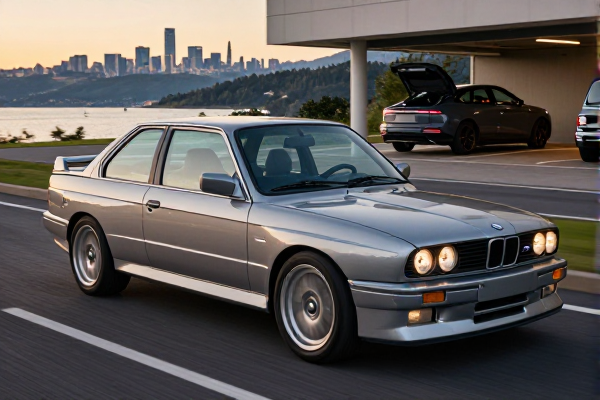
Updated May 7, 2026 — The original BMW M3 is one of those rare machines that means different things to different eras. For the 1980s, it was a homologation special built to take on Group A touring-car racing. For collectors in 2026, it is a compact, naturally aspirated icon that offers genuine driving involvement and steady value. The E30-generation M3, sold from 1986 through 1991, remains the spiritual starting point of every modern M car. This collector spec sheet puts the essential numbers and market context in one place.
The E30 M3 was never a case of a styling department adding stripes and calling it a day. BMW Motorsport needed a road car to qualify for Group A racing, and it used the 3 Series as the base to create a new kind of compact performance machine. The wide fenders, boxed rocker panels, and low front splitter were not decoration; they were part of the racing package. The aero work was surprisingly effective, and the M3 took race wins and DTM titles during its career.
Most North American collectors first saw the M3 in showrooms in the late 1980s. The U.S.-spec car came with a catalytic converter and a slightly milder S14 tune, which cost a few horsepower but preserved everyday drivability. Even in that form, the car’s balance, brakes, and steering made it stand far apart from the standard 3 Series.
| Specification | E30 M3 (1986–1991) |
|---|---|
| Body styles | 2-door coupe; 2-door convertible from 1988 |
| Engine | S14 2.3L DOHC 16-valve four-cylinder; 2.5L in Sport Evolution |
| Power | 192 hp for U.S. standard cars; 200 PS for many European cars; roughly 238 hp in Sport Evolution |
| Torque | approximately 170–177 lb-ft depending on market and tune |
| Transmission | 5-speed manual only |
| Drive layout | Front-engine, rear-wheel drive |
| Differential | Factory limited-slip differential |
| Suspension | MacPherson strut front, semi-trailing arm rear |
| Brakes | Four-wheel disc brakes |
| Curb weight | about 2,600–2,800 lb depending on trim |
| Production period | 1986–1991 |
| Total production | approximately 17,970 units across all variants |
The S14 is not just any four-cylinder. It uses an M10-based iron block with an M88-derived, 16-valve DOHC cylinder head, which is the same engine family link that gives it a motorsport personality. In the E30 M3, the S14 revs freely past 7,000 rpm and the car rewards drivers who keep it in the upper rev range. That natural eagerness is the main reason enthusiasts still place it above most modern turbocharged BMWs.
The U.S. S14, with its catalytic converter, is slightly softer at the top end than the European version, but it is still a deeply rewarding engine. Valve adjustments are a normal maintenance item, and receipts showing valve clearance work are far more valuable than any cosmetics. A car with regular mechanical attention will feel alive today, while a neglected engine can turn into an expensive project.
Total production of the E30 M3 was around 17,970 units over its six-year life. That number includes the standard coupes, the rare M3 Convertible, and the three Evolution homologation models. While the standard M3 was never common, it is the Evolution cars and cabriolets that generate the highest collector interest.
| Variant | Approximate production | Notes |
|---|---|---|
| Standard M3 coupe | largest share of total | 2.3L S14; sold in all major markets |
| M3 Convertible | about 786 | Built from 1988–1991; rarity keeps prices strong |
| M3 Evolution | about 502 | Homologation-focused 2.3L package |
| M3 Evolution II | about 501 | Improved version of the first Evolution |
| Sport Evolution | about 600 | 2.5L S14 with deeper aero and sharper focus |
North America received mostly standard M3 coupes, so Evolution models are especially difficult to find in the United States. The convertible is not as stiff as the coupe, but its limited numbers and open-top experience make it a distinct addition to any BMW collection.
As of May 7, 2026, the E30 M3 no longer trades like a used BMW. Auction platforms and private sales have settled into a clear pattern. A driver-quality U.S. coupe with solid history and a few cosmetic issues can still be found in the high five figures. A clean, turn-key example with original panels and matching numbers will move toward six figures. A genuinely original, low-mileage car can comfortably exceed $125,000.
Sport Evolution models occupy their own price tier because so few were built. When one appears at a public auction, it can command some of the highest prices ever paid for a four-cylinder BMW. The latest trend in the American market is a premium on originality: buyers are spending more for untouched bodywork and correct VIN stamps, while heavily modified cars tend to earn thinner bids.
The E30 M3 has known weak spots that should shape a pre-purchase inspection. Rust is the biggest enemy, especially on the sills, jacking points, inner wings, floor pans, spare-wheel well, and rear shock mounts. These areas require more than a quick glance; a proper inspection on a lift is worth the cost. Original bodywork has become more important than a fresh repaint, so check door gaps and VIN stamp locations carefully.
Mechanically, the S14 is durable but not maintenance-free. Common items include oil leaks from the cylinder head gasket and timing case, an aging cooling system, and worn gearbox synchronizers. The limited-slip differential should also be checked for chatter and leaks. A specialist’s report can identify problems before they become negotiation-ending surprises.
For buyers who want solid verification, a BMW Classic certificate is the best neutral way to confirm build date, model code, and correct engine number. It does not replace an inspection, but it gives confidence when there are many modified cars in the market.
The 1986–1991 BMW M3 remains the purest expression of BMW M in its modern form. It is small, analog, and mechanically honest, yet it has enough performance to entertain a skilled driver today. The collector market has matured, but the car is not fragile; well-sorted examples are still used for track days, weekend rallies, and long road trips. For anyone looking for the beginning of the M story, the E30 M3 is still the essential chapter.