Browse

Log in / Register
 Share
Share
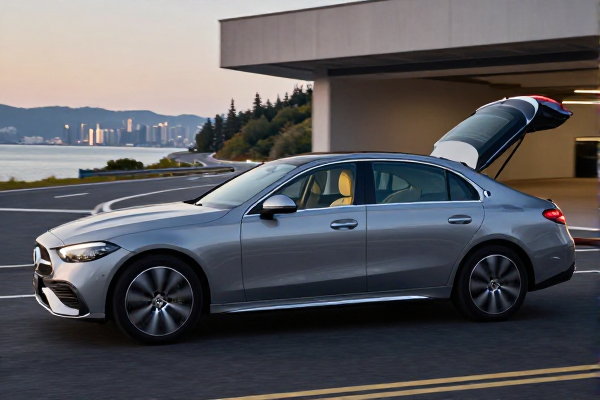
March 5, 2026 — Mercedes-Benz is already more than a year into rolling out a visual cue I proposed publicly back in January 2016: an exterior lamp that signals when a car is driving itself. The turquoise lights now fitted to EQS and S-Class models equipped with Drive Pilot follow SAE standard J3134 and hold regulatory approvals in California, Nevada and Germany, plus a US NHTSA exemption. I am genuinely pleased the concept has reached production. I just believe the color and placement Mercedes chose — and the SAE sanctioned — are wrong.
Back in January 2016, I wrote that any car with a meaningful level of autonomous capability should be required to carry a lamp mounted high on the roof, visible from 360 degrees in every direction. The point was simple: make machine control obvious at a glance.
My suggested color was purple. Not because it looked cool, but because purple is the only major color not already claimed by automotive lighting. Red means braking, amber means caution, white means forward, green means go, blue means law enforcement. Purple had no job, so it could take on this one without causing hesitation or panic.
I also framed it as a gesture of openness — a respectful courtesy offered by the robots to the humans who still choose to drive. In the early years of autonomous vehicles, public trust will be fragile. A clear indicator that helps pedestrians, cyclists and other drivers adjust their expectations would go a long way toward smoothing that transition. It could even become a visual signature for self-driving cars, announcing that autonomy is safe enough to be seen.
Mercedes-Benz, through a special regulatory exemption, has integrated lamps into the front and rear light units as well as the side mirrors of its Drive Pilot-equipped S-Class and EQS vehicles. The lamps are turquoise, a color the company says allows other road users to know when conditional automated driving is active. That makes it easy for traffic authorities and police to check whether a driver is allowed to look away from the road or read a text message, or whether they need to be ready to take back control at any moment.
In the US, the technology has been approved in California and Nevada, and Mercedes received a NHTSA exemption that makes the lamps legal nationwide. Germany's transport authority has also granted permission. Drive Pilot operates at speeds up to 40 mph in approved freeway conditions, and the turquoise lights switch on precisely when the system is managing the vehicle. When the driver resumes control, they switch off.
That is a proper, no-nonsense implementation of a useful idea. Autonomous status is no longer invisible. So why am I complaining?
Green already has one critically important meaning in traffic: it is the color of "Go." Every day, millions of drivers make split-second decisions based on green lights — at intersections, pedestrian crossings, and in dense highway traffic. Turquoise is a blue-green, and in reduced visibility conditions such as rain, fog, twilight or glare, the difference between a green signal and a turquoise indicator grows dangerously small.
A lamp at the front or rear of a Mercedes is not directly competing with a traffic light for attention, but it is still another green-tinged source of light in the driving environment. Human vision does not do spectral analysis at 60 mph; it sees a bright greenish lamp and may reflexively read "go" or hesitate while trying to identify it. That hesitation is exactly what road lighting design is supposed to eliminate.
Blue is the color of law enforcement in nearly every North American jurisdiction. A driver glancing in a rearview mirror and seeing a blue-tinted lamp from a Mercedes approaching could reasonably believe a police vehicle is behind them. At night or in poor weather, distinguishing turquoise from the blue rooftop bars and dash lights of police cruisers becomes significantly harder.
The whole purpose of this indicator is to remove ambiguity from the road. Picking a color that invites even occasional confusion with either "go" or "police" undermines that mission. Purple, by contrast, has no existing traffic or emergency meaning anywhere in the system. If an emergency vehicle ever needs to add lavender to its palette, we can have that argument later.
Taillights already communicate a great deal: braking, turning, hazards, position, reverse, fog, and in modern designs, animated signatures. Headlights have their own full-time jobs. Cramming yet another status lamp into these assemblies means it will compete for attention with the existing signals. It is a small light asked to do a big job inside a housing that is already visually noisy.
A roof-mounted pod, as I originally argued, solves several problems at once. It sits above the roofline, clear of clutter, and offers true 360-degree visibility. In dense traffic, a roof light remains visible from several cars back, even when windows and bodywork obscure the tail lamp clusters of the car directly ahead. It also gives designers a fresh surface to work with — a skyline marker that could become a useful new design signature for autonomous vehicles.
SAE J3134 has been in development since at least 2015, but Mercedes-Benz is the only automaker currently building production cars with lamps that comply with it. That gives the standard a strange advantage: there is no competing color or placement backed by another major manufacturer.
This matters. As more brands adopt Level 3 technology — and the levels beyond it — they will be looking for an existing convention rather than inventing a new one. Once a generation of Mercedes vehicles establishes turquoise integrated lamps as the norm, future autonomous cars are far more likely to copy it than to challenge it. Car makers are also unlikely to embrace an add-on roof pod for aerodynamic, aesthetic, and packaging reasons. The SAE standard, in other words, will probably win by default.
SAE began drafting what would become J3134 around the same time I published my proposal, and I am not claiming the standard borrowed anything from me. I was, to my knowledge, the first journalist in the mass market to advocate for a dedicated autonomy indicator lamp, and I repeated the case in my 2019 book. Whether that mattered to anyone in Michigan or Stuttgart is unknowable.
What is knowable is that the concept I argued for a decade ago is now legal, standardized, and factory-installed on real cars. That is a win for the idea itself. But it is a missed opportunity that the winning execution uses a color with built-in conflicts and hides the lamp inside the existing lighting units.
The turquoise light will likely become as normal as brake lights. Once it is everywhere, nobody will think much about it. But during the years while autonomous vehicles are still an exception on public roads, the indicator lamp has a crucial educational job to do. That is when it needs to be unmistakable.
If the SAE ever revisits J3134 — and standards committees always revisit — my argument will be ready. Purple, roof, 360 degrees. It is not a radical idea; it is the cautious one, designed to be instantly understood by humans who are only trying to share the road with machines. SAE, you know where to find me.