Browse

Log in / Register
 Share

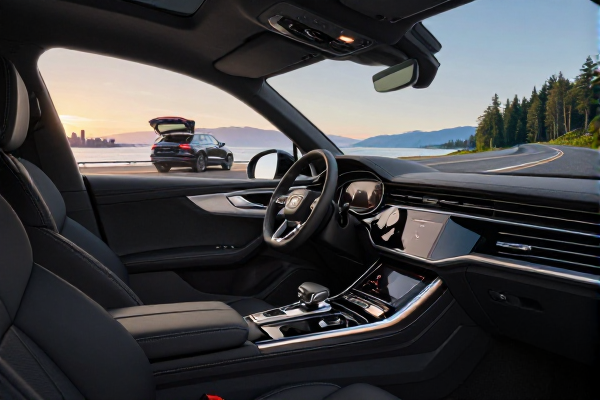
Audi has confirmed that the Q9, its next flagship electric SUV, will reach U.S. showrooms in 2026 with a curved OLED rear light panel built from 512 individually controlled segments. The full-width unit replaces the flat, segmented displays on the Q6 e-tron and marks the biggest shift in Audi's exterior lighting since the brand delivered the world's first production OLED tail lamps on the TT in 2016. The details, firm as of May 10, 2025, give the Q9 a rear end that is part sculpture, part screen, and, eventually, part signal system.
Audi's history with OLED goes back nearly ten years. The TT facelift turned heads in 2016 because its tail lamps glowed with the even, homogenous light that OLEDs are known for — no hot spots, no reflectors, just a clean sheet of light. Since then, the technology has moved down the range, with units on the Q5 and Q3, and then took a digital turn on the Q6 e-tron in 2024. That model's setup used six OLED panels with sixty segments each, 360 points of light that could be dimmed independently to create moving light patterns and personalized signatures.
The Q9 takes that idea considerably further. Where the Q6 e-tron needed multiple flat panels to cover the rear, the Q9 uses a single curved panel. And where 360 segments were enough to produce flowing animations, the Q9's 512 segments give the light surface enough resolution to do something more interesting: display shapes that aren't just decorative.
You don't need 512 individually dimmable segments just to make a taillight look pretty. You need them when you want the light panel to act like a low-resolution display. At 512 points, the rear of the Q9 can render recognizable symbols — a warning triangle, an arrow, a progress bar — rather than just abstract motion.
The jump matters for another reason too. OLED panels illuminate evenly across each segment, unlike LED units that show individual dots. Combined with the added resolution, that means a warning icon can appear as a solid, continuous image instead of a pixelated approximation. Audi's designers describe the effect as making the rear of the car "readable" at a glance, even at highway distances.
There's also the aesthetic angle. More segments mean finer gradations in brightness, so the Q9's light signatures can fade in and out with a smoothness that even the best LED systems don't match. It's the kind of precision that luxury buyers notice, often without knowing why.
Curving an OLED panel is not like bending a sheet of metal. The organic light-emitting diodes sit on a substrate that has traditionally been rigid, and the first question Audi's engineers had to answer was whether a curved panel could survive the thermal cycling, vibration, and UV exposure that a taillight deals with for a decade. Substrates that flex more freely generally carry durability penalties, so the Q9's curved unit required years of material development to meet the brand's validation standards.
The payoff is visual and practical. A curved panel wraps around the rear fenders, eliminating the seams and flat spots that break up the Q6 e-tron's rear light bar. It also gives designers more freedom with the tailgate's shape, because the light itself can follow the body's curves instead of forcing the body to accommodate a rigid rectangle of light.
Audi has been fairly open about where all this is heading: communication. The Q9's rear OLED isn't just a nicer way to signal a turn; it's designed to eventually talk to the traffic behind you. The system can receive information via the car's data connection and, in more immediate circumstances, respond to what the vehicle itself detects — a hard braking event, a disabled vehicle ahead, or a lane that's blocked.
In principle, the display could show a warning triangle or a directional arrow to alert following drivers before they're close enough to see the hazard themselves. Audi calls this passive communication, and it's deliberately designed to supplement, not replace, the standard lighting functions required by law.
The road to full legal approval is still being paved, though. In the U.S., federal rules under FMVSS 108 are prescriptive about what rear lights may do. Flashing is reserved for turn signals, hazards, and braking; steady-burning is the rule for everything else. European rules under UN R48 are similarly strict. So while the hardware is ready for the Q9's 2026 launch, some of the most interesting functions will arrive only as regulators catch up. Audi says it's working with certification bodies on both continents, and early-stage approvals for car-to-x lighting are already being discussed.
For U.S. buyers, the practical impact in 2026 will be mostly cosmetic — which isn't a small thing in the luxury segment. The curved OLED panel will be an instant visual identifier for the Q9, the way Audi's light bars became for the brand more than a decade ago. But the communication features, the ones that create real safety value, hinge on federal action. Expect Audi to roll them out in markets where approval comes first, likely Europe or Asia, and then push stateside.
The lighting is the teaser, but the Q9 is a substantial vehicle on its own. Built on the PPE platform that already underpins the Q6 e-tron and the Porsche Macan Electric, the Q9 is positioned as Audi's largest EV, a three-row attempt to take on the BMW iX, the Mercedes EQS SUV, and the Tesla Model X. Battery capacity is expected to top 100 kWh, with dual-motor all-wheel drive as standard and a performance variant likely from the get-go. The rear light system previews the level of detailing Audi wants the flagship to be judged on.
Audi is hardly alone in treating light as a brand signature. Cadillac has plastered its Escalade with elaborate LED sequences; Lincoln plays with animated lighting on start-up; Chinese EV makers like Zeekr and NIO use hundreds of LEDs to put full-width light shows on their vehicles. What separates Audi's approach is function. The Q9's OLED is built with safety communication in mind, not just a party trick when the owner walks up with a key fob. That's a defensible position in the premium market, and it plays to a history Audi established with LED headlights at Le Mans in the early 2000s — a technology story that the brand has been telling ever since.
The 512-segment curved OLED on the Q9 is not the ceiling. As OLED costs fall and flexible substrate technology improves, the resolution will climb, and Audi's designers have already pointed toward rear surfaces that act as full message displays. The Q9, in that sense, is the opening chapter. Everything the brand learns from this car — about durability, about regulation, about what drivers actually use — will flow into the rest of the PPE lineup.
For now, the Q9 gives Audi something it has lacked in the electric era: a technical signature that people can see from a hundred yards away. The rear light panel is quietly doing a lot of work. It's styling, it's branding, and, over time, it's a safety device. Not bad for a taillight.