Browse

Log in / Register
 Share
Share
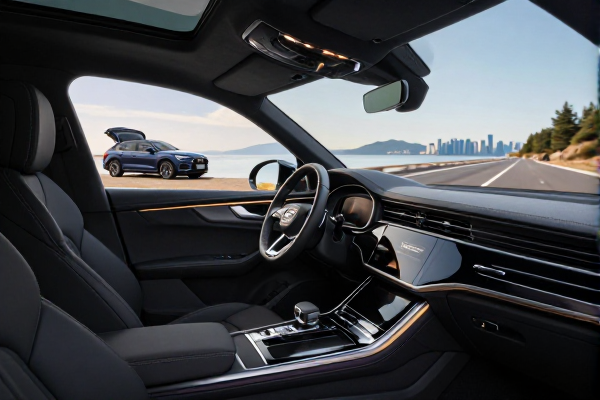
Audi has officially taken the wraps off its biggest SUV ever — the Q9 — a full-size luxury flagship that redefines the brand’s top end. Orders open in Germany at the end of July 2026, with deliveries beginning in November. The starting price lands at €108,400 (approximately $118,000 at current exchange rates), positioning it firmly against rivals like the Mercedes GLS, BMW X7, and Cadillac Escalade.
While the diesel-only launch strategy suits European markets, Audi has confirmed that the Q9 will reach the United States and Canada by late 2026 with a yet-to-be-announced powertrain lineup — likely including a gasoline V6 or plug-in hybrid to match American preferences. The adaptive driving assistant plus, enabling Level 2 hands-free operation up to 130 km/h, will be available at launch in Germany, the US, and Canada.
“The Q9 is our new flagship — it blends premium materials with driver assistance and an immersive cabin experience that sets a new standard for the segment,” said Audi CEO Gernot Döllner during the unveiling.
Length and Design: Built to Dominate
The Q9 measures 5.31 meters (209 inches) long, 2.21 meters (87 inches) wide, and 1.81 meters (71 inches) tall, riding on a 3.14-meter (124-inch) wheelbase — making it the largest Audi ever produced. Two exterior trims are offered: the standard advanced line with vertical grille slats and the sportier S line featuring an open Singleframe grille, a bolder lower front fascia, and a larger rear spoiler.
Wheel sizes span from 20 to 23 inches, with 22- and 23-inch tires equipped with acoustic foam inserts to suppress road noise. The design is unmistakably Audi while emphasizing presence and aerodynamic efficiency.
Interior: Seven or Six Seats, Auto Doors Standard
The Q9 seats seven as standard, with an optional six-seat layout that swaps the second-row bench for two individual power-adjustable seats. All seats are electrically adjustable, and the seven-seat version uses a 35/30/35 split with Isofix anchors on all three second-row positions. Sports seats are standard, with ventilation, heating, and massage available on the sports seats plus upgrade.
Audi’s first-ever automatic doors are a standout feature — they open and close via the myAudi app, cabin switches, or key fob, and integrate obstacle detection that stops the door if it can’t fully open. The soft-close mechanism ensures gentle shutting. This convenience feature is expected to be a hot ticket among luxury buyers in North America, where full-size SUVs often double as family shuttles.
Panoramic Sunroof: Largest Audi Has Ever Fitted
A 1.5-square-meter panoramic glass roof is standard — the biggest fitted to any Audi to date. An optional switchable transparency roof divides into nine individually controllable segments, and the top trim adds a 30-color illuminated version synchronized with the ambient lighting. Note: the illuminated roof won’t be available at the start of presales.
World-First Lighting: Third-Gen Digital OLED Panels
The Q9 introduces third-generation digital OLED rear lights with curved panels — a world first for a production vehicle. The outer panel uses 0.1mm curved glass and holds 99 segments; center and inner panels carry 84 and 73 segments respectively, totaling 512 segments across six panels. Features include a stylized turn-signal projection onto the road, a hazard-triangle communication light, and a rhombus-shaped welcome graphic under the doors. Up front, digital Matrix LED headlights with micro-LED modules handle forward lighting.
Powertrain: Diesel at Launch, More to Come
German market launch offers a 3.0-liter V6 diesel in two outputs: 220 kW (299 hp, 630 Nm) and a lower 180 kW (245 hp, 500 Nm) for select European markets. Both are paired with an eight-speed tiptronic transmission and permanent quattro all-wheel drive. A mild-hybrid system (MHEV plus) adds up to 18 kW (24 hp) via a powertrain generator, belt alternator starter, and a lithium iron phosphate battery. The V6 also features an electric compressor with 7.5 kW peak power for sharper throttle response.
EPA fuel figures aren’t available yet, but the 220 kW TDI returns official European fuel consumption of 8.0–7.4 L/100 km (about 29–32 mpg US) with CO2 emissions of 209–194 g/km (CO2 class G). Industry analysts expect Audi to announce a gasoline V6 and a plug-in hybrid variant in 2027 for North America, where diesel demand is minimal.
Suspension, Braking, and Driver Aids
Standard adaptive air suspension offers 90 mm ride height adjustment, and all-wheel steering turns the rear wheels up to 5 degrees. An optional sport adaptive air suspension with controlled damping is available. Braking uses a 400 mm front and 350 mm rear ventilated discs with six-piston fixed calipers.
Driver assistance includes automatic emergency braking with pedestrian/cyclist detection, blind-spot monitoring, rear cross-traffic alert, 360-degree camera, park assist, trailer maneuvering assist, trailer stability control, and integrated brake control for trailers. The exit warning system uses radar in the rear bumper to detect vehicles, cyclists, or pedestrians and can prevent doors from opening.
The new emergency assist function can steer the Q9 to the shoulder and stop if the driver becomes unresponsive. Adaptive driving assistant plus provides hands-free Level 2 driving up to 130 km/h on approved highways. “This system was validated over thousands of miles in US highway conditions,” an Audi engineer noted, highlighting its readiness for American roadways.
Infotainment and Connectivity
The MMI panoramic display combines a 12.3-inch virtual cockpit with a 14.5-inch touch display, plus a 12