Browse

Log in / Register
 Share

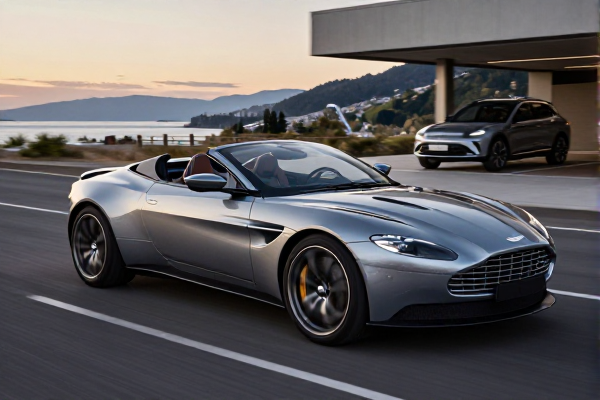
Aston Martin has taken the wraps off the Valhalla Spider, a roofless addition to its mid-engined hybrid flagship line, and the car is set for a North American public appearance at the Concours at Wynn Las Vegas. The open-air plug-in hybrid delivers a claimed 1,065 horsepower and 811 pound-feet of torque from a twin-turbo V8 paired with three electric motors, and Aston says it can reach an electronically limited 217 mph with the roof off. Customer deliveries are planned to begin in the third quarter of 2027; U.S. pricing has not been announced as of Nov. 5, 2025.
The Valhalla program, finally in full flow
Valhalla arrived as an idea back in 2019, when Aston Martin talked up a more accessible hybrid supercar to run beneath the flagship Valkyrie. The coupe took years to reach production, with multiple delays along the way. Now the Spider is following it out of the gates, confirming that the program has hit its stride. Positioned below the Valkyrie in Aston's hierarchy, the Valhalla was always meant to be the more livable option — and the Spider leans further in that direction by dropping the roof.
The powertrain, in plain numbers
Mechanically, the Spider mirrors the coupe: a 4.0-liter twin-turbo V8 with a flat-plane crankshaft drives the rear axle through an eight-speed dual-clutch gearbox. A pair of electric motors sits on the front axle, adding drive and torque vectoring; a third motor is integrated with the transmission to support the V8 at the rear. Total system output is 794 kW and 1,100 Nm, which works out to roughly 1,065 hp and 811 lb-ft in U.S. units. There's no mechanical connection between the axles — the front wheels are driven purely by their electric motors and managed by the hybrid control software.
The plug-in layout also gives the Spider a trick beyond raw pace: it can creep along on electric power alone for low-speed maneuvers and tight garages. Aston hasn't published an EV-specific range for the Spider, and the battery is best understood as part of the performance package rather than a commuting accessory.
Roof up means speed down
Aston's claimed 217 mph maximum — 350 km/h in European spec — applies when the car is running without a roof, or with the optional carbon-fiber hardtop installed. The standard fabric roof tells a different story. With the cloth cover in place, the top speed is electronically limited to 124 mph (200 km/h).
There's a logic to that. Soft roofs don't handle high-speed airflow the way fixed panels do; the fabric can lift, flutter, and alter the flow around the cabin. Aston has recalibrated the active aerodynamics and stability control for roof-on and roof-off driving separately, so the Spider's behavior changes with its configuration. The fabric roof is designed to be removable and stowable — a convenience feature, not a performance one.
Real downforce, even with the roof off
With a roof fitted, the Spider generates more than 600 kilograms of downforce, or about 1,320 pounds. That's a number more commonly associated with closed-cockpit track cars than convertibles, and it means the Spider can be driven hard through high-speed corners with the stability of a fixed-roof machine — a key part of Aston's pitch to buyers who plan to use the car on circuit days as well as boulevards.
Engineering for open-air running
The body has been reworked for roofless life. The air intake snorkel is 35 mm taller than the coupe's, keeping induction air flowing cleanly without the roof's guidance. The doors are frameless dihedral units, and the passenger cell is built around a carbon-fiber tub. A clip-in wind deflector folds into three sections and tucks into a 15-liter compartment cut into the door sill — about half a cubic foot, which is enough space for the deflector plus a few small travel items. A separate rain cover can be thrown over the cockpit when the Spider is parked without its roof.
Inside, Aston introduces a new standard piece: a carbon-fiber Touring Seat. It's a more supportive, touring-oriented design than the coupe's deep race bucket, and buyers who want the coupe's seat instead can spec it at no extra cost. The Touring Seat's standard fitment is a subtle signal that Aston expects Spider buyers to drive more than they track — or at least to enjoy the drive to the track.
Where the Spider sits in the U.S. market
The Valhalla Spider steps into a crowded top tier of open-top hybrid supercars, and it has numbers on its side. Ferrari's SF90 XX Spider lands around 1,016 hp; Lamborghini's Revuelto is rated at roughly 1,001 hp. The Aston's 1,065 hp tops both on paper, and its 217-mph roofless claim matches Lamborghini's stated "more than 350 km/h" maximum for the Revuelto.
But the character differs. The Ferrari plays the refined, tech-forward role; the Lamborghini leans into spectacle and V12 theater. The Aston's focus remains aero and chassis dynamics — expect the Spider to be discussed in terms of lap times and downforce figures more than exhaust notes.
The decision to show the car in Las Vegas rather than at a traditional auto show also speaks volumes. Concours lawns have become the new staging grounds for seven-figure collectibles, and the Wynn event has quickly become a destination for ultra-high-net-worth buyers from the West Coast and beyond.
What's next
Aston says deliveries begin in Q3 2027, which puts the first Spiders on U.S. roads about two years from now. Factory options, full pricing, and final specs are expected to be detailed closer to launch. Aston hasn't confirmed a production cap for the Spider, nor whether it will separate from the coupe's limited run.
For now, the Valhalla Spider holds a rare position: a series-production convertible that beats most fixed-roof supercars in a straight line — and keeps its bragging rights intact only when the roof is left behind.