Browse

Log in / Register
 Share

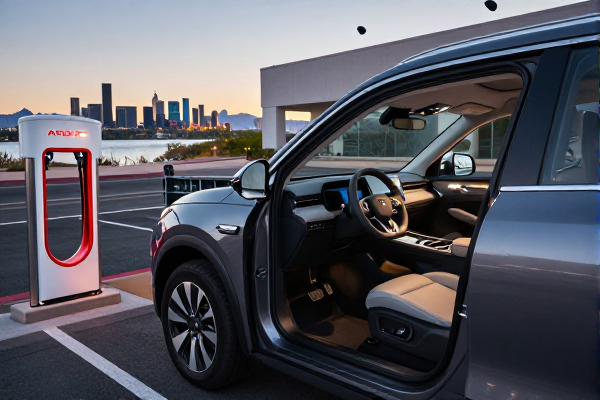
Arizona has powered up its first three electric-vehicle fast-charging stations built with federal funding, marking the visible start of a statewide network designed to make EV travel as routine as a gas-station stop. The three sites opened to the public on May 7, 2026, according to the Arizona Department of Transportation (ADOT). They are the first of roughly 80 planned charging locations that ADOT will develop through the National Electric Vehicle Infrastructure (NEVI) program.
All three new stations are along major travel corridors and are open now for public use:
These are not urban-only charging points. They sit on routes that connect Phoenix with Tucson, the Arizona-Mexico border area and the California border, meaning drivers can now cross long stretches of the state with a reliable place to recharge.
The NEVI program exists for a simple reason: many drivers still hesitate to buy an EV because they worry about finding a working charger before the battery runs out. Arizona’s plan addresses that by spacing stations strategically along interstate and state highways. Almost every planned location will be no more than 90 miles from the next one, and all will sit within three miles of a highway exit. That gives EV owners a strong safety buffer, even if they drive an older or shorter-range vehicle.
This first cluster of stations also sets the pattern for what drivers can expect from the rest of the network. Most locations will have at least four 150-kilowatt direct current fast chargers. That level of power is enough to take a typical EV from low battery to an 80 percent charge in about 30 minutes, depending on the vehicle and weather conditions.
Connector compatibility will not be a guessing game. Most stations will include both the Combined Charging System (CCS) plug and Tesla’s North American Charging Standard (NACS) connector. That means drivers of nearly all major EV models — from Ford, Hyundai, Chevrolet, Rivian, Tesla and others — can use the same public charging site.
Arizona is administering $76.5 million in federal money through NEVI, and the program could support as many as 79 public charging stations across the state. The funding structure is a public-private partnership. The federal government covers up to 80 percent of eligible project costs, while private developers and site owners contribute at least 20 percent. The stations themselves are privately owned and operated. No Arizona state funds are used for construction.
This model allows ADOT to stretch federal dollars further while letting private charging companies handle maintenance, software updates and day-to-day operations. It also reflects the NEVI program’s broader goal of creating a self-sustaining nationwide charging network rather than a short-term pilot.
Two more Arizona stations are expected to open later this year along Interstate 40 in Seligman and Holbrook. Those will be important additions for drivers traveling between Arizona and the Four Corners region.
ADOT also reports that eleven other projects are now under construction or in design, and contracts are expected to be issued on another fourteen projects by late 2026. In other words, the first three openings are just the beginning of a much larger rollout that will keep building through the end of the decade.
The next major phase involves 49 future stations, and ADOT has already opened the bidding process. An estimated $49 million in federal funds is available for this batch. The proposed locations cover a wide range of highways:
This third phase includes 31 new locations, plus 18 locations from earlier phases that were not previously awarded. It follows an initial round of 16 stations along Interstates 10, 8, 40, 17 and 19, and a second round of 14 stations along Interstate 10, U.S. routes 60, 89, 93 and 160, and state routes 95 and 260.
One of the most important details in the NEVI program is that it does not just fund hardware; it requires that hardware to keep working. Federal rules set uptime and operational reliability standards for funded chargers. Drivers have long complained about broken or out-of-service public chargers, and NEVI was designed to prevent that problem from scaling up.
Because Arizona’s stations are spaced with backups in mind, a single offline charger is less likely to strand a driver. If one station reports a problem, the next one is usually close enough to be a practical alternative. This corridor-level redundancy is a major improvement over older charging networks that often concentrated stations in metro areas and left the miles between them as dead zones.
Companies that want to build and operate the next group of Arizona charging stations have a deadline of 2 p.m. on Jan. 15, 2027 to submit proposals. If the current schedule holds, construction would begin in 2028, with most sites expected to take about one year to complete.
The timetable is intentionally phased. NEVI funding was always meant to be spent steadily across several years, not dumped into the market at once. That allows state transportation agencies to refine site selection based on traffic data, utility hookups and developer interest.
For now, the practical takeaway is simple: drivers using the Tucson, Green Valley and Wellton stations can expect fast charging, multiple connector types and a location at or near an existing business. More importantly, the opening of these first three stations signals that Arizona’s broader EV highway network is leaving the planning stage.
The full buildout will take time, but the direction is clear. With more stations already under construction, another round about to enter the pipeline, and a large procurement open through early 2027, Arizona is steadily moving toward a statewide, publicly accessible fast-charging network.
Travelers who want to follow the rollout, see the full map or confirm which corridors are next can visit AZDOT.gov/EVPlan.