Browse

Log in / Register
 Share

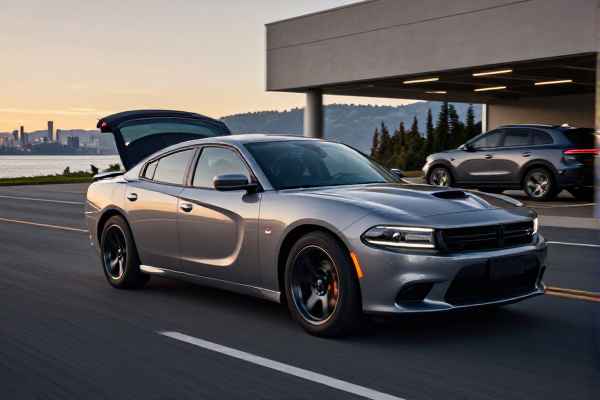
May 9, 2026 — Dodge is moving past the Hemi era, but it is clearly not done building loud, sideways, tire-shredding Chargers. The brand’s latest project pairs two custom Charger drift cars with Hemmings and Suppy’s Garage, and the result is a 60-day master class in getting serious power out of the turbocharged Sixpack engine. Both cars clear the 750-hp benchmark, yet they take entirely different roads to reach it: one chases response, the other chases peak output.
The Sixpack name carries some old-school Mopar weight, but the engine underneath is all new. It is built around Dodge’s 3.0-liter Hurricane inline-six, a twin-turbo powerplant that has replaced the V-8 in the current gas-powered Charger lineup. In standard production form, the Sixpack is already a strong performer. The project cars prove that the engine has far more headroom when builders are willing to change the intake, fuel system, turbocharger, and engine management.
That matters because the Charger Daytona EV now handles the electric side of Dodge’s performance lineup. The Sixpack is the brand’s internal-combustion answer for buyers who still want engine noise, shifting, and burnout-friendly rear-drive behavior. These two drift cars are not simply marketing decorations. They are early proof that the new inline-six can handle serious modifications without needing a completely different drivetrain philosophy.
Drift cars live in a strange place between acceleration and loss of traction. Drivers do not just open the throttle and hold on; they need smooth, predictable power at strange angles, part throttle, and low engine speeds. That makes the tuning approach just as important as the final horsepower figure.
The first Charger is built around response. The team prioritized a quick-spooling turbo setup, upgraded intercooling, and a calibration that brings boost in early. The mid-range punch is strong enough to hold a long drift without waiting for the tach to climb. This is the easier car to drive sideways, because the power curve is consistent and forgiving.
The second Charger goes in the opposite direction. It uses a larger turbocharger, a higher-boost map, and a fuel setup built for extreme output. The power comes later, but when it arrives, it arrives hard. This build is more dramatic and less polite, and it requires more skill from the driver. It is the kind of car that wants to be driven with anticipation rather than reaction.
The two approaches are not all that different from the old argument between cubic inches and boost, they are just happening on the same engine platform. One car highlights tractability; the other highlights theater.
The most important detail is not the number itself, it is how the number was reached. According to the build theme, both cars stayed with the same core engine architecture, and that sends a strong signal to the aftermarket. The Hurricane inline-six has enough structural strength and fuel-system capacity to handle a serious power increase without becoming a science project.
The builds still required real work. Upgraded turbochargers, larger injectors, supplemental fuel pumps, and a standalone engine controller are all part of the package. Cooling also had to be addressed because a drift car spends more time at high load and low speed than a drag car. Any owner thinking about chasing similar results will need to budget for those items rather than just changing a tune and expecting reliability.
It is also worth noting that these are one-off builds, not production upgrades. The 750-hp number is a target reached under a tight deadline, not a factory rating. But that is exactly why the project matters. It shows what the Sixpack can do when tuners get serious, and it gives the aftermarket community a starting point for future packages.
The engine work was only part of the project. Both Chargers also received suspension upgrades, roll-cage work, upgraded brakes, and hydraulic handbrakes. Wheel and tire packages were chosen for sustained tire slip at high speed, and the cars were deliberately set up to be driven hard in real drift conditions instead of just being dyno queens.
That is an important distinction. A drift build has to manage heat, weight transfer, and steering angle while putting hundreds of horsepower through the rear tires. The two 60-day builds had to be ready for all of that, not just for a pull on a dynamometer. The result is a pair of cars that look as aggressive as their engine specs suggest.
As of today, Dodge has not announced where these two cars will appear next. Public showcase dates remain unconfirmed, but the timeline and the level of work suggest they are meant to be seen in action. The more lasting takeaway for enthusiasts is simpler: the Sixpack is not just the engine that replaced the Hemi. It is a turbocharged performance platform that can be tuned hard and engineered for serious motorsport use.
The 750-hp builds with Hemmings and Suppy’s Garage may have started as a 60-day challenge, but they ended up as the sharpest statement yet that Dodge’s gas-powered Charger still has plenty of attitude left. One car uses response; the other uses peak power. Both finished the sprint with huge power figures and even more proof that the Sixpack engine can be pushed hard.