Browse

Log in / Register
 Share
Share
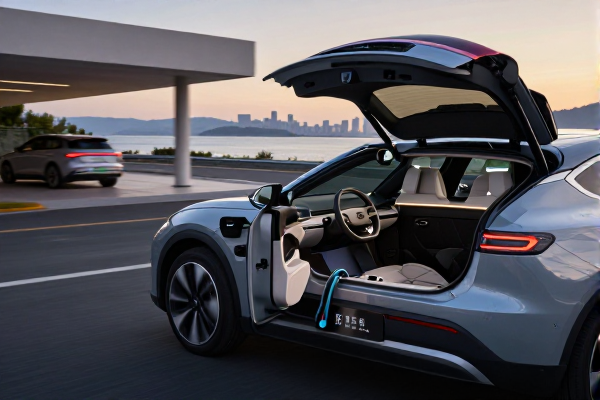
Filling a gas tank takes about four minutes. On May 10, 2026, that yardstick no longer belongs only to gas stations. Geely says its fifth-generation charging station can take a compatible electric vehicle from 10 percent to 70 percent in four minutes and thirty seconds. BYD has already pulled off a similar flash charge earlier this year. The convenience gap that made gas cars an easy sell is starting to close.
The numbers are shocking if you still think of EV charging as a twenty-minute coffee stop. But the race has moved from merely adding range to erasing the refueling stop altogether. Here is how the Chinese auto industry got here, and what it will mean for drivers elsewhere.
A New Megawatt Benchmark
Geely’s “Smart Charging Station” isn’t just a stronger plug. Its fifth-generation system outputs up to 2,250 kilowatts, or 2.2 megawatts, through a single charging gun. That is roughly ten times what most public fast chargers can deliver today.
The battery had to be designed to survive that kind of power. The automaker matched the station with its Shendun Golden Battery, which supports a 12C charging rate. In simple terms, a 12C battery can accept twelve times its own capacity in current. Real-world tests on the Zeekr 001 and Lynk & Co 10 produced a 10-to-70 percent charge in exactly four minutes and thirty seconds. Going from 10 percent to 97 percent took eight minutes and forty seconds.
BYD set an earlier benchmark with its 1,500-kW flash charger and second-generation Blade Battery. That system took about five minutes to go from 10 to 70 percent. So the target has shifted from “faster than a meal” to “faster than a fill-up.”
These numbers only apply under ideal conditions: a compatible car, a station with energy storage, and a battery that is already at the right temperature. Still, the engineering direction is clear. Automakers are not just improving range; they are changing the definition of charging.
This performance is possible only because the industry stopped thinking of the charging station as a separate box. Geely’s station includes its own energy storage, and the vehicle battery is built around sustained high current. The weak link in a 2-megawatt setup isn’t the cable—it’s heat.
Inside the AI That Keeps Batteries From Melting
Shoving two megawatts into a lithium-ion pack creates enormous heat. Without careful thermal management, one session can start a chemical cycle that destroys capacity within a dozen charges. This is where software does the heavy lifting.
Geely’s energy management algorithm, developed with the AI firm StepFun, coordinates the car, the charger, the cloud, and the station’s storage battery in real time. The system predicts internal temperature spikes up to thirty seconds before they occur. It then cuts power before hot spots form, keeping average cell temperatures below 55 degrees Celsius.
Liquid cooling runs through a five-point loop that touches every part of the charging chain, including the station’s buffer battery, not just the vehicle. Heat is removed before it can build up in any one spot.
The harder question is whether repeated fast charging kills the battery. Here, too, Chinese makers are trying to change the physics. Geely says its “lithium-ion pulse restoration” technology sends micro-pulse currents into the negative electrode to reactivate trapped lithium ions during charging. The company claims this extends battery cycle life by up to 20 percent. Independent labs are still verifying that number, but even partial success would ease one of the biggest worries about ultra-fast charging.
Why Chinese Automakers Are Racing So Hard
The reason for the speed race is simple: the domestic market is brutal. Chinese consumers are no longer treating EVs as a second car. At the same time, fuel vehicle sales have sagged, and EV makers are fighting a price war that has squeezed margins across the board.
Innovating on charging is a survival strategy. A sub-five-minute stop means drivers don’t need a huge 1,000-km battery pack to feel safe on a road trip. They can rely on shorter stops, which in turn reduces the weight and cost of the car.
The pressure is also spreading to charging infrastructure. Brands like Zeekr and BYD are already planning large highway networks with megawatt-level stations. Once thousands of those sites are live, the “where do I charge?” question gets answered the same way “where do I fill up?” is answered today.
Inside the battery, there is no free lunch. To sustain a 12C charge rate, cell makers need low internal resistance, high-voltage coatings, and current collectors that don’t break down under repeated thermal stress. Energy density often takes a backseat. That is why automakers are splitting their battery lineups: some packs optimized for long drive time, others for quick partial charges. The market is deciding that the ability to add hundreds of miles at a highway stop may be more valuable than the ability to drive 600 miles on a single charge.
Infrastructure Is Moving, but Grid Limits Remain
One obstacle is larger than battery chemistry: the grid. A 2.25-megawatt charger is not a normal utility load. Every such site needs either a heavy connection to the grid or a big on-site battery to release stored energy during a session. Chinese station operators are building buffer storage into the stations, exactly like a localized power plant, so they don’t trip local grids.
This is why the charging race is not only about the car. The winning companies will be those that manage energy supply, grid fees, and station utilization efficiently. Data centers learned this lesson with AI workloads; EV charging is now learning it too.
What This Means for U.S. Drivers
For American EV owners, the Chinese systems won’t appear in your local charging map any time soon. Tariffs, software and safety certification rules, and different voltage standards keep Chinese charging hardware mostly out of the U.S. market. But the change in consumer expectations will reach the U.S. quickly.
Most public DC fast chargers in the U.S. still peak between 250 and 400 kW. A typical road-trip charge at a 350-kW station, on a newer EV, often takes 15–20 minutes for a meaningful range bump. Meanwhile, U.S. station operators are more focused on reliability and scaling than on setting speed records. The Chinese benchmark will push U.S. automakers to design cars that can handle bigger sustained power, even if the stations here can’t yet deliver it.
There are real reasons to be skeptical. Aggressive fast charging can strain battery life more than ordinary users expect, and the early 12C numbers come from the companies selling the batteries. But the trend line is unmistakable. If Chinese roads prove that megawatt-class charging can run safely at scale, the old “gas car convenience” argument collapses globally.
Range anxiety will not disappear tomorrow. But it will transform. Instead of worrying about how many miles a battery holds, drivers will start worrying about the efficiency of the charging network itself. In that race, the bar has moved from twenty minutes to under five. And that changes the math for every electric vehicle announced from now on.