Browse

Log in / Register
 Share

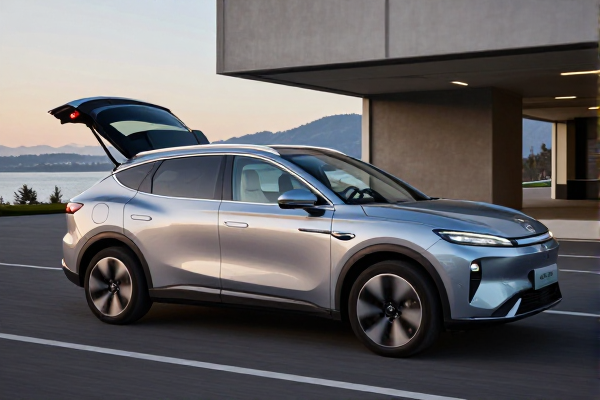
If you are shopping for a 2027 compact SUV and your budget stretches anywhere from the low $30,000s to the mid-$50,000s, two very different options will probably land on your shortlist: the 2027 Volvo XC60 and the 2027 GMC Terrain. One is a Scandinavian luxury crossover with electrified powertrains; the other is a freshly refreshed mainstream SUV built around simplicity and value. As of June 2, 2026, here is how these two stack up in the areas that matter most.
The 2027 XC60 is not cheap, and it is not trying to be. Canadian order books currently show six trim levels running from CAD $58,100 up to roughly CAD $84,000, plus CAD $3,100 freight and PDI. If history is a guide, the U.S. version will open a little higher than the Canadian entry price once destination is added, likely around $50,000 to $51,000 for the base B5 Core trim. The range-topping T8 plug-in hybrid can climb toward the mid-$70,000 mark before options.
The 2027 GMC Terrain, by contrast, keeps its feet firmly on the ground. Canadian pricing starts at CAD $38,499 and tops out near CAD $50,199 for the Denali trim, with CAD $2,300 freight and PDI. U.S. numbers have not been officially released yet, but the current model starts at just over $30,000, and the 2027 refresh should stay close to that figure. Even a loaded Terrain Denali should remain thousands below the entry-level XC60.
That price gap defines the entire comparison. The XC60 is buying you more engineering, more luxury, and more electrification. The Terrain is buying you transportation value, and that is exactly the point.
Volvo offers the XC60 with two electrified paths. The B5 uses a 2.0-liter turbo four-cylinder with 48-volt mild-hybrid assistance, producing 247 horsepower and 266 lb-ft of torque. Step up to the T8 plug-in hybrid and output jumps to 401 horsepower with 494 lb-ft of torque, which puts it in genuine performance-SUV territory.
The GMC Terrain keeps its lineup simple. Every 2027 trim uses a 1.5-liter turbocharged four-cylinder making 175 horsepower and 203 lb-ft of torque. That is enough for everyday commuting and light highway passing, but it will not embarrass the XC60. If you want official numbers, Volvo’s B5 is rated around 9.1 L/100 km combined under Canadian testing, which translates to roughly 26 mpg. The T8 plug-in hybrid can dip to 3.4 Le/100 km, or about 69 MPGe, when driven with a full charge.
The Terrain, according to NRCan ratings, returns 9.9 L/100 km in the city, 8.9 L/100 km on the highway, and 9.5 L/100 km combined — roughly 24 mpg city, 26 mpg highway, and 25 mpg combined. Wrap your head around the real-world difference: the Terrain costs less to buy, but it also costs more at the pump per mile unless you can regularly plug in the T8 XC60. If you cannot charge at home, the XC60 B5 and the Terrain are close enough on fuel that the purchase price becomes the deciding factor.
Volvo has built its reputation on safety, and the XC60 continues that tradition. The 2027 model has already posted strong results with the U.S. NHTSA: five stars for frontal and side crash tests, four stars for rollover resistance, and a five-star overall rating. Volvo also fits seven airbags, including front, side, side-curtain, and a driver’s knee airbag.
The GMC Terrain’s 2027 crash-test cycle is still incomplete as of this writing. That does not mean the vehicle is unsafe — GMC has a solid recent record — but it means the official numbers are not available yet. Buyers who put crash ratings at the top of their checklist will have to wait for updated data or give the XC60 the nod based on what is already published.
On standard driver-assistance features, both SUVs come well equipped. Automatic emergency braking, lane-keeping assist, and blind-spot monitoring are expected on both. The XC60 adds more advanced options higher up the trim ladder, including Pilot Assist semi-autonomous driving aids, while the Terrain keeps its feature list simpler and easier to understand.
Let us talk about coverage, because this is where many buyers get surprised.
Volvo covers the 2027 XC60 with a 4-year / 50,000-mile comprehensive warranty and a 4-year / 50,000-mile powertrain warranty. Roadside assistance runs for 4 years with unlimited mileage. Volvo also includes scheduled maintenance for 3 years or 36,000 miles, which saves you a few hundred dollars in the first ownership years.
GMC’s coverage on the Terrain is structured differently. The comprehensive warranty lasts 3 years / 36,000 miles, while the powertrain warranty extends to 5 years / 60,000 miles. Roadside assistance also lasts 5 years / 60,000 miles.
Which is better? It depends on how long you plan to keep the vehicle. If you tend to trade every three years, Volvo’s shorter powertrain coverage is less relevant. If you plan to own for six or seven years, GMC’s longer powertrain warranty is a genuine advantage. Keep in mind, though, that Volvo’s maintenance plan removes many small out-of-pocket costs early on, and the brand historically holds up well with proper care.
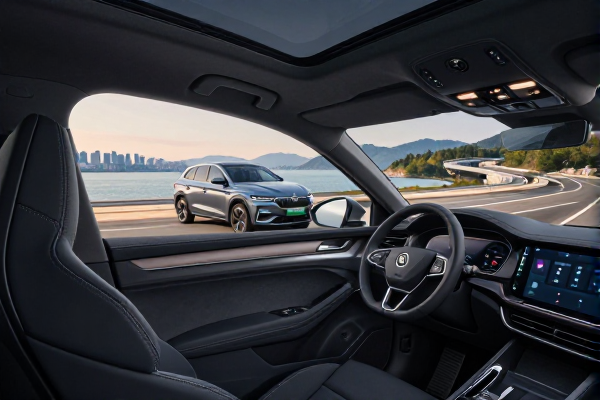
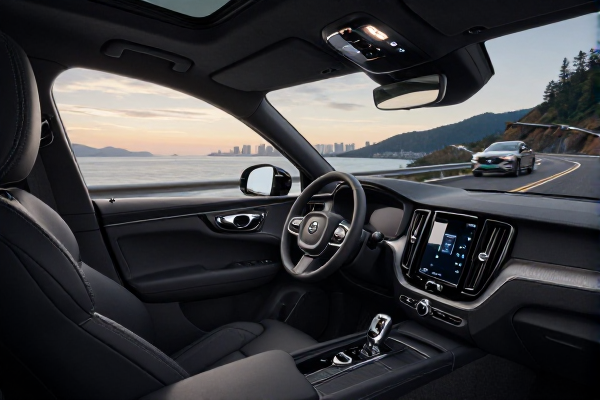
Step inside the XC60 and the cabin feels expensive. The B5 Plus Black Edition trim we featured includes an 11.2-inch touchscreen infotainment system with Google built-in, wireless Apple CarPlay and Android Auto, a 14-speaker Harman Kardon surround-sound audio system, and a 21-inch alloy wheel package. You also get memory seats, in-car Wi-Fi, a wireless charging pad, navigation, and leather upholstery. The design is clean, minimalist, and very Scandinavian.
The 2027 GMC Terrain, especially in AT4 trim, takes a more rugged approach. It comes with an 11-inch touchscreen, wireless CarPlay and Android Auto, a six-speaker audio system, in-car Wi-Fi, a wireless charging pad, navigation, cloth seats, and 17-inch alloy wheels. The materials are a big step forward versus the previous generation, but there are still harder plastics on the lower doors and dash. It is not an insult to the Terrain — it is just the reality of a mainstream crossover trying to hit a $30,000 price point.
Technology-wise, both vehicles offer the essentials. The XC60 wins on audio quality, interior ambience, and screen resolution. The Terrain wins on simplicity, with physical climate controls and an easier-to-learn layout.
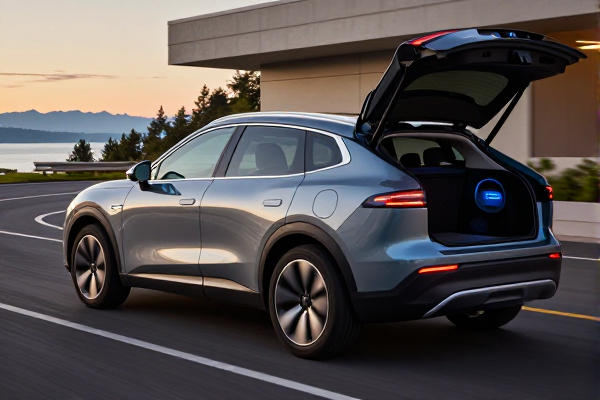
The XC60 offers 613 liters (21.6 cubic feet) of cargo space behind the rear seats, expanding to 1,543 liters (54.5 cubic feet) with the rear seats folded. That is respectable for a compact luxury SUV, and the load floor is flat when everything is stowed.
The Terrain is the more practical hauler. It provides 844 liters (29.8 cubic feet) behind the rear seats and up to 1,798 liters (63.5 cubic feet) with the rear seats folded down