Browse

Log in / Register
 Share

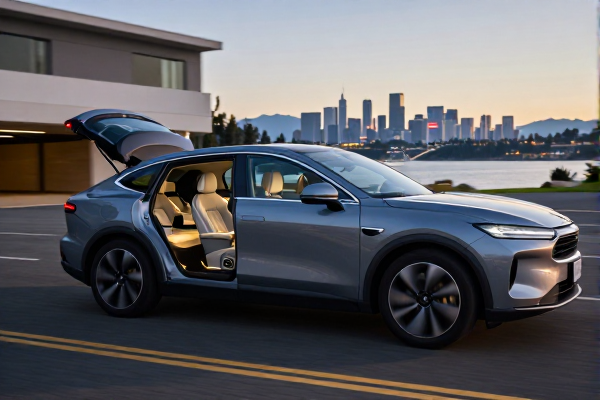
Audi pulled the covers off its biggest SUV ever—the Q9—and it’s clear the German automaker is hunting for Range Rover and Escalade buyers in America. While the official U.S. launch date and pricing remain under wraps, the Q9 is already turning heads with its colossal dimensions, advanced tech, and a cabin that feels more like a private jet than a family hauler.
What’s the Q9’s powertrain lineup for the U.S.?
At launch, the Q9 will be offered with a 3.0‑liter V6 turbo‑diesel mild‑hybrid engine, making 295 horsepower and paired with an eight‑speed automatic transmission. Audi’s trademark quattro all‑wheel drive is standard. The mild‑hybrid system allows short bursts of electric‑only driving and smooth start‑stop operation. A plug‑in hybrid (PHEV) version is expected later, which would give the Q9 a direct edge over the current BMW X7 and Mercedes GLS, which only offer conventional gas or diesel powertrains. The Range Rover already offers a PHEV, and an all‑electric variant is on the horizon.
A high‑performance SQ9 with a twin‑turbo 4.0‑liter V8 (around 600 hp) will be available in the U.S., unlike the UK market where it won’t be sold. That V8 model is expected to compete head‑on with the Mercedes‑AMG GLS 63 and the BMW Alpina XB7.
Ride, handling, and brakes: built for American roads
Every Q9 comes standard with adaptive air suspension that can adjust ride height by up to 90mm, lowering the vehicle by 62mm for easier entry. An optional sport system stiffens the suspension for more agile handling. All‑wheel steering is standard in the U.S., a boon for maneuvering the 5.3‑meter‑long beast in tight parking lots. The braking system is equally massive: 400mm front discs with six‑piston calipers and 350mm rear discs.
Exterior design: “I’m here”
Audi’s design chief David Caffrey told us the goal was to create “powerful luxury” that commands respect. The Q9’s face is dominated by a huge grille, but unlike the US‑spec model shown with illuminated vertical slats (a bit too Rolls‑Royce, some say), the U.S. version will get Audi’s more familiar honeycomb pattern, similar to the latest Q7. The Q9 is available with 23‑inch alloy wheels, and the LED matrix headlights pack 25,000 pixels per unit. The top Vorsprung trim features the world’s first curved digital OLED taillights, which are more visible from the side and integrate seamlessly into the body.
Interior: an executive lounge meets Scandinavian cool
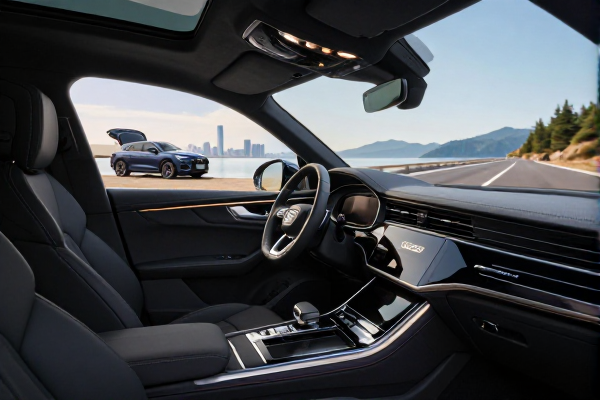
Audi describes the Q9’s cabin as a “sanctuary for family, business, and long journeys.” Soft‑closing automatic doors (like a Rolls‑Royce Phantom) are standard. The design leans toward a modern, minimalist vibe with fabric on the dashboard and speaker covers, minimal glossy black plastic, and extensive ambient lighting that even runs under the screen cluster to create a floating effect. The panoramic sunroof is standard and also incorporates ambient lighting.
You can customize the interior with real wood trim, Nappa leather, or alpaca wool upholstery, and new colors like tamarind brown and stone beige aim to create a calm atmosphere. However, physical controls remain scarce: even the direction of the air vents is adjusted via the touchscreen, which may take some getting used to.
Infotainment: triple screens, ChatGPT, and 4D audio
The Q9 features a 12.3‑inch digital instrument cluster, a 14.5‑inch central touchscreen, and a 12.3‑inch passenger display—all housed in a single curved panel. The passenger screen has a privacy mode that prevents the driver from seeing it while the car is moving. The system runs on Android Automotive, allows app downloads (video, games, navigation), and integrates wireless Apple CarPlay and Android Auto. Audi’s virtual assistant now uses ChatGPT to answer virtually any question.
For audiophiles, the Vorsprung trim includes a 22‑speaker, 1,360‑watt Bang & Olufsen system with 4D sound: AI syncs the music’s rhythm to the ambient lighting, and actuators in the front seats let you “feel” the bass.
Practicality and cargo space
The Q9 has three rows of seating, and the second row can be optioned with captain’s chairs for easier access to the third row. Cargo space is generous, though Audi hasn’t released final U.S. figures yet. Expect around 40 cubic feet behind the third row and over 80 with the seats folded.
U.S. pricing and availability
Audi has not yet announced official U.S. pricing or a release date. Industry analysts expect the Q9 to start around $95,000–$105,000 for the base V6 diesel, with the Vorsprung trim and SQ9 V8 easily exceeding $130,000. That would position it squarely against the Range Rover ($107,000+), BMW X7 ($80,000–$110,000), Cadillac Escalade ($85,000–$120,000), and Lincoln Navigator ($80,000–$110,000). The Q9’s main advantage is its combination of diesel efficiency (for long‑range American road trips) and a more modern, tech‑laden interior than the aging Escalade.
Expert perspective
“The Q9 is Audi’s most ambitious shot at the top tier of luxury SUVs,” said John McElroy, veteran auto analyst and host of Autoline After Hours. “If they can nail the U.S. pricing and get the PHEV out quickly, they could steal sales from Range Rover and Mercedes. But the diesel‑only launch may limit appeal in states like California, where diesel isn’t popular.”
The bottom line
The Audi Q9 is a commanding presence that aims to be a true alternative to the Range Rover and Escalade. Its combination of advanced tech, air‑suspension comfort, and a luxurious interior makes it a compelling choice for American buyers who want something that says “I’m here” without being too flashy. Keep an eye on Audi’s official U.S. announcements in the coming months.
(Rewrite date: April 2025)