Browse

Log in / Register
 Share

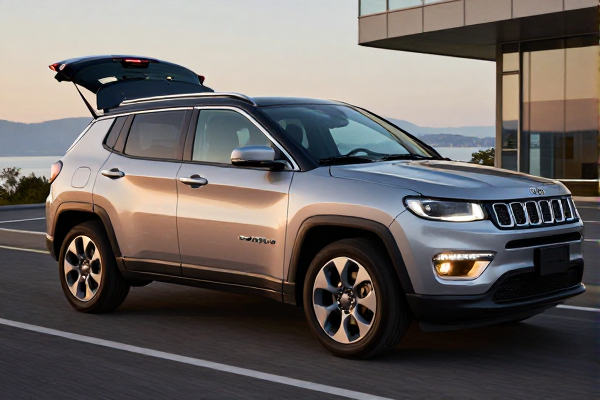
March 18, 2025 — A 2018 Jeep Compass Longitude that just surfaced on New Zealand's Auto Trader, asking NZ$13,500 (roughly US$8,000), is a useful reality check on how far this compact SUV has dropped from its original showroom price. The Auckland listing isn't available to American buyers, but the car's equipment, condition and quirks map cleanly onto the questions US shoppers are asking about the same model sold locally.
The white 2018 Compass is a mid-range Longitude, a badge used in markets like Australia and New Zealand. In the US, the same generation was sold as the Sport, Latitude, Limited and Trailhawk, so this unit's equipment roughly slots between the US Latitude and Limited trims. Highlights from the listing:
That mileage discrepancy is worth pausing on. The vehicle details block lists 112,187 km; the seller's write-up says 118,000 km — a difference of roughly 5,800 km (about 3,600 miles). It's probably a copy-and-paste slip. But in any used-car listing, an odometer mismatch is exactly the kind of thing a buyer should pin down before negotiating.
After currency conversion, NZ$13,500 lands near US$8,000 — but don't expect that number on a stateside window sticker. A 2018 Compass with around 70,000 miles in good condition typically lists for $14,000 to $18,000 on US dealer lots, varying by trim, drivetrain and region. The two markets aren't directly comparable: different taxes, exchange rates, supply and buying habits all move the needle.
What the NZ listing does confirm is depreciation. A 2018 Compass started life in the low-to-mid $20,000s in the US; seven years on, it's worth roughly half that in almost any market. That's normal for the compact-SUV class, not a red flag — but it does mean buyers are paying for a used car with used-car expectations.
The 2.4-litre "Tigershark" four-cylinder was the primary engine for the 2018 Compass in most global markets. The NZ data sheet shows consumption of 8.8 L/100km, which converts to about 27 US mpg — consistent with the EPA's official 23–26 mpg combined range for US-spec 2.4L examples, depending on drivetrain and transmission.
At US pump prices, a typical 12,000-mile year works out to roughly $1,300–$1,500 in fuel. That's unremarkable for the class, neither a bargain nor a burden. The NZ listing's own estimate of NZ$3,450 per year reflects New Zealand's much higher fuel prices; American owners will spend closer to half that.
One caveat: US-market 2018 Compasses paired the 2.4L with a standard 6-speed manual and an optional 9-speed automatic, while this NZ-market car is listed with a 6-speed automatic. Global specs genuinely differed, which is why anyone comparing international listings against US inventory should verify the drivetrain by VIN rather than assume.
The five-star VSRR rating here is a New Zealand government estimate of real-world crash risk, not a US crash-test score. Stateside shoppers should rely on their own data: NHTSA awarded the 2018 Compass an overall five-star rating, and IIHS crashworthiness tests returned solid results.
The recurring weak spot in US testing was headlight performance, especially on halogen-equipped trims. Night drivers who spend time on unlit two-lane roads should check whether the unit they're considering has the better-rated lighting options.
The 2018 Compass is the first model year of the second-generation design, and first-year models tend to carry more early-production bugs. Independent scorers at both Consumer Reports and J.D. Power have rated the 2018 Compass below average for predicted reliability, and Jeep as a brand has consistently trailed the industry average in J.D. Power's long-term dependability studies in recent years.
The most frequently cited complaints on this generation include:
None of these are guaranteed failures, and plenty of owners report uneventful ownership. But the pattern justifies a disciplined approach: an independent pre-purchase inspection, a complete service history, and a long test drive that includes stop-and-go traffic and highway merging. Running the VIN through NHTSA's recall lookup is also non-negotiable, since several field actions covered the 2018 Compass.
Set aside the spec sheets for a second. What this listing demonstrates is what a properly maintained example looks like when a seller is realistic about condition: a current safety inspection, active registration, a pet-free and smoke-free interior, and a plain, credible reason for selling — in this case, an overseas move. Whether or not the story is true (and most listing stories are true), the signals are the ones US buyers should hunt for locally: maintained paperwork, honest photos and a seller who answers drivetrain questions without deflecting.
Those signals matter more on a model with below-average reliability scores. The fresh inspection and floor mats don't make the Compass a hidden gem, but they suggest the previous owner was attentive — and on a first-year model that has already seen seven years of use, that's worth more than a shiny coat of wax.
At its current used price, the 2018 Jeep Compass sells on styling, standard CarPlay/Android Auto and a strong safety list. The trade-off is a powertrain with known quirks and reliability scores that trail the class leaders. The New Zealand listing, mileage hiccup and all, is a fair snapshot of the deal — regardless of which side of the ocean you're shopping on.