Browse

Log in / Register
 Share
Share
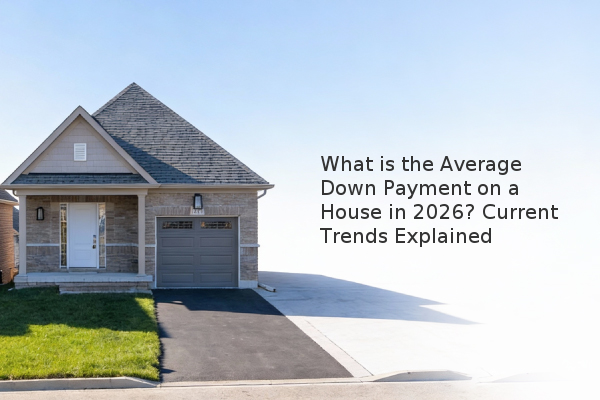
The average down payment on a house reached record highs in 2024, a trend that continues to shape the 2026 real estate market. The typical down payment was $30,250, or 14.4% of the purchase price, in the fourth quarter of 2024. This reflects a market dominated by high-earning, financially prepared buyers, while higher mortgage rates and home prices push entry-level buyers to the sidelines. Understanding these trends is crucial for anyone planning to purchase a home in 2026.
The historical peak in down payments was driven by a combination of economic factors. According to 2024 data, the median down payment amount was 3.4 percentage points higher than pre-pandemic levels in 2019. Two primary forces influenced this trend:
This confluence of factors meant that the market activity shifted toward more expensive home segments. In 2024, home sales picked up in the $750,000-plus price range while shrinking for homes under $750,000. This shift in the mix of homes sold contributed to pushing the median down payment amount higher.
While the median down payment was $30,250, there is a wide distribution of what buyers actually pay. For many first-time homebuyers, a more realistic figure is the "modest" down payment, approximated by the 30th percentile. In Q4 2024, the 30th percentile down payment was $8,200. This amount is less than a third of the median and is often associated with buyers using government-backed loan programs.
These programs, including loans from the Federal Housing Administration (FHA), the Department of Veterans Affairs (VA), and the U.S. Department of Agriculture (USDA), are designed to help buyers purchase homes with lower upfront costs. An FHA loan, for example, may require as little as 3.5% down. In the fourth quarter of 2024, these government loans comprised roughly 37% of all mortgages, indicating a significant portion of buyers are not putting down 20%. However, the share of these loans has fallen compared to pre-pandemic levels, which is a key reason why even modest down payment amounts have increased.
The type of property being purchased significantly impacts the required down payment. Down payments on investment properties and second homes are typically nearly double those on primary residences. In Q4 2024, the average down payment for an investment property was 27.4%, and for a second home, it was 28%. In contrast, the average for a primary residence was 14.4%.
Lenders impose these higher requirements for non-primary residences because they are considered higher-risk investments. Buyers who can afford these properties often opt to put more money down to secure better loan terms and avoid higher interest payments. In dollar terms, the typical down payment on a second home or investment property in late 2024 was more than 2.5 times larger than that on a primary residence.
Based on our experience assessment, the trends observed in 2024 are likely to persist through 2026. The housing market is not expected to shift dramatically in the near term. Down payments are likely to remain relatively high as the market continues to be accessible mainly to buyers with significant purchasing power. The incentive to minimize a large home loan remains strong while mortgage rates are elevated.
Looking ahead, a meaningful increase in housing affordability will likely require lower mortgage rates. As rates eventually ease, a more diverse set of buyers may enter the market, potentially softening the incentive to make an exceptionally large down payment. However, if buyer demand surges without a corresponding increase in for-sale inventory, competition could push down payments up once again. For prospective buyers in 2026, preparing for a down payment of at least 10-15% is a prudent strategy, though exploring low-down-payment government loans remains a viable path for eligible individuals.