Browse

Log in / Register
 Share

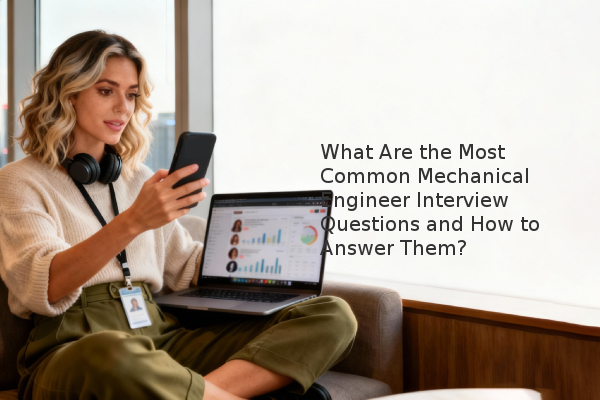
Mastering the mechanical engineer interview requires a blend of technical knowledge and strong soft skills. To outperform other candidates, you must be prepared to discuss your design experience, problem-solving approach, and ability to communicate complex ideas. This guide breaks down the most common questions with sample answers to help you refine your approach.
Employers use behavioral questions to gauge how your soft skills complement your technical expertise. Your answer should align with the job description and demonstrate traits that enhance teamwork and project success.
How You Could Answer: "Analytical thinking and problem-solving are essential and work together symbiotically. When designing, I'm always analyzing how to innovate or streamline. Flexibility is also key; I don't limit myself and actively listen to team feedback. Communication is then critical for maintaining dialogue and explaining complex ideas to non-engineers. I'd also emphasize sustained concentration and unwavering attention to detail."
This question assesses your passion and ingenuity. Your response should tell a story that shows early curiosity and the application of engineering principles, even in a personal project.
How You Could Answer: "In college, inspired by Dutch artist Theo Jansen's kinetic sculptures, I built a miniature, wind-propelled 'Strandbeest' using a planar mechanism for leg movement. This project, born from a desire to challenge the status quo, demonstrated the inherent link between creativity and engineering and was my first hands-on application of complex mechanical linkages."
Balance is key. While acknowledging necessary but less exciting tasks like troubleshooting, focus on the core creative and collaborative aspects of the role that you genuinely enjoy.
How You Could Answer: "I truly enjoy the entire problem-solving cycle: identifying an issue, brainstorming, and developing a logical solution. Creating blueprints is a highlight, but I also find the tactile aspects of assembling a prototype and managing a manufacturing process exhilarating. Finally, being part of a talented team resolving issues together is always satisfying."
This tests your communication skills. The goal is to demonstrate your ability to translate technical jargon into understandable concepts without losing the core message.
How You Could Answer: "I am highly aware of my audience's knowledge level. I avoid technical jargon and use analogies. For clients, I prefer in-person meetings with visual, step-by-step presentations, pausing frequently for questions. I always conclude by clearly underlining the design's direct benefits to them, ensuring the value proposition is understood."
A Piping and Instrumentation Diagram (P&ID) is a detailed schematic that illustrates the relationships between process equipment, piping, and instrumentation. Unlike a broader Process Flow Diagram (PFD), a P&ID includes all mechanical equipment, control devices, and other details necessary for construction and operation.
How You Could Answer: "In my previous role at an auto-manufacturing plant, I drafted P&IDs during the design stage for a site expansion. We used them to detail the installation of a new industrial process control, creating several versions based on iterations of equipment designs and initial flowchart data."
Your answer should justify your preference based on efficiency, cost, and safety, while showing familiarity with all systems. The context of the job you're applying for is important.
How You Could Answer: "I often prefer pneumatic systems for their cost-effectiveness and efficiency. They rely on compressed air, making them fast, dependable, and relatively simple. They also offer significant safety advantages by reducing fire or explosion hazards, which is crucial in many industrial settings."
To succeed, practice articulating your experiences clearly and confidently. Focus on providing specific examples, tailor your answers to the company's needs, and always demonstrate how your unique combination of skills adds value.