Browse

Log in / Register
 Share
Share
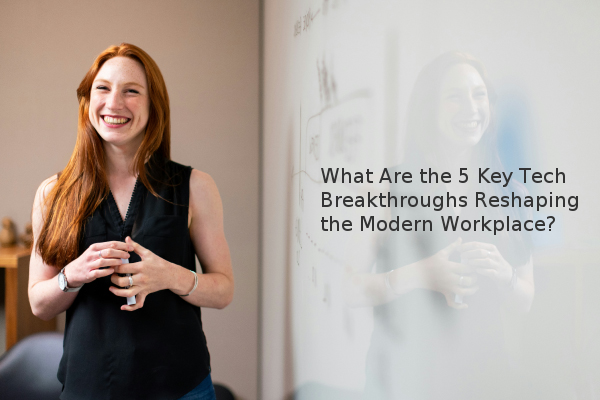
The five most impactful technological breakthroughs revolutionizing today's workplace are cloud technology, big data analytics, advanced wireless systems, video-based communication tools, and immersive technologies like Virtual Reality (VR) and Augmented Reality (AR). These innovations are fundamentally reshaping recruitment, talent management, and daily operations by prioritizing flexibility, data-driven decision-making, and seamless collaboration. For HR professionals and business leaders, understanding and integrating these technologies is no longer optional but essential for staying competitive in the talent market and future-proofing their organizations.
Cloud technology refers to the delivery of computing services—including servers, storage, databases, networking, and software—over the internet ("the cloud"). This technology has become the backbone of the modern, flexible workplace. From a human resources perspective, cloud-based Human Resource Information Systems (HRIS) have streamlined everything from the candidate screening process to onboarding and performance management. Recruiters can access candidate profiles from anywhere, enabling faster responses and improving the candidate experience. For collaboration, platforms like Google Workspace or Microsoft 365 allow teams to work on the same document simultaneously, regardless of location. This eliminates version control issues and significantly reduces project timelines. The competitive market for cloud services also means that solutions are scalable, allowing small and medium-sized businesses to access enterprise-level tools without a massive upfront investment, thereby leveling the playing field in the war for talent.
Big data in HR involves analyzing large, complex datasets to uncover patterns, trends, and associations related to human behavior and interactions in the workplace. This goes beyond simple metrics, enabling talent assessment and strategic workforce planning. By analyzing data from application tracking systems, employee performance reviews, and even anonymized productivity metrics, companies can identify the traits of their most successful employees. This allows for more accurate structured interviews and hiring decisions that are based on empirical evidence rather than intuition. For example, data can reveal which skills are true predictors of success in a specific role or what factors most significantly impact employee retention rates. The following table illustrates common HR data points and their strategic applications:
| Data Point | Strategic HR Application |
|---|---|
| Time-to-Hire | Optimizing the recruitment process to reduce bottlenecks. |
| Source of Hire | Identifying the most effective recruitment channels (e.g., job boards, social media). |
| Employee Turnover by Department | Pinpointing management or cultural issues needing intervention. |
| Skills Gap Analysis | Informing targeted training programs and future hiring needs. |
The evolution of wireless technology, particularly Wi-Fi 6 and 5G, has created truly mobile and agile work environments. This shift directly supports the growing demand for flexible work arrangements, a key factor in employer branding. When employees are not tethered to a desk, they can collaborate spontaneously in common areas or work from different locations within an office, fostering innovation. For remote or hybrid teams, robust wireless connectivity is non-negotiable. It ensures that employees have secure and reliable access to company resources, which is critical for maintaining productivity. An office free from the clutter of cables also presents a more modern and professional image, which can be a subtle but powerful selling point for attracting top tech talent who value a contemporary work environment. This technological infrastructure is a prerequisite for supporting other breakthroughs like IoT (Internet of Things) devices and seamless video conferencing.
Video-based technology has moved from a novelty to a core component of HR functions. Its most prominent application is in recruitment, where video interviews have become standard practice. They expedite the initial candidate screening process, especially for remote candidates, saving significant time and resources for both recruiters and applicants. Platforms like Zoom or Microsoft Teams facilitate these interactions and are also integral to internal communication, enabling cross-office meetings that feel more personal than a phone call. Furthermore, video has revolutionized training and development. Video training content allows for scalable, on-demand learning, eradicating the logistical challenges and costs associated with on-site trainers. Employees can learn at their own pace, and content can be easily updated, ensuring consistency across the organization. This directly ties into the development of more immersive VR and AR training modules.
Virtual Reality (VR) creates a completely simulated, digital environment, while Augmented Reality (AR) overlays digital information onto the user's real-world view. These immersive technologies are transforming experiential learning and collaboration. In training, VR can simulate high-risk scenarios (e.g., equipment operation for engineers) or soft skills practice (e.g., difficult conversation simulations for managers) in a safe, controlled environment. This leads to better knowledge retention and competency. AR, on the other hand, can provide real-time guidance; for instance, a new employee on a manufacturing floor could use AR glasses to see assembly instructions overlaid on the machinery they are using. For collaboration, VR can create virtual meeting rooms where geographically dispersed teams feel as if they are in the same space, a significant step up from standard video calls. As this technology becomes more accessible, its role in onboarding, employer branding presentations, and complex collaborative projects will only expand.
To leverage these technologies for career success, job seekers should focus on developing a specific digital skillset. For HR professionals and business leaders, the key takeaways are: