Browse

Log in / Register
 Share
Share
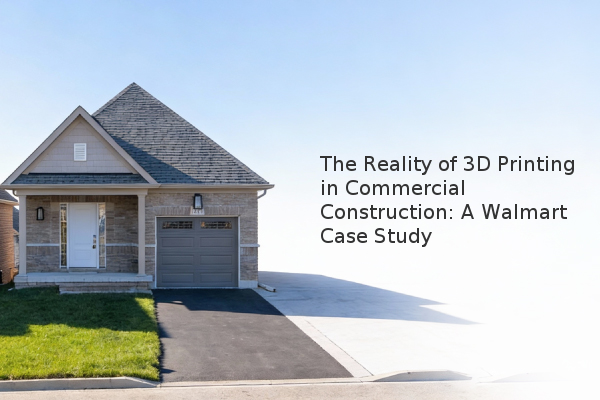
3D printing, or additive manufacturing, is not yet a faster or cheaper alternative to traditional construction methods for most commercial projects. Based on a recent case study involving a Walmart store expansion, the technology shows significant promise but is hampered by logistical challenges and environmental sensitivities. While it can reduce labor needs for certain tasks, factors like weather, material handling, and regulatory hurdles currently prevent it from achieving widespread cost or time savings. This analysis explores the practical realities of using 3D printing in commercial real estate development based on a completed project.
What is 3D Concrete Printing and How Was It Used? 3D concrete printing is an additive manufacturing process where a computer-programmed robotic arm deposits layers of specialized concrete mixture to build structures from the ground up. In the case of the Walmart project in Tennessee, the technology was employed to construct an 8,000-square-foot addition intended for online order pickups. The goal was to assess whether this method could accelerate construction timelines and reduce costs compared to conventional techniques. The project was one of the largest commercial applications of 3D printing in the United States, providing valuable real-world data on its viability.
Did 3D Printing Make the Walmart Project Faster? The project did not meet its original schedule and finished weeks behind initial projections. The primary causes for delay were related to the technology's sensitivity to external conditions. High humidity and summer heat in Tennessee adversely affected the printing material, causing it to overheat. Crews had to spend additional time cooling the material to the correct temperature for application. Furthermore, obtaining local building permits for a novel construction method added unforeseen time to the pre-construction phase. These experiences indicate that while the printing process itself can be rapid, real-world variables can significantly offset potential time savings.
Was 3D Printing More Cost-Effective Than Traditional Construction? For this project, the final cost of building with 3D printing was roughly equivalent to traditional construction. Although the method can require fewer laborers on-site for the actual printing phase, these savings were offset by unexpected expenses. Challenges included dealing with clogged hoses, the need for equipment adjustments, and the time lost to weather-related interruptions. The cost of the specialized concrete mix used in 3D printing also remains a factor. Therefore, based on this case study, significant cost reduction is not yet a guaranteed outcome.
What Were the Biggest Technical Hurdles Encountered? The construction team faced several technical obstacles that highlighted the technology's nascent stage for large-scale commercial use. The fast-setting nature of the printing material left little room for error during application. Additionally, the original pump used was incompatible with the material, requiring a mid-project replacement. Perhaps the most significant lesson was the material's reactivity to environmental factors, which can vary dramatically by location and season. These hurdles required continuous problem-solving and adaptation from the combined team of traditional contractors and 3D printing specialists.
What is the Future Outlook for 3D Printing in Construction? Despite the challenges, the future of 3D printing in construction remains promising. The lessons learned from the Tennessee project are being applied to new endeavors, with expectations of improved efficiency. In the residential sector, 3D-printed homes have shown advantages in indoor environmental quality and humidity control according to data from monitored projects. The key takeaway is that 3D printing is best suited for controlled environments and projects where design simplicity can maximize its strengths. As material science advances and protocols are standardized, its competitiveness is likely to increase.
Conclusion For developers and commercial real estate investors considering 3D printing, the current landscape requires a measured approach. The technology is intriguing but not yet a proven shortcut for saving time or money on complex projects. Success is more likely in regions with stable, moderate climates and on sites where design and engineering parameters are tightly controlled. The most practical advice is to partner with experienced teams who have navigated these challenges and to build significant contingencies for time and budget into any project plan. The potential is undeniable, but widespread adoption awaits further refinement.