Browse

Log in / Register
 Share
Share
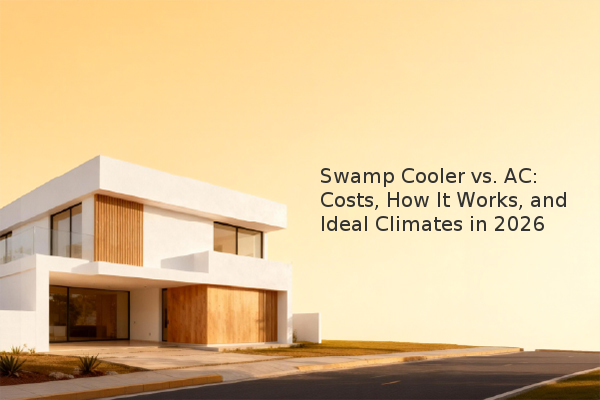
For homeowners in arid climates, a swamp cooler (evaporative cooler) can be a highly efficient and cost-effective alternative to traditional air conditioning, potentially reducing energy consumption by up to 75%. However, its performance is strictly limited to regions with low humidity, typically under 50%, making it unsuitable for much of the eastern and southeastern United States. Based on our experience assessment, the key advantages include significantly lower operating costs and the use of water instead of chemical refrigerants, but drawbacks involve limited cooling capacity in extreme heat and added moisture that can affect a home's interior.
How Does a Swamp Cooler Work? An evaporative cooler, commonly known as a swamp cooler, operates on a simple physical principle: the evaporation of water cools the surrounding air. A motorized fan draws warm, dry air through water-saturated pads. As the water evaporates, it absorbs heat from the air, and the cooler, moistened air is then circulated into the living space. This technology is most effective in dry environments because dry air has a greater capacity to absorb moisture, which enhances the cooling effect. The U.S. Department of Energy notes that in ideal, low-humidity conditions, these units can lower air temperature by up to 40 degrees Fahrenheit. It is not an effective solution for humid climates, as the air is already saturated with moisture, preventing further evaporation.
What Are the Costs and Installation Options for a Swamp Cooler? Swamp coolers are generally less expensive to purchase and install than central air conditioning systems. Portable or window-mounted units can range from $150 to $350. For whole-house cooling, a down-flow system installed on the roof with ductwork is an option. According to industry estimates from 2026, the total cost for a professional installation of a roof-mounted system typically ranges from $1,600 to $3,800, varying by home size and regional labor rates. This compares favorably to central AC systems, which often have installation costs that are double or more. While portable units are plug-in appliances, permanent installations should always be handled by a qualified contractor to ensure proper function and avoid potential water damage.
Swamp Cooler vs. Air Conditioner: Key Differences The primary difference between these systems is their cooling mechanism and environmental impact. A central AC system uses compressors and chemical refrigerants to remove heat from the air, consuming significantly more electricity. An evaporative cooler uses only a fan and a water pump, leading the Department of Energy to estimate it uses about a quarter of the energy of a central AC unit. Furthermore, swamp coolers do not use environmentally harmful refrigerants. In terms of lifespan, a quality swamp cooler can last up to 15 years, while the average air conditioner may need replacement after 5 to 7 years. The critical trade-off is that an AC unit provides powerful, humidity-controlling cooling in any climate, while a swamp cooler is a specialized tool for dry regions.
What Are the Limitations of a Swamp Cooler? The most significant limitation is its dependence on dry air. In humid conditions, the cooler will not function effectively and can make a space feel muggy. Even in dry climates, on extremely hot days when temperatures exceed 100°F, a swamp cooler may only lower the indoor temperature to the 80s or 90s, unlike AC which can achieve a set temperature. The added moisture introduced into the home requires careful management; without adequate ventilation, it can promote mold growth and damage wood furniture or other moisture-sensitive materials. Proper ventilation is essential to allow humid air to escape and prevent these issues. Based on our experience assessment, they are also harder to control precisely compared to a thermostat-driven AC system.
Conclusion Choosing between a swamp cooler and an air conditioner hinges almost entirely on your local climate. For those in the Southwest and other low-humidity regions, a swamp cooler offers substantial savings on energy bills and a more environmentally friendly cooling method. However, homeowners must be prepared for its limitations: it will not cool a home as deeply as AC on the hottest days, and it requires active moisture management. Before investing, verify that your area's typical summer humidity levels are consistently below 50% for this to be a viable primary cooling solution.