Browse

Log in / Register
 Share
Share
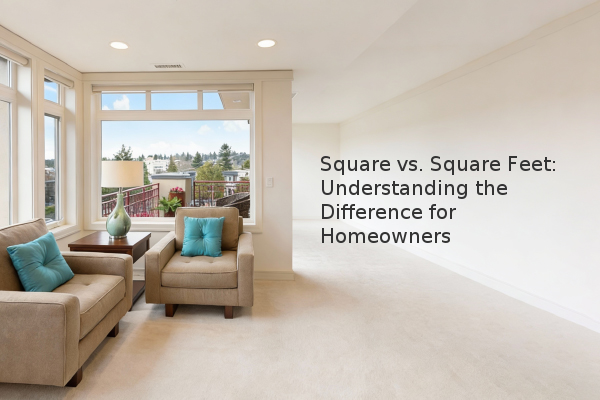
When measuring property, the terms "square" and "square feet" are often used, but they represent different units of measurement. A square foot is a standard unit of area equal to a square measuring one foot on each side. In contrast, a square is a contractor-specific term shorthand for 100 square feet, commonly used in industries like roofing and siding. Understanding this distinction is crucial for accurate project estimation and clear communication with contractors.
A square foot (sq ft) is the fundamental unit of area measurement in US real estate. It is defined as the area of a square with sides that are each one foot long. This measurement is used to calculate the total livable space of a home, known as the Gross Living Area (GLA), which is a primary factor in property valuation. For example, a room that is 10 feet long and 12 feet wide has an area of 120 square feet (10 ft x 12 ft = 120 sq ft). This precise measurement is essential for everything from listing a property to determining property taxes.
When reviewing a property's details, the square footage should reflect the finished, heated, and cooled areas of the home. It typically does not include garages, unfinished basements, or attics. An accurate square footage calculation ensures you are comparing properties on a like-for-like basis and can prevent disputes during a transaction.
In construction terminology, one "square" is a unit equal to 100 square feet. This term is used for efficiency when ordering materials that cover large surface areas. For instance, a roofer might determine that a roof is 20 squares, meaning it has a total area of 2,000 square feet (20 x 100 sq ft). This simplifies communication and material estimation, as many roofing materials like shingles are packaged and sold by the "square" rather than by the individual square foot.
Using this unit helps prevent errors in large-scale project estimates. If a contractor provides a quote based on squares, it is vital to confirm the total square footage to ensure you understand the scale and cost of the project. Misunderstanding this term could lead to a significant miscalculation in the amount of materials required and the final price.
The conversion between these units is straightforward. To convert squares to square feet, you multiply the number of squares by 100.
For example, if a siding contractor says you need 15 squares of material, the calculation is 15 × 100 = 1,500 square feet. Conversely, to convert square feet to squares, you divide the number of square feet by 100.
If your roof measures 2,400 square feet, it is equivalent to 24 squares (2,400 ÷ 100 = 24). The table below provides common conversions for quick reference.
| Squares | Square Feet |
|---|---|
| 1 | 100 |
| 5 | 500 |
| 10 | 1,000 |
| 15 | 1,500 |
| 20 | 2,000 |
| 25 | 2,500 |
Confusing these terms can have real financial consequences. When obtaining quotes for a new roof or siding, a price per "square" will be vastly different from a price per "square foot." A quote of $400 per square for roofing is equivalent to $4.00 per square foot ($400 ÷ 100 sq ft). If you mistakenly interpreted that as $400 per square foot, the cost estimate would be 100 times larger. Always ask for a detailed, written estimate that clarifies the units of measurement being used.
Furthermore, when evaluating a home's listing price, the cost per square foot is a key metric. You calculate this by dividing the listing price by the home's total square footage. This metric allows for a more objective comparison between different properties in a market. For example, a $500,000 home with 2,000 square feet has a price per square foot of $250.
To ensure clarity and accuracy, always verify the unit of measurement in any real estate or construction context. When dealing with contractors, request that estimates specify both the total square footage and the number of squares. For property transactions, rely on the precise square footage from the appraisal report to make informed decisions. Understanding the difference between a square and a square foot empowers you to manage projects and evaluate properties with greater confidence.