Browse

Log in / Register
 Share

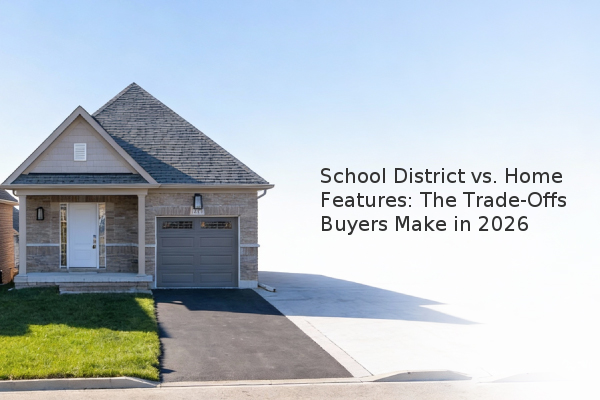
In today's competitive real estate market, a majority of home buyers are prioritizing location in a desirable school district over specific property features. According to recent survey data, 73% of recent buyers considered school districts "important," with 39% deeming them "very important." This trend means many are making significant compromises, most commonly sacrificing garages, large backyards, and updated kitchens to afford a home in their chosen educational zone. For these buyers, a fundamental real estate principle holds true: you can change a house, but you cannot change its location.
The emphasis on school districts is driven by long-term financial and lifestyle planning. With home prices at record highs, buyers, especially younger ones, plan to stay in their homes for longer periods. A home in a well-regarded school district is often viewed as a stable investment. Danielle Hale, a chief economist, notes that "Location can’t be changed, but a property can be remodeled, updated, or adjusted." This perspective leads buyers to prioritize the permanence of a good school district over amenities that can be added later. Furthermore, for families with children, a strong public school system can offset the need for costly private school tuition, making a higher-priced home in a better district a financially sound decision over time.
The data reveals a clear hierarchy of compromises. When buyers focus on school districts, 78% reported having to make compromises on their home purchase. The most common features sacrificed include:
As seen in the case of one New York couple, a garage was considered non-essential "storage" that could be rented or built later, unlike the school district or local property taxes. This sentiment is common among buyers who value the community composition and long-term value of the location above immediate creature comforts.
The importance of school districts varies significantly based on the buyer's life stage. The data shows a sharp divide:
This divergence underscores that school district priority is closely tied to family planning. Older buyers, often empty-nesters, are free to prioritize other amenities, while younger buyers are making strategic sacrifices for their family's future.
The financial commitment is substantial. Real estate professionals report clients trading larger, newer homes for smaller, older ones in premium school districts. In some markets, buyers might pay $500,000 for a smaller, older house in a top public school district instead of $300,000-$400,000 for a modern home on a larger lot in a less prestigious area. This decision is often a calculated choice between paying a premium for a home in a good school zone versus the ongoing expense of private school, with many opting for the former.
For buyers navigating this trade-off, a strategic approach is essential. Start your search by firmly establishing your budget and identifying target school districts. Use online tools and community recommendations to research schools. Be prepared to compromise on interior features with the understanding that cosmetic updates can be made over time. Focus your non-negotiable criteria on aspects that are permanent, such as the neighborhood's character and property tax rates. Ultimately, buying in a respected school district is a long-term investment in both your family's education and your property's value resilience.