Browse

Log in / Register
 Share
Share
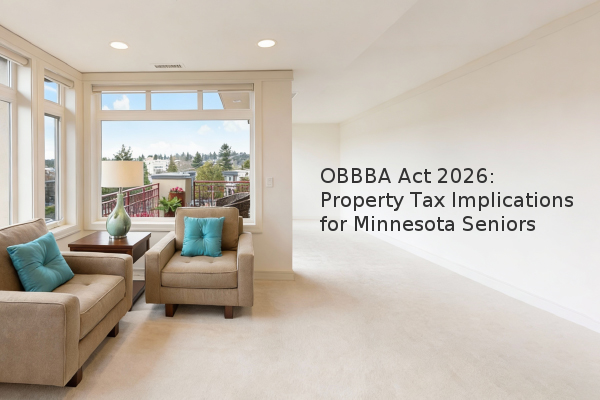
The proposed One Big Beautiful Bill Act (OBBBA) could significantly reduce the property tax burden for seniors in Minnesota in 2026, primarily through a new federal tax deduction that increases disposable income for housing costs. For retirees on fixed incomes, this financial relief may make aging in place more feasible by offsetting rising property tax and insurance premiums. The key takeaway is that the OBBBA's senior deduction does not directly lower your property tax bill but increases your after-tax income, providing more flexibility to cover housing expenses.
The OBBBA itself is a federal tax law and does not alter local Minnesota property tax rates or assessment rules. However, its financial impact is substantial. The act introduces a senior-specific deduction of $6,000 for individuals and $12,000 for married couples filing jointly, both aged 65 or older. When combined with the elevated standard deduction, a single senior could have a total federal deduction of $23,750 in 2026, while a qualifying married couple could see $46,700. This means less of your Social Security income is subject to federal tax, leaving more money available for essential housing costs, including property tax payments. For many, this could be the difference between staying in their current home or being forced to relocate due to financial pressure.
Minnesota offers several state-level programs to help seniors manage property taxes, which operate independently of the OBBBA. Understanding these is critical for comprehensive financial planning. The Homestead Classification for seniors aged 65+ can lower the taxable market value of your primary residence, directly reducing the tax calculation base. Furthermore, the Property Tax Refund (Circuit Breaker) program provides a refund based on your property tax burden relative to your income. Another key program is the Senior Citizen Property Tax Deferral, which allows eligible seniors to postpone a portion of their property taxes, with a lien placed on the property that is repaid when the home is sold or as part of the estate settlement.
| Program | Key Eligibility Criteria | Primary Benefit |
|---|---|---|
| Senior Homestead Classification | Age 65+, owner-occupied primary residence | Reduces the taxable market value of the home |
| Property Tax Refund (Circuit Breaker) | Income-based limits; high tax relative to income | Provides a partial refund of paid property taxes |
| Property Tax Deferral | Age 65+, specific income and equity thresholds | Allows postponement of tax payments with interest |
The potential benefit of the OBBBA is that it works in tandem with Minnesota's existing programs. The increased disposable income from the federal tax savings does not count against the income limits for state refund or deferral programs. This layered approach to tax planning can create a powerful financial cushion. Based on our experience assessment, seniors should first apply for all eligible Minnesota property tax relief programs to get direct reductions or deferrals on their tax bill. Then, the additional cash flow preserved through the OBBBA's federal deduction can be used to cover remaining property taxes, home maintenance, or insurance costs, thereby enhancing overall housing affordability.
To maximize these benefits, a proactive approach is essential. As the 2026 tax year approaches, seniors should consult with a tax professional familiar with both federal and Minnesota state laws. Key actions include verifying your eligibility for the Minnesota homestead classification, gathering necessary income documentation for the Property Tax Refund application, and understanding the long-term implications of a tax deferral. It is also prudent to contact your county assessor’s office for localized information and application deadlines. Proper planning can ensure you leverage every available resource to maintain financial stability and secure your housing situation throughout retirement.
In summary, the OBBBA's federal tax changes provide indirect but meaningful relief for housing costs, while Minnesota's state programs offer direct property tax assistance. A combined strategy is the most effective path to managing your property tax obligations in 2026.