Browse

Log in / Register
 Share

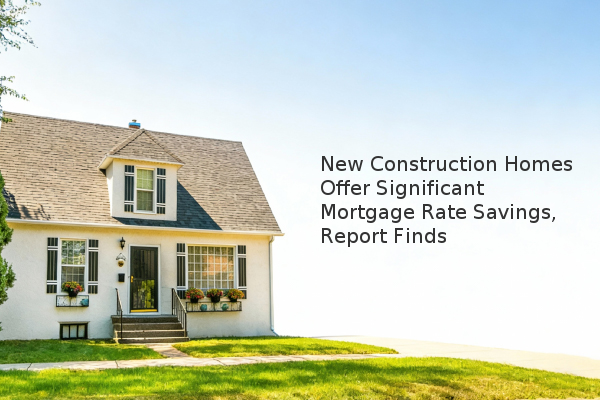
Homebuyers purchasing newly built homes are saving approximately half a percentage point on their mortgage interest rate compared to buyers of existing homes, according to recent economic research. This significant rate reduction, primarily driven by builder incentives like mortgage rate buy-downs, translates to substantial monthly savings and has become a critical factor in improving affordability for cost-conscious buyers in today's market.
In 2023, the average mortgage rate for buyers of new-construction homes was 6.1%, compared to 6.6% for buyers of previously owned homes. This half-point (0.5%) gap represents the largest mortgage rate saving for new-home buyers in at least a decade, tying with the savings seen in 2024. This data, derived from deed analysis, suggests builders are offering more substantial incentives than previously indicated by surveys.
For a typical home loan, this rate difference has a direct impact on monthly payments. On a $400,000 home with a 30-year fixed-rate mortgage and a 20% down payment, a reduction from 6.6% to 6.1% saves the homeowner approximately $105 per month, or about $1,260 annually.
Table: Estimated Monthly Payment Comparison
| Home Price | Down Payment (20%) | Loan Amount | Interest Rate | Monthly Principal & Interest |
|---|---|---|---|---|
| $400,000 | $80,000 | $320,000 | 6.6% | $2,044 |
| $400,000 | $80,000 | $320,000 | 6.1% | $1,939 |
| Monthly Savings | $105 |
The primary reason for lower rates is that homebuilders actively use below-market financing as a powerful marketing incentive to close sales. They achieve this mainly through mortgage rate buy-downs. A buy-down involves paying an up-front fee, known as discount points, to a lender to secure a lower interest rate for the buyer, either temporarily or for the entire loan term.
While any borrower can pay points to buy down their rate, this tactic is particularly prevalent with new construction. Builders often cover the cost of these points as a sales incentive. According to senior economist Joel Berner, "Some builders have in-house financing wings, and others have close relationships with lenders that allow them more flexibility than existing-home sellers have when it comes to using mortgage rates as a marketing tool."
The attractiveness and prevalence of builder buy-downs are closely tied to the overall interest rate environment. During periods of ultralow rates, like from 2020 to 2021, there was virtually no rate advantage for new-home buyers. Few builders offered incentives because mortgages were already highly affordable.
However, with mortgage rates remaining above 6% since late 2022—recently averaging 6.76% for the week ending May 8, 2024—the dynamic has shifted. "What's driving the gap wider is simply that mortgage rates are higher, which makes below-market rates more attractive and more effective in getting new builds sold, so more buy-downs are being offered," Berner explains. In a market where affordability is a significant challenge, even a half-point reduction becomes a powerful purchase incentive.
When considering a new construction home, it is essential to ask the builder or sales agent about available financing incentives. A lower interest rate can significantly impact your long-term housing costs and should be a key factor in your homebuying decision.