Browse

Log in / Register
 Share
Share
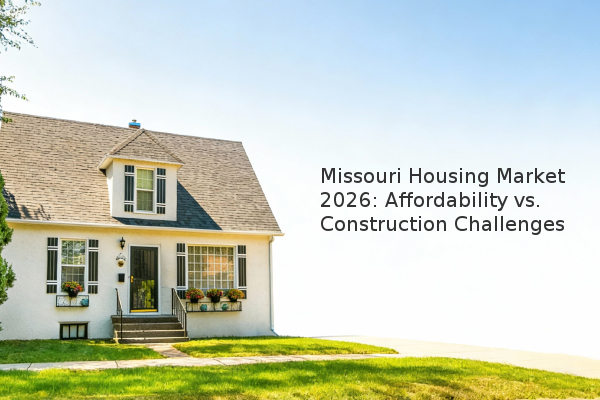
Missouri's housing market in 2026 is defined by a critical tension: it remains relatively affordable for many households, but a significant lag in new home construction threatens that affordability in the long term. Based on our experience assessment, the state's median home price continues to be below the national average, providing opportunities for buyers. However, with construction activity failing to keep pace with population needs, future price pressures are a predictable concern. The key challenge for policymakers and builders is to stimulate the production of new, moderately priced homes to prevent a sharp decline in affordability.
What is the current state of housing affordability in Missouri?
As of 2026, Missouri continues to be one of the more affordable states for homeownership. The median household income supports the ability to purchase a home priced around the state's median listing price. The affordability score—a key metric used by economists to gauge the percentage of homes on the market that are within financial reach of the median-income household—remains favorable compared to many other states. This is largely because price growth has been moderate in many of Missouri's markets outside of the most competitive suburbs. For a typical family, finding a home within their budget is still a feasible goal, though it requires careful financial planning and a realistic understanding of the current inventory.
Why is new home construction a concern for Missouri's future?
The primary concern for Missouri's long-term housing health is the slow pace of new construction. Data indicates that the state's share of national housing permits is significantly lower than its share of the national population. This permit-to-population ratio of less than 1.0 signals that new home building is not matching demographic demands. Furthermore, the homes that are being built often carry a substantial new construction premium. This term refers to the price difference between a newly built home and an existing one. When this premium is high, as it is in Missouri, it indicates that builders are focusing on higher-end properties rather than the entry-level homes that are in shortest supply. Without a consistent pipeline of new, diverse housing stock, the state's aging inventory will struggle to meet the needs of a new generation of buyers.
| Missouri Housing Metrics (Based on Recent Data) | |
|---|---|
| Median Home Listing Price | ~$300,000 |
| Key Affordability Challenge | Limited new construction for entry-level buyers |
| Regional Context | Steadier, slower growth compared to Southern states |
How does Missouri's housing situation compare to neighboring states?
Regionally, the Midwest, including Missouri, exhibits a pattern of steadier but slower growth compared to the South, which leads in new construction volume. While Missouri's affordability is a strength, states with more aggressive building programs are better positioned to manage future demand without significant price spikes. Markets in Missouri's largest metropolitan areas, such as St. Louis and Kansas City, face specific hurdles like rising land and labor costs, which can constrain builder activity. This regional context is important for understanding that Missouri's challenges are part of a broader Midwestern trend, though specific state-level policies can create distinct outcomes.
What can be done to improve housing supply in Missouri?
Addressing the supply gap requires a multi-faceted approach focused on policy and development incentives. A practical roadmap could involve streamlining the approval process for new housing projects and modernizing zoning codes to allow for a greater variety of housing types, such as duplexes and townhomes. Reducing permitting delays can lower costs for builders, making it more feasible to construct moderately priced homes. Additionally, promoting careers in the skilled trades is essential to ensuring a sufficient workforce to meet construction goals. Expanding housing supply is not just about affordability; it also supports local economies by creating jobs and supporting small businesses. By taking a more active role in encouraging workforce housing and infrastructure investment, Missouri can work toward a more balanced and sustainable housing market.
Conclusion
For prospective buyers and current residents, the Missouri housing market in 2026 presents a clear picture. The immediate opportunity lies in the state's persistent affordability. However, the long-term outlook depends heavily on increasing the supply of homes. Key advice for buyers is to act with a clear understanding of their budget and to be prepared for competition in the entry-level segment. For the state, the path forward involves implementing policies that incentivize the construction of a wider range of housing options to ensure the "Show-Me State" can show its residents a future where homeownership remains an achievable goal.