Browse

Log in / Register
 Share

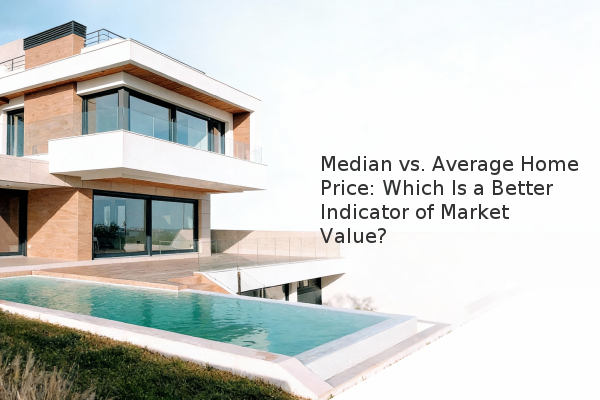
When evaluating a local housing market, relying on the median sale price rather than the average provides a more accurate picture of typical home values by minimizing the distorting effect of extremely high or low-priced sales. Understanding this key difference is critical for making informed decisions, whether you are buying your first home or setting a competitive listing price.
The average sale price is calculated by adding together the final sale prices of all homes sold in a specific area over a defined period and then dividing that sum by the total number of properties sold. For example, if 15 homes sold in a neighborhood last month for a combined total of $7,500,000, the average price would be $500,000 ($7,500,000 ÷ 15).
However, the primary weakness of the average is its susceptibility to outliers. A single, ultra-luxury property sale or a few foreclosure sales can significantly skew the average higher or lower, making it an unreliable measure of what a "typical" home costs.
The median sale price is the middle value in a data set when all sale prices are arranged in order from lowest to highest. This figure represents the point where half of the homes sold for a higher price and half sold for a lower price. Because it identifies the central point of the market, the median is not influenced by extremes at either end. Major institutions like the U.S. Census Bureau use the median price as a primary gauge for national housing trends, as it offers a more stable and representative benchmark over time.
The table below illustrates the impact of outliers on these two metrics in a hypothetical market:
| Home | Sale Price |
|---|---|
| Home 1 | $350,000 |
| Home 2 | $400,000 |
| Home 3 | $425,000 |
| Home 4 | $450,000 |
| Home 5 | $475,000 |
| Home 6 | $500,000 |
| Home 7 | $525,000 |
| Home 8 | $550,000 |
| Home 9 | $575,000 |
| Home 10 | $1,500,000 |
| Average Price | $575,000 |
| Median Price | $487,500 |
In this scenario, the $1.5 million sale (an outlier) pulls the average price up to $575,000, which is higher than nine of the ten homes sold. The median price of $487,500 more accurately reflects the center of the market for the majority of transactions.
For most consumers, the median sale price is the superior figure for understanding the core market conditions in a city or neighborhood. It answers the essential question: what is the typical home selling for? This is invaluable for buyers determining their budget or sellers establishing a realistic listing price based on recent, comparable sales.
That said, the average price still has utility. A significant and consistent gap between the average and median prices can signal a segmented market. For instance, if the average is substantially higher than the median, it indicates a healthy number of high-end sales. Calculating both figures can provide a more nuanced view. If you see a large discrepancy, it's a signal to investigate further. An outlier may have unique features or circumstances that do not apply to your property.
To get the most accurate snapshot of your local market, consider these steps: