Browse

Log in / Register
 Share

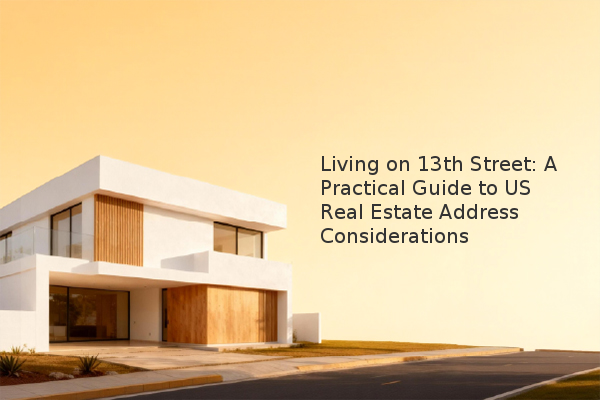
For homebuyers and investors, the question of whether a 13th Street address impacts property value is a common consideration. Based on our experience assessment, a 13th Street address typically has a negligible direct effect on a home's market value or resale potential in most US markets. The fundamental drivers of real estate worth—location, property condition, and local amenities—far outweigh the influence of a street name. This guide provides an objective analysis of the factors to consider when evaluating a property on 13th Street.
The concept of triskaidekaphobia, or fear of the number 13, leads some to believe that homes on a 13th Street could be less desirable. In real estate, this would classify the property as a stigma property, which is a home perceived as less valuable due to a psychological or emotional factor rather than a physical defect. However, the impact of such stigmas is highly localized and often generational. In large, diverse metropolitan areas, this consideration is frequently absent, especially among younger demographics. The primary concern is whether a sufficient number of potential buyers in a specific market would be deterred, which is increasingly uncommon.
The key to making an informed decision is to focus on concrete data rather than perception. Start by analyzing comparable sales, or "comps," which are recently sold properties with similar characteristics in the same area. If homes on 12th Street and 14th Street sell for similar prices, it indicates the street number itself is not a significant market factor. You should also research neighborhood trends, school district ratings, and future development plans. These tangible elements have a proven, direct correlation to property value appreciation over time.
| Research Area | Key Questions to Answer | Where to Find Data |
|---|---|---|
| Market Comps | Do sale prices on 13th St. differ from adjacent streets? | County Assessor Records, MLS Data |
| Neighborhood Demand | How long do homes in this ZIP code stay on the market? | Local real estate market reports |
| Future Development | Are there new infrastructure or commercial projects planned? | City Planning Department Websites |
From a financial standpoint, a 13th Street address might present a unique opportunity. Some investors actively seek out perceived stigmatized properties, anticipating a lower purchase price. If you are not personally superstitious, you could acquire a property at a relative discount, with the understanding that its long-term value will be tied to the area's overall growth. When applying for a mortgage or an appraisal, licensed appraisers are trained to evaluate objective criteria and are unlikely to adjust a valuation downward solely based on a street number, provided the comps support the value.
Ultimately, the decision should center on livability. Visit the street at different times of the day and week. Assess the proximity to your work, public transportation, parks, and shopping. Introduce yourself to potential neighbors and ask about their experience living on the street. The sense of community, noise levels, and overall upkeep of the properties will have a much greater impact on your daily life and long-term satisfaction than the street's name. A well-maintained, friendly block on 13th Street is invariably a better choice than a neglected property on a more "auspiciously" named road.
In summary, while the number 13 carries a stigma for some, its effect on real estate is minimal in modern markets. Your focus should be on comprehensive research, financial due diligence, and personal comfort. The most critical takeaway is that a property's true value is determined by its location's quality, not its alphanumeric designation.