Browse

Log in / Register
 Share
Share
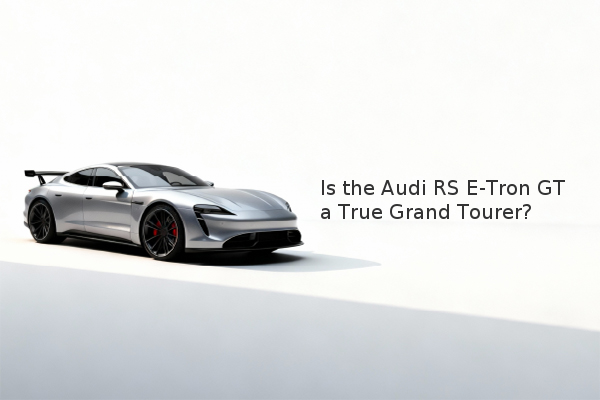
The 2023 Audi RS E-Tron GT successfully blends supercar-like performance with surprising daily driving comfort, making it a compelling electric grand tourer, though its limited driving range is a significant compromise for long-distance travel.
At first glance, the Audi RS E-Tron GT's specifications suggest a hardcore performance machine. With a formidable 590 horsepower (which jumps to 637 hp in boost mode) and a claimed 0-60 mph time of just 3.1 seconds, it firmly sits in supercar territory. As the first all-electric member of Audi's high-performance RS lineup, expectations are high for a track-focused beast. However, after a thorough assessment, the RS E-Tron GT reveals itself as something more nuanced: a luxurious and comfortable grand tourer that excels at high-speed, refined travel, with one major caveat.
The secret to the RS E-Tron GT's grand touring character lies in its expertly tuned standard air suspension, which delivers a remarkably comfortable and forgiving ride even on large 21-inch wheels.
Audi's RS models are typically known for stiff, race-inspired suspensions that prioritize cornering agility over comfort. The RS E-Tron GT shatters this expectation. In the Drive Select system's Comfort mode, the ride is exceptionally plush, soaking up road imperfections with ease. Switching to Dynamic mode firms things up noticeably but remains far more tolerable than most performance vehicles. This is a significant achievement, especially considering our test car was equipped with low-profile tires on 21-inch wheels—a combination that often leads to a harsh ride. Based on our assessment experience, this is the most relaxed and comfortable RS model available, a direct result of the sophisticated suspension tuning that prioritizes long-distance comfort without entirely sacrificing dynamic capability.
The cabin is finished with premium materials expected in a car surpassing $145,000, offering good space for front passengers, but rear-seat comfort and cargo capacity are compromised by the sleek, low-slung design.
Step inside, and the RS E-Tron GT meets Audi's renowned standards for interior quality. Available full-leather upholstery and meticulous fit-and-finish create a genuinely luxurious environment. Despite its coupe-like silhouette, interior space is better than expected. A tall adult (around 6-foot-1) will find ample headroom in the front seats. The rear seat is passable for short journeys, though taller passengers will find their knees elevated and headroom tight.
The primary practical shortcomings are visibility and cargo space. The sloping roofline impedes over-shoulder visibility for the driver. Furthermore, trunk space is limited. The rear trunk offers just 9.2 cubic feet, and a front trunk (or "frunk") adds another 1.8 cubic feet, for a combined 11 cubic feet. This is less than the trunk space in Audi's own compact A4 sedan. Some may also find the center console controls, while user-friendly, a bit basic for a six-figure luxury car.
The powertrain and chassis provide effortless power and stable cruising at highway speeds, though the car's significant weight is felt during aggressive cornering.
On the road, the dual-motor all-wheel-drive system provides immense, instant power reserves, making highway merging and passing maneuvers effortless despite the car's curb weight of over 5,100 pounds. The steering is light and natural, contributing to a relaxed driving feel. The optional carbon-ceramic brakes offer excellent pedal feel and stopping power.
However, when pushed hard on a twisting road, you are always aware of the car's substantial mass. Cornering stability is good, but it doesn't feel as agile as lighter sports cars. Notably, the RS E-Tron GT does not offer a true one-pedal driving mode, a feature common in many EVs that allows for slowing down significantly by simply lifting off the accelerator. Instead, steering-wheel paddles allow the driver to adjust the level of regenerative braking, which is a less intuitive system.
The Achilles' heel for long-distance travel is its EPA-estimated 232-mile range, which falls short of key rivals, though its ultra-fast 270-kW charging capability helps mitigate this drawback.
A traditional grand tourer must be capable of covering long distances with minimal stops. This is where the RS E-Tron GT faces its biggest challenge. Its EPA-estimated range of 232 miles is substantially less than competitors like the Tesla Model S (405 miles) and Lucid Air (up to 516 miles).
The counterbalance to this is an exceptionally fast maximum DC fast-charging rate of 270 kilowatts. Audi claims that at a compatible 350-kW charger, the RS E-Tron GT can add approximately 180 miles of range in just 22 minutes. In real-world use, achieving and sustaining peak charging rates can be inconsistent, but this capability makes road trips more feasible than the range figure alone suggests. As the network of ultra-fast chargers expands, this weakness will become less pronounced.
In summary, the Audi RS E-Tron GT is a compelling and unique proposition. It delivers on the core grand touring tenets of luxury, comfort, and crushing high-speed performance. For buyers whose long-distance journeys are well-served by the growing DC fast-charging infrastructure, it is a brilliant and deeply satisfying EV. However, those who regularly undertake trips beyond 200 miles without reliable charging may find its limited range a dealbreaker.