Browse

Log in / Register
 Share
Share
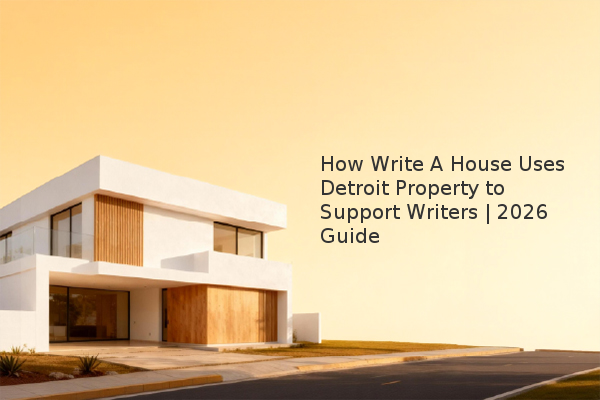
The Write A House program offers a unique path to homeownership for writers by renovating abandoned Detroit properties and awarding them to selected authors. This initiative directly addresses neighborhood stabilization by placing long-term residents in revitalized homes. The program requires winners to live in the home for two years, paying only property taxes and insurance (approximately $6,000 annually), before receiving the deed. This model demonstrates a creative approach to urban revitalization that leverages local real estate opportunities to foster community arts.
Write A House is a nonprofit organization that supports Detroit's literary community by providing stable housing. Founded in 2012, the program acquires foreclosed properties—homes reclaimed by a lender due to the previous owner's failure to meet mortgage obligations—at low cost. Through extensive renovations, these abandoned houses are transformed into habitable homes. The core mission is twofold: to give writers the financial stability of homeownership and to contribute to the architectural and social revitalization of Detroit neighborhoods. Based on our experience assessment, this approach focuses on long-term community investment rather than short-term gains.
The selection process is competitive and designed to identify writers who will actively contribute to the local literary scene. Applicants must submit a portfolio of published work, a writing sample, and a personal statement outlining their plans to engage with Detroit's community. A panel of esteemed judges, including recognized poets and authors, reviews the applications. Finalists are interviewed by the founders. Crucially, applicants must qualify as low- or moderate-income earners by local standards, which for an individual was an annual income of $39,750. This ensures the program reaches its target demographic of artists who would otherwise struggle to afford a home.
The selected writer is required to live in the home for a minimum of two years. During this period, they are responsible for the annual property tax and insurance costs, which for the first home amounted to around $6,000 per year. This financial arrangement provides significant housing security compared to standard mortgage or rental payments. After the two-year residency, the writer receives the deed, the legal document that transfers ownership of the property, free and clear. If the winner decides to sell the home later, Write A House holds the first right of purchase at fair market price, a clause that helps the organization maintain control over the property's future and its community impact.
The program’s impact extends beyond the individual writer. By placing a committed resident in a previously abandoned house, Write A House contributes to neighborhood stabilization. The presence of a homeowner often leads to improved property maintenance and increased community engagement. For example, the first winner, poet Casey Rocheteau, established a free neighborhood library and became a writer-in-residence at local schools. This model of using affordable real estate as a tool for community building offers a replicable framework for other cities facing similar challenges with vacant properties. The goal is to make neighborhoods "more full" with engaged, long-term residents.
In conclusion, the Write A House program represents an innovative fusion of real estate development and arts patronage. It provides a tangible solution for writers seeking affordability and stability, while simultaneously activating vacant properties in Detroit. For communities exploring similar revitalization strategies, the key takeaways are the focus on long-term residency requirements and the selection process that prioritizes genuine community involvement. This model demonstrates that strategic investment in local real estate can yield significant cultural and social returns.