Browse

Log in / Register
 Share
Share
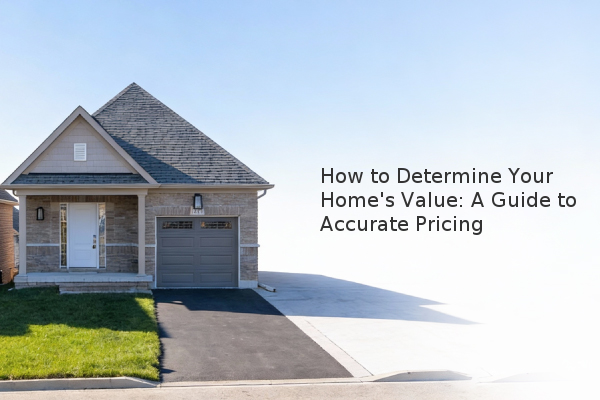
Understanding your home's accurate market value is the critical first step to a successful sale or simply assessing your investment's growth. While online estimators offer a quick starting point, a Comparative Market Analysis (CMA) conducted by a real estate agent provides the most precise valuation. This guide outlines the professional methods to determine your home's worth and how to set a competitive listing price that attracts serious buyers.
A practical first step is to use an online home value estimator. By entering your address, these automated valuation models (AVMs) generate an estimate within seconds based on data like your home's square footage and recent sales of similar properties in the area. These tools are free and easily accessible, offering a helpful ballpark figure.
However, it is important to understand their limitations. AVMs rely on public data and may not account for unique property features, recent upgrades, or the specific condition of your home. They are a useful starting point but should not be the sole basis for your pricing strategy. For a more accurate estimate, the expertise of a local real estate agent is invaluable.
A Comparative Market Analysis (CMA) is a detailed report prepared by a real estate agent to determine a home's likely selling price. This is the industry standard for accurate valuation. The agent accesses the Multiple Listing Service (MLS), a comprehensive database of property listings and sales, to find recently sold homes, or "comps" (comparables), that are similar to yours.
The most accurate comps are properties that:
Your agent will average the sale prices of these comps to establish a baseline value for your home. As industry expert Chris Dossman notes, "You should always look at the sale prices of other listings in your community." If your neighbor’s similar home sold for $400,000, listing yours at $500,000 requires a clear justification for the difference, such as significant renovations.
Setting the right price involves more than just the final number. Several common pitfalls can deter buyers:
Ignoring Search Filters: Many buyers search online in round increments, such as $475,000 to $500,000. If your home's fair market value is $503,000, listing it at that price could exclude it from these common search brackets. Listing at $500,000 might generate more traffic and potentially lead to a bidding war.
Using "Psychological" Pricing: Unlike retail, odd pricing like $999,000 is often confusing in real estate. Based on our experience assessment, it lacks justification and can seem gimmicky to buyers seeking a serious transaction.
Letting Emotions Dictate Price: Personal attachment can lead to overpricing. It's difficult to separate memories from market value, but renovations, on average, only yield a 64% return on investment. Overpricing risks the home staying on the market too long, which can lead buyers to assume there is something wrong with the property.
Underpricing to Spark Bidding Wars: While sometimes effective in a hot seller's market, intentionally listing below market value can backfire. Buyers may assume the home is worth only the list price, potentially limiting final offers.
Comparison of Home Valuation Methods
| Method | Pros | Cons | Best For |
|---|---|---|---|
| Online Estimator | Free, instant, readily available | Less accurate; can't assess condition | Getting a preliminary, ballpark figure |
| Comparative Market Analysis (CMA) | Highly accurate; considers local market nuances | Requires contacting a real estate agent | Sellers preparing to list their home |
Accurately determining your home's value requires a blend of technology and professional expertise. Your best strategy is to know your home's true market value and list it close to that figure. Start with an online estimate for a general idea, but always follow up with a local real estate agent for a comprehensive CMA. This approach helps you cut through the haze, avoid common mistakes, and set a price that attracts serious buyers while maximizing your return.