Browse

Log in / Register
 Share
Share
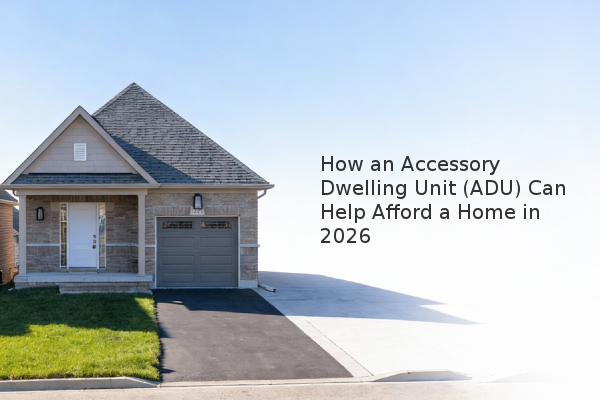
For many aspiring homeowners, building an Accessory Dwelling Unit (ADU), a secondary housing unit on a single-family lot, has become a viable strategy to achieve homeownership in high-cost markets. By generating rental income from the primary residence or the ADU itself, buyers can offset a significant portion of their mortgage, making ownership possible where it once seemed out of reach. This approach leverages existing property space to create more affordable housing options.
An Accessory Dwelling Unit (ADU) is a self-contained residential unit located on the same lot as a primary single-family home. Often referred to as a granny flat or in-law unit, an ADU typically includes its own entrance, kitchen, bathroom, and living space. It can be a detached structure, a converted garage, a basement apartment, or an addition to the main house. The key characteristic is its independence from the primary residence, allowing for separate occupancy. This flexibility makes ADUs a powerful tool for addressing housing shortages.
The primary financial benefit of an ADU is the potential for rental income. In expensive regions, the revenue from renting out either the main house or the ADU can cover a substantial part of the monthly mortgage payment. For example, based on our experience assessment, a well-located ADU in a competitive rental market could generate enough income to cover 50% or more of a homeowner's principal and interest payment. Furthermore, recent lending reforms in states like California now allow lenders to consider projected rental income from an ADU when qualifying a borrower for a mortgage, easing the path to loan approval for first-time buyers.
Over the past few years, many states and municipalities have streamlined regulations to encourage ADU construction. Key changes include:
These regulatory shifts have led to a significant increase in ADU construction, adding gentle density to neighborhoods without drastically changing their character.
The return on investment for an ADU depends on local construction costs and rental rates. However, the long-term financial benefits are compelling. Homeowners can use the rental income to build equity faster, create a mortgage helper, or provide housing for family members, thereby avoiding other expenses. It's a strategy to maximize the utility of a property asset.
| Consideration | Financial Impact |
|---|---|
| Average Construction Cost | Varies widely by region and type (e.g., prefab vs. custom) but can range from $100,000 to $300,000. |
| Potential Rental Income | Can range from $1,500 to $3,000+ per month, depending on unit size and local market rates. |
| Impact on Property Value | A permitted ADU typically increases the overall market value of the property. |
Building an ADU is a significant project that requires careful planning. The most critical step is to research local zoning laws and building codes, as regulations differ by city and county. Next, establish a realistic budget that includes not only construction but also permits, utility connections, and potential landscaping. It is also essential to decide how you will use the unit—for rental income, family, or personal use—as this will influence the design and financing. Consulting with a local contractor experienced in ADU projects is highly recommended to navigate the process smoothly.
Building an ADU represents a strategic use of property to create affordable housing solutions. While not a one-size-fits-all answer to the housing crisis, it provides a practical avenue for many households to achieve financial stability through homeownership. By understanding the costs, regulations, and income potential, homeowners can make an informed decision about whether this innovative approach is right for them.