Browse

Log in / Register
 Share

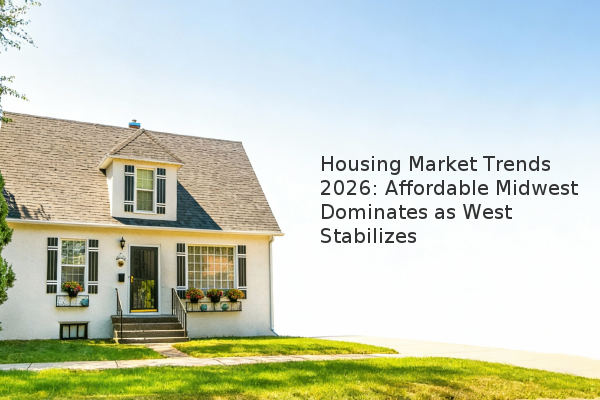
The US housing market in 2026 continues to be defined by affordability, with affordable Midwestern markets dominating buyer activity while key Western markets show signs of stabilization and potential recovery. Fort Wayne, Indiana, retains its position as the nation's hottest market, a title it has held for three consecutive months, according to the latest market analysis. The data indicates that the most expensive metropolitan areas are experiencing a slowdown, but the rate of this deceleration is less severe than earlier in the year. This suggests a gradual rebalancing, with buyer demand persisting strongly in regions where median listing prices remain below the national average.
The hottest markets, characterized by high demand relative to supply, are receiving 1.4 to 2.1 times more views per listing than the national average. Homes in these top 20 markets are selling 16 to 33 days faster than the typical US property. A key driver is affordability; 13 of the top 20 markets have a median listing price (the middle point of all active listing prices) below the national figure, with the top five markets averaging 32% less.
For the third month running, Fort Wayne, IN, leads the list. New entrants for this period include Topeka, KS, and Sioux City, IA, alongside the returning markets of Sacramento and San Francisco, CA. The reappearance of major Californian markets is a significant indicator of shifting conditions. The top 20 list features markets from 11 states, with Ohio and California each claiming four spots, underscoring a diverse yet concentrated heat map. This month's data highlights that while the Midwest remains the epicenter of activity, with nine markets on the list, the West is showing resilience with seven representatives.
The Midwest's dominance is primarily linked to a favorable balance of housing supply and buyer demand, driven by affordability. Based on our experience assessment, markets in this region offer a lower cost of entry, which is a primary consideration for buyers in 2026. Furthermore, the inventory of homes for sale in the Midwest has declined by 4.2% over the past year, creating a more competitive environment. When the number of available homes decreases while demand holds steady or increases, properties tend to sell faster, contributing to a market's "hotness." This contrasts with the national trend, where some regions are experiencing inventory growth.
Data from late 2025 into 2026 suggests that Western markets are stabilizing. While inventory is still growing in the West overall, the growth rate has slowed significantly, from 7.0% to 4.9% year-over-year. More importantly, several major Western metros have begun to see inventory decline. For instance, San Francisco's inventory remained stable compared to the previous year, while Seattle's declined by 2%. Other large California markets like Riverside, San Jose, Sacramento, and San Diego saw inventory drops between 5% and 13%. If demand, potentially fueled by economic factors, continues into the season, it is predictable that Western markets could see inventory declines and greater representation on the hottest markets list in the coming months.
The decline in the rankings of the country's 40 largest metropolitan areas has decelerated. On average, these large markets have fallen 15 spots since the previous year, an improvement from drops of 17 spots and 22 spots in the preceding two months. Western large metros showed the most considerable improvement, falling an average of only 14 spots over the past year compared to 27 spots the previous month. The most-improved major markets include Charlotte, NC (+42 spots), Cincinnati, OH (+37 spots), and Pittsburgh, PA (+26 spots). These improving markets are seeing homes sell three days faster than last year, while the largest 40 markets overall are seeing properties sit for three days longer.
In summary, the 2026 housing market presents a clear picture: affordability remains the key driver of demand. For buyers, this means the most competitive conditions are found in reasonably priced Midwestern cities. However, the stabilization in the West indicates potential opportunities for those looking in markets that have recently corrected. Sellers in the hottest markets can expect faster sales, but should price their homes competitively based on local comparables. For all parties, focusing on markets with balanced or shrinking inventory provides a more predictable outlook for the remainder of the year.