Browse

Log in / Register
 Share
Share
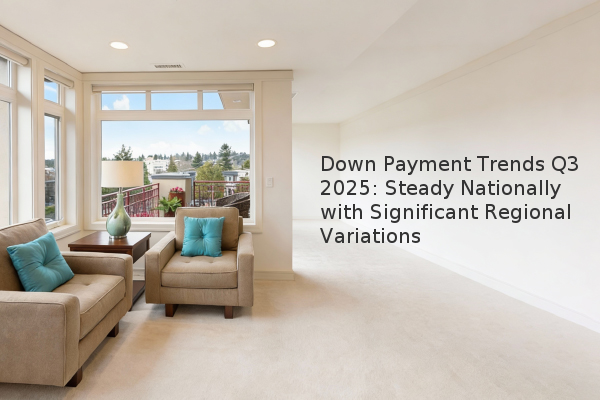
The typical U.S. homebuyer made a 14.4% down payment in Q3 2025, averaging $30,400, showing minimal change from the previous year. This stability is attributed to a softer housing market, though significant regional disparities exist. The Northeast had the highest down payment percentage (18.2%), while the South was the most affordable (12.0%). Affluent buyers purchasing high-end homes are keeping the national median elevated, even as down payments for investment properties and second homes have declined to three-year lows.
What was the average down payment in Q3 2025?
According to the latest quarterly data, the median down payment for U.S. homebuyers from July to September 2025 was 14.4% of the purchase price, or approximately $30,400. This figure is nearly unchanged from the same period in 2024, indicating a period of remarkable stability. A senior economic research analyst notes that the typical seasonal increase in down payments was more modest in 2025, rising only half a percentage point between the first and third quarters. This contrasts with a 0.8 percentage point increase recorded during the same period in 2024. The primary reason for this easing is a softer, steadier housing market where persistent affordability challenges are keeping many potential buyers on the sidelines.
How do down payments vary by U.S. region?
Down payment requirements are not uniform and reflect starkly different local market conditions. The data reveals a clear affordability divide across the country:
Why are down payments for primary residences remaining steady?
Despite a cooling market, the median down payment has not fallen significantly due to a shift in the types of homes being sold. Since the start of 2025, sales of homes priced above $750,000 have surged by 5.8% from a year ago, while sales below that price point fell by 3%. "This shift has pushed both the median sale price and the median down payment higher," according to the analyst. Buyers in these higher price tiers not only put down more money in absolute terms but also tend to contribute a greater percentage of the purchase price. This activity offsets the cooling effect in more affordable market segments.
What is the trend for investment properties and second homes?
Although down payments for non-primary residences remain substantially higher, both categories saw significant declines in Q3 2025. The average down payment fell to 26.7% for investment properties and 26.9% for second homes—representing the lowest levels in three years. In dollar terms, the medians were $84,200 for investment properties and $110,100 for second homes, which is more than 2.5 times higher than the median for primary residences. This suggests that investors and second-home buyers are facing less competitive pressure or are more sensitive to current market conditions.
How does a buyer's credit score influence the process?
A FICO credit score is a critical number used by lenders to assess a borrower's creditworthiness. Ranging from 300 to 850, a higher score indicates lower risk. In Q3 2025, the typical homebuyer had a FICO score of 735, which has held steady for five consecutive quarters and remains near its highest level in over a decade. This trend reflects a housing market composed of more financially qualified buyers, as elevated home prices and mortgage rates have raised the bar for affordability.
Key takeaways for buyers: