Browse

Log in / Register
 Share
Share
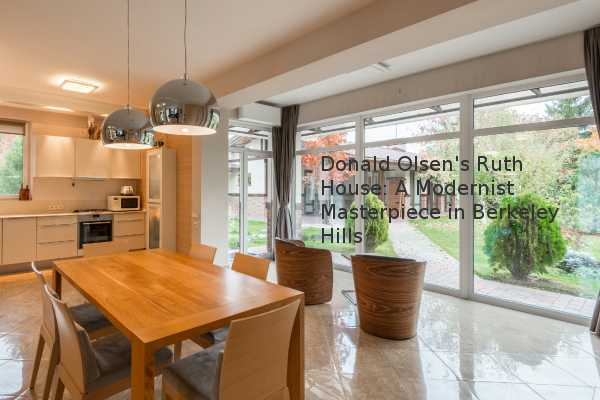
For architecture enthusiasts and buyers seeking a historically significant modern home, the Ruth House in Berkeley, CA, represents a rare opportunity. Designed by renowned architect Donald Olsen, this 1967 Bauhaus-inspired residence is a protected piece of architectural history priced at $2,235,000. Its seamless integration with a forested 16,000-square-foot lot and near-original condition make it a unique find in the competitive Bay Area real estate market.
What Makes the Ruth House an Architecturally Significant Property?
The Ruth House is considered a prime example of Mid-Century Modernism, a style emphasizing simplicity, integration with nature, and functional design. The home was designed by Donald Olsen, an architect who studied under Walter Gropius, the founder of the German Bauhaus school. This educational lineage is critical; the Bauhaus philosophy prioritized the unity of art, craft, and technology, which Olsen translated into the California context. The home's significance is further cemented by the fact that Olsen's own residence in Berkeley is a National Park Service landmark, placing the Ruth House within an important local architectural legacy. Its decades-long ownership by a single family has preserved its original design integrity, a key factor for preservation-minded buyers.
How Does the Design of the Home Integrate with Its Natural Setting?
The property's layout was meticulously planned around the existing landscape. The term "setback"—referring to the required distance between a structure and the property line—was leveraged by Olsen to preserve the mature live oak trees. The house comprises two rectangular "pavilions" connected by a central entry, a design choice that minimizes its footprint and allows the natural environment to envelop the structure. Walls of seamless glass provide uninterrupted views of the surrounding forest, effectively bringing the outdoors in. A steel bridge over a creek serves as the approach, emphasizing the journey into a private, natural sanctuary. This thoughtful siting on a 16,000-square-foot lot is a masterclass in maximizing privacy and harmony with the environment.
What Are the Key Interior and Exterior Features of the Residence?
Spanning approximately 3,500 square feet, the home is both spacious and intelligently organized. One pavilion features a dramatic 15-foot-high ceiling encompassing the living room, dining area, and kitchen. A key innovative feature is the seamless glass wall that encloses the kitchen, effectively containing cooking odors—a detail that highlights the home's focus on experiential living. The other pavilion contains four bedrooms, three bathrooms, a laundry room, a playroom, and a garage. The interior is a "poem in white and gray," characterized by its stucco and glass exterior. Outdoor living is facilitated by a patio that functions as an alfresco dining area, with stone paths weaving through the oak grove. A notable postmodern-style guest bathroom, added later by Olsen and humorously known as "Herman’s Folly," provides a striking contrast to the consistent modernist aesthetic.
Why is the Ruth House a Compelling Real Estate Opportunity in 2026?
In the current real estate market, properties with architectural provenance and unique histories offer more than just shelter; they are tangible assets. The Ruth House is not just a home but a piece of preserved history, which can be a strong value driver. Its "as-is" condition is a benefit, as it has not been altered by renovations that could compromise its original design. For a buyer, this means acquiring an authentic landmark. The home's privacy and timeless aesthetic, which many mistake for a 21st-century construction, ensure its appeal remains strong. The asking price of $2.235 million reflects the premium for a turnkey, historically significant property in a prime Berkeley location.
Purchasing a architecturally significant home like the Ruth House requires a focus on preservation and long-term value. Prospective buyers should prioritize specialized inspections to assess the condition of original materials and systems. Understanding any local historical preservation ordinances is also crucial, as they may affect future alterations. Ultimately, this property is ideal for someone who values architectural integrity and a profound connection to a curated natural environment. Its sale is not just a transaction but the passing of a legacy to the next custodian of this Donald Olsen masterpiece.