Browse

Log in / Register
 Share
Share
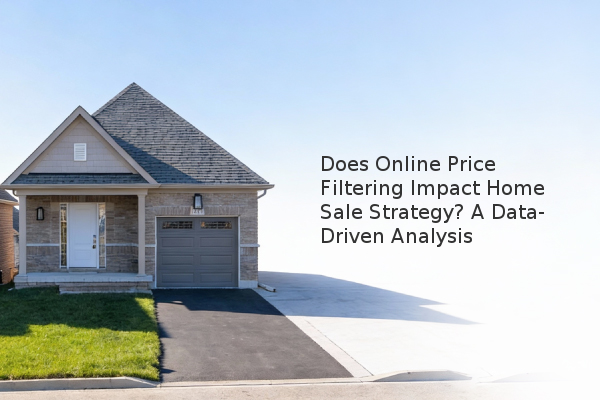
For homeowners pricing a property, a key question is whether to adjust the list price to align with the common search filters on real estate websites. Based on an analysis of user search data, the impact is generally minor and should only be a consideration when a property is priced extremely close to a major filter threshold, such as $550,000. The potential gain in buyer exposure for most neighborhoods is a maximum of 6.5%, making it a secondary factor compared to fundamental pricing strategy.
Most major real estate search portals allow buyers to filter listings by price. These filters typically use set increments. At lower price points, filters often jump in $25,000 increments (e.g., $300,000-$325,000, $325,000-$350,000). For higher-priced homes, the increments usually widen to $50,000 (e.g., $500,000-$550,000, $550,000-$600,000). The core question for sellers is whether a home priced at $549,999 appears in more searches than one priced at $550,001. The $549,999 price would be included in searches filtered up to $550,000, while the $550,001 price would only appear in the next bracket, starting at $550,000.
A study of website logs from a major real estate platform provides concrete insights. The analysis revealed two critical points:
The following table, derived from the study, illustrates the price points with the most significant drop in search exposure in specific Seattle neighborhoods:
| Neighborhood | Price Point of Largest Exposure Drop | Approximate Drop in Search Activity |
|---|---|---|
| Bridle Trails | $550,000 | Significant |
| Capitol Hill | Varies by inventory cluster | Moderate |
| Queen Anne | Specific threshold points | Varies |
The data suggests that adjusting a price for search filter visibility is not a primary strategy. It should only be a factor in a very specific scenario. For example:
The decision should always be based on a comparative market analysis (CMA) conducted with a real estate professional. A CMA evaluates recent sales of similar properties (comps) to determine a competitive and accurate market value.
The most effective pricing strategy is grounded in local market data, not search engine mechanics. While online visibility is important, it should not override fundamental pricing principles.
Key takeaways for sellers:
Ultimately, setting the right market value is far more important than optimizing for search filters. Focus on accurate pricing based on comps and condition, and consider filter alignment only as a final, minor tweak in very specific circumstances.