Browse

Log in / Register
 Share
Share
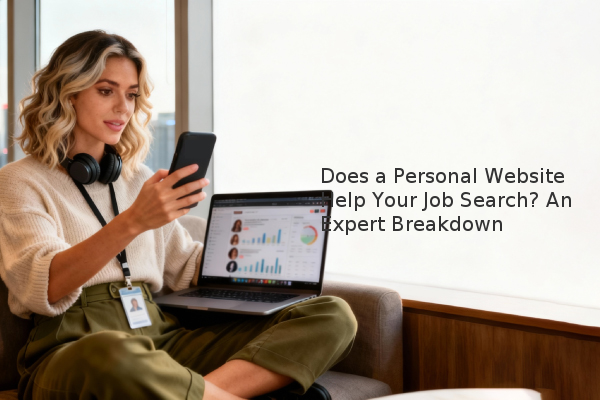
A personal website can be a powerful differentiator in a competitive job market, particularly for professionals in creative or technical fields. It provides a controlled platform to showcase your portfolio, articulate your professional narrative, and demonstrate technological proficiency directly to hiring managers. While not essential for every role, its strategic use can significantly enhance your candidacy by appealing to cultural fit and providing a more comprehensive view of your skills than a traditional resume alone.
The return on investment for a personal website varies by profession. Its impact is most pronounced for roles where visual or tangible proof of work is critical to the hiring decision. Based on our assessment experience, the following professionals typically gain the greatest advantage:
For these individuals, a personal website acts as a dynamic, interactive portfolio. It moves beyond the static PDF of a resume to provide verifiable evidence of expertise and achievement.
A personal website is not a replacement for a resume but a complementary tool. Its strategic use throughout the candidate screening process is key.
Utilizing a personal website also demonstrates to employers that you are comfortable with current technologies, a soft skill increasingly valued across industries.
To be effective, your website must be concise and purposeful. Avoid overcrowding it with information. The core pages should include:
The goal is to provide a seamless user experience that answers a recruiter's key questions quickly.
When building your site, focus on clarity and professionalism over complex design. The principles of a good user experience (UX) are paramount.
Creating a professional-looking website is more accessible than ever, thanks to user-friendly platforms. You will need to purchase a custom domain name (e.g., yourname.com) through a registrar.
| Platform | Best For | Key Feature |
|---|---|---|
| Squarespace | Beginners, non-designers | Pre-designed, aesthetically-focused templates; all-in-one hosting. |
| WordPress | Users wanting full flexibility | Vast library of themes and plugins; requires more technical setup. |
| Wix | Drag-and-drop simplicity | Intuitive editor with extensive design freedom. |
The most critical step is to choose a platform and start building. The best website is a live one that accurately represents your professional capabilities.
In summary, a personal website is a strategic asset for many job seekers. To maximize its impact: focus on a clean, easy-to-navigate design, populate it with your strongest work samples and a clear resume, and integrate its URL across all your professional profiles. This approach provides a significant advantage by offering a holistic view of your qualifications.