Browse

Log in / Register
 Share

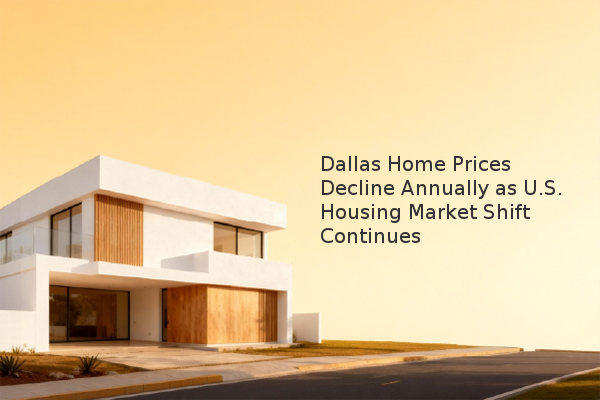
The U.S. housing market is undergoing a significant transition, with home prices in Dallas, Texas, falling on an annual basis according to the latest data. This shift signals a more buyer-friendly environment nationally, marked by slowing price growth and diverging regional trends. Core market indicators now show that affordability constraints and local economic fundamentals are driving performance, replacing the broad-based speculation that characterized the pandemic-era boom.
The most recent S&P CoreLogic Case-Shiller Index, a key measure of U.S. home values that tracks repeat sales of the same properties over time, revealed a 0.21% year-over-year price decline for single-family homes in the Dallas metro area in April. This places Dallas alongside Tampa, Florida, as the only two major metros among the 20 tracked by the index to experience negative annual price growth. Nationally, the picture is one of deceleration; home values rose 2.7% in April, the smallest annual gain since August 2023 and down from the 3.4% increase recorded in March. Nicholas Godec of S&P Dow Jones Indices notes this represents "a maturing market that's increasingly driven by fundamentals rather than speculative fervor."
The current cycle has dramatically reshuffled regional performance. Markets that were pandemic darlings, like many in Texas and Florida, are now lagging. In contrast, historically steady performers in the Northeast and Midwest are leading the nation. In April, New York reported the highest annual gain at 7.9%, followed by Chicago (6.0%) and Detroit (5.5%). According to ok.com® Senior Economist Anthony Smith, this divergence is directly linked to inventory: "Price growth is expected to remain strongest in the Northeast and Midwest where inventory is tightest and demand still exceeds supply." In overheated markets, prices have now surpassed what local wages can reasonably support, leading to a necessary correction.
Elevated financing costs continue to be a major factor. With mortgage rates hovering above 6.6% since the start of the year, many potential sellers are opting to stay in their homes to keep pandemic-era rates that were below 4%. This "lock-in effect" is constraining supply, keeping April's inventory of existing homes for sale 16% below typical pre-pandemic levels (2017-2019). While new construction is attempting to fill the gap, a significant supply shortfall remains. Based on our experience assessment, this persistent imbalance between supply and demand is creating a price floor, preventing more severe market corrections despite slowing sales activity.
For prospective buyers and sellers, this environment demands a hyper-local focus. Regional dynamics now outweigh national trends. Buyers in cooling markets may find more negotiating power, while sellers must price homes competitively based on recent comparable sales. In all markets, understanding local inventory levels and affordability metrics is crucial for making informed decisions.