Browse

Log in / Register
 Share
Share
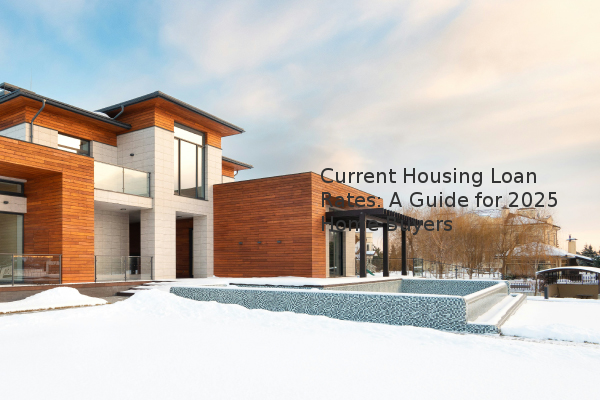
Understanding current housing loan rates is the first step to making an informed home purchase in 2025. As of early 2025, the average rate for a 30-year fixed-rate mortgage hovers in a specific range, influenced by broader economic factors. Securing a competitive rate can save you tens of thousands of dollars over the life of your loan. This guide will break down the types of rates available, the key factors that cause them to fluctuate, and practical strategies to improve your chances of locking in a favorable rate.
It's crucial to recognize that there is no single "current" rate. The rate you are offered is highly personalized, based on your financial profile. However, tracking national averages provides a useful benchmark. Rates are typically quoted for a conforming loan, which is a mortgage that meets the funding criteria of government-sponsored enterprises like Fannie Mae and Freddie Mac. For context, as of early 2025, averages for a primary residence with a 20% down payment are generally observed within a certain band. It is essential to get personalized quotes from multiple lenders, as even a difference of 0.25% can have a significant long-term impact.
| Loan Type | Average Rate Range (Early 2025) | Typical Term |
|---|---|---|
| 30-Year Fixed-Rate | [e.g., 6.00% - 6.75%] | 30 years |
| 15-Year Fixed-Rate | [e.g., 5.50% - 6.25%] | 15 years |
| 5/1 Adjustable-Rate (ARM) | [e.g., 5.75% - 6.50%] | Fixed for 5 years, then adjusts annually |
The movement of housing loan rates is tied to a complex interplay of national and personal factors. On a macroeconomic level, the Federal Reserve's monetary policy is a primary driver. While the Fed does not set mortgage rates directly, its decisions on the federal funds rate influence the cost of lending for financial institutions. Additionally, the yield on the 10-year U.S. Treasury bond is a key indicator that lenders watch closely, as mortgages are often packaged into securities and sold to investors.
On a personal level, your credit score is paramount. Borrowers with higher FICO scores are seen as less risky and are therefore offered lower rates. Your debt-to-income ratio (DTI), which is your total monthly debt payments divided by your gross monthly income, also plays a critical role. Lenders use DTI to assess your ability to manage monthly payments. Furthermore, the loan-to-value ratio (LTV), determined by your down payment size, affects your rate; a larger down payment typically results in a lower rate.
Securing a favorable rate requires preparation and strategy. Your first action should be to check and improve your credit score. Obtain copies of your credit reports, dispute any errors, and pay down existing credit card balances to lower your credit utilization ratio. Next, save for a larger down payment. Putting down 20% or more not only helps you avoid paying for private mortgage insurance (PMI)—an additional fee that protects the lender—but also often qualifies you for a better interest rate.
Perhaps the most powerful tool at your disposal is shopping around with multiple lenders. This includes large national banks, local credit unions, and online mortgage lenders. When you apply, you will receive a Loan Estimate—a standardized form that clearly outlines the interest rate, monthly payment, and closing costs—from each lender, making comparison straightforward. Finally, consider mortgage points, which are fees paid directly to the lender at closing in exchange for a reduced interest rate. This strategy, known as "buying down the rate," can be a wise investment if you plan to stay in the home for a long time.
The choice between a fixed-rate mortgage (FRM) and an adjustable-rate mortgage (ARM) depends on your financial goals and how long you intend to own the property. A fixed-rate mortgage offers stability, as your interest rate and monthly principal-and-interest payment remain unchanged for the entire loan term. This is a predictable and safe option, ideal for buyers who plan to stay in their homes long-term. In contrast, an adjustable-rate mortgage typically starts with a lower introductory rate for a set period (e.g., 5, 7, or 10 years). After this initial period, the rate can adjust annually based on a market index.
An ARM might be suitable if you are confident you will sell or refinance before the initial fixed period ends. However, it introduces uncertainty, as your payment could increase significantly in the future. Carefully review the ARM's terms, including caps on how much the rate and payment can increase at each adjustment period and over the life of the loan.
To navigate current housing loan rates successfully, focus on strengthening your financial profile, obtaining quotes from at least three different lenders, and understanding the long-term trade-offs between loan products. By taking these steps, you position yourself to make a financially sound decision based on your personal homeownership timeline and risk tolerance.