Browse

Log in / Register
 Share
Share
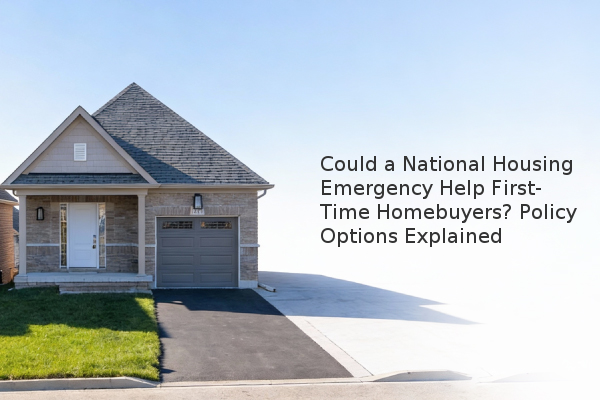
A potential national housing emergency declaration could provide critical relief for first-time homebuyers, who currently represent a historic low of just 24% of home sales. With affordability at a crisis point, such a declaration would grant the federal government powers to address key barriers: the severe shortage of starter homes, prohibitively high closing costs, and elevated mortgage rates. Based on our experience assessment, targeted interventions like down payment assistance and zoning reforms could offer the most immediate impact for buyers struggling to enter the market.
Declaring a national housing emergency is not without precedent. The last formal invocation was nearly 80 years ago by President Harry Truman to address the severe post-World War II housing shortage. Such a declaration grants the executive branch broad authority to bypass standard legislative processes and act swiftly. An emergency declaration would enable unilateral federal action to accelerate construction, provide financial assistance, and implement regulatory changes aimed directly at the housing crisis. While the specific powers a modern administration might use remain unclear, this tool could circumvent the current political gridlock that has stalled congressional housing bills.
A primary driver of today's affordability crisis is a chronic undersupply of homes, estimated at nearly 4 million units. One proposed solution is releasing federal land for residential construction. The American Enterprise Institute has suggested auctioning 850 square miles of land managed by the Bureau of Land Management (BLM), a federal agency overseeing public lands, which could potentially support up to 3 million new homes. However, most federal land is located far from employment centers and lacks essential infrastructure, limiting its effectiveness as a nationwide solution.
A more impactful approach may involve federal encouragement of local zoning reform. Zoning laws, which are regulations dictating how property in specific geographic zones can be used, are typically controlled by cities and counties. A national emergency could provide a platform for the White House to incentivize municipalities to legalize more affordable housing types, such as townhomes, duplexes, and accessory dwelling units (ADUs)—smaller, independent residential units on the same lot as a primary home. Reforming rules that mandate large lots or prohibit multi-unit structures could help create "missing middle" housing, particularly in high-demand suburbs where starter homes are often priced over $1 million.
For many qualified buyers, the biggest hurdle isn't the monthly mortgage payment but the upfront cash required to close the deal. Closing costs, the fees and expenses paid to finalize a real estate transaction, typically range from 2% to 5% of a home's purchase price, on top of the down payment. Potential federal interventions could include fee waivers, direct subsidies, or caps on these transaction costs, similar to efforts authorized in the 1940s. Even modest reductions in these upfront expenses could make homeownership attainable for millions.
Furthermore, a declaration could increase political pressure to address high mortgage rates. While the Federal Reserve—the central banking system of the United States—does not set mortgage rates directly, its policies influence them. Targeted federal support for down payments is often cited as one of the most effective short-term solutions. "Many buyers can handle the monthly mortgage payment but are priced out by the initial cash requirements," says Daniel Smith, a real estate team lead. Down payment assistance could provide the necessary bridge for renters to become homeowners.
While a national housing emergency declaration sounds dramatic, its tangible effects would likely be incremental. Sweeping change is unlikely overnight. However, even modest interventions can tip the scales.
Key practical advice for first-time buyers includes:
A national emergency could elevate housing to a top-tier national issue, creating momentum for stalled reforms. For first-time buyers waiting on the sidelines, the most significant outcome may be a renewed focus on making affordable homeownership a reality.