Browse

Log in / Register
 Share

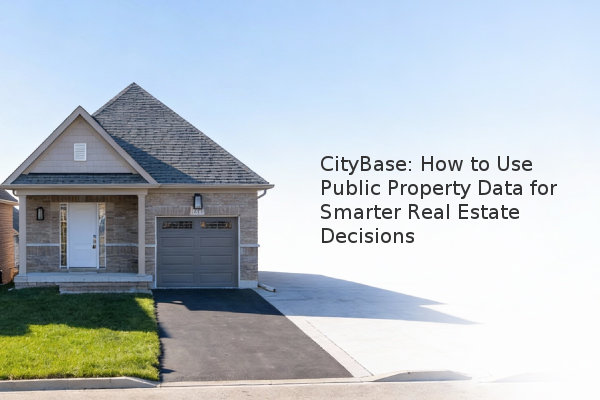
Leveraging a city’s public property database, often called a CityBase, is a powerful first step for buyers, sellers, and investors to make data-informed real estate decisions. These official online portals provide verified information on property characteristics, ownership history, and tax records, offering a foundation for accurate valuation and market analysis. Understanding how to access and interpret this data can significantly enhance your research process, whether you're estimating a home's value or verifying key details before a purchase.
A CityBase is a term commonly used to refer to a municipal government's online database of property records. These systems are maintained by local county assessor or recorder offices and are part of the public record. The primary function of a CityBase is to provide transparency in property ownership and taxation. For anyone involved in a real estate transaction, this database serves as a critical source of truth. Key data points typically available include the property's legal description, square footage, number of bedrooms and bathrooms, lot size, and most importantly, its assessed value for tax purposes. By starting your research here, you ensure the information you're using is official, which is crucial for avoiding costly mistakes based on outdated or incorrect listings.
For home buyers, a CityBase is an invaluable tool for due diligence, which is the process of verifying all material facts about a property before completing a purchase. After identifying a potential home, you can use the database to confirm the seller is the legitimate owner listed on the title. You can also review the property's tax assessment history to understand current tax obligations and anticipate future increases. Furthermore, the database may contain records of building permits, indicating any major renovations or additions that were officially approved by the city. This helps you identify any unpermitted work that could become your responsibility to fix after closing. For example, if a listing claims the home is 2,500 square feet, but the assessor's record shows 2,200, it warrants a deeper investigation.
Home sellers can use a CityBase to accurately price their property by researching recent sales of comparable homes, or "comps," in the immediate area. By analyzing the final sale prices of homes with similar attributes, you can establish a competitive and realistic listing price. Real estate investors heavily rely on this data to analyze neighborhood trends, calculate potential rental yields, and assess the tax burden on an investment property. The ability to quickly pull data on multiple properties allows for efficient market analysis. For an investor, understanding the relationship between a property's assessed value, its potential market value, and the resulting property tax is fundamental to calculating profitability.
| Use Case | Key Data Points from CityBase | Strategic Benefit |
|---|---|---|
| Home Buying | Ownership history, tax assessment, permit records | Verifies listing accuracy and identifies red flags |
| Home Selling | Sales history of comparable properties | Informs a data-driven, competitive listing price |
| Real Estate Investing | Area-wide tax assessments, property characteristics | Enables rapid analysis of cash flow and return on investment |
While a CityBase is a powerful starting point, it is essential to recognize its limitations. The data is not always updated in real-time; a tax assessment may lag behind a rapidly changing market. The assessed value for tax purposes is often different from the current fair market value. These databases also do not provide a complete picture of a property's condition, such as the age of the roof or the state of the mechanical systems. Therefore, public records should be used as a foundational tool, not a substitute for a professional appraisal, a home inspection, or the expertise of a real estate agent. The most effective strategy combines the objective data from a CityBase with qualitative, on-the-ground insights.
To effectively use a CityBase in your real estate journey, start by locating your county's official website, use the parcel number or address to search, cross-reference the data with other sources, and always consult with a professional to interpret the findings within the full context of your transaction.